Injera
Ge'ez (Ethiopia/Eritrea)
History meets tasting
Historical and cultural context
Injera belongs to Ethiopian fermented-cereal traditions described by FAO.
Sensory guide
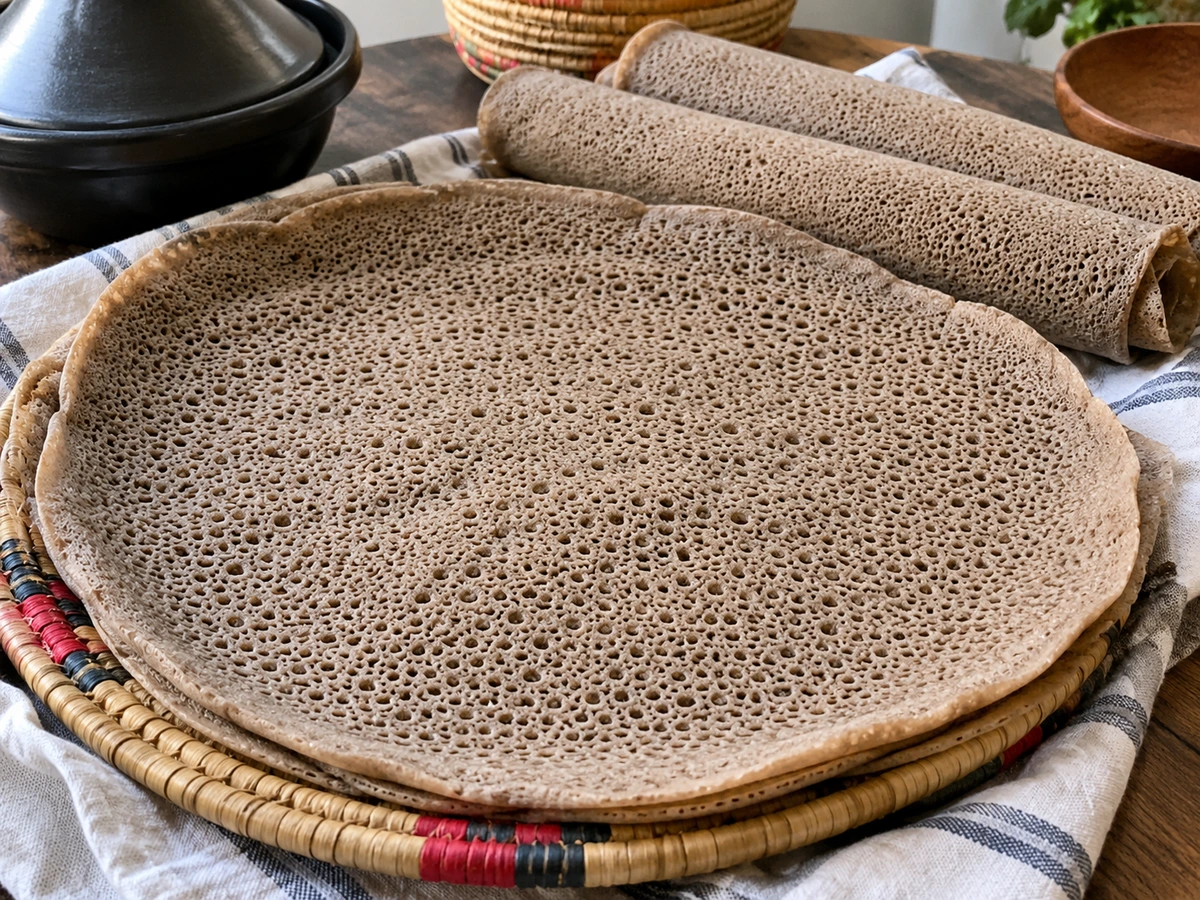
Supple, porous flatbread with variable tang; cereal choice and fermentation change the result.
Skill to observe
Observe pores and flexibility, not only the flatbread’s colour.
Indicative sensory descriptions: variety, fermentation, cooking and accompaniments change the result. Catalogue illustrations, not a shared botanical scale.
FAO · Traditional fermented food and beveragesUnderstanding : Injera
INTRODUCTION
The quintessential symbol of Ethiopian and Eritrean cuisines, injera stands out as one of Africa's most renowned, identity-defining, refined, and fascinating breads. A large, flexible, and airy flatbread with a characteristic tangy taste, it is much more than a food: it is a way of life, a memory of peoples, a reflection of territories and seasons, a link from feast to daily life. Behind the apparent simplicity of its presentation – a large crepe laid out like a tablecloth, on which sauces, vegetables, meats, lentils, eggs, or fish are arranged – lies a long agricultural history, a complex fermentation technique, gestures passed down from generation to generation, and a social and symbolic dimension that makes injera the foundation of "eating together" in the Horn of Africa. This detailed portrait explores the origins, making, consumption methods, nutritional richness, ritual and social roles, modernity, and the unique place of injera in African culinary heritage and daily life.
Prepare this speciality
Choose a detailed recipe, adjust the portions and prepare your ingredients before starting. Our cooking tips and food safety advice complement the steps described in the recipes.
Explore further: Cooking tips · Food hygiene and safety advice.
History and uses
1. ORIGIN, HISTORY, AND SPREAD
1.1. Agricultural Roots Injera finds its roots in the heart of the Ethiopian plateau, the original land of a cereal that is still central to the region's crops today: teff (Eragrostis tef). Teff, an Amharic word meaning "lost" (due to the fineness of its grains), has been cultivated for over 3,000 years. It is also used by neighboring populations: Eritrea, parts of Sudan, Yemen (Zanzibari cuisine). The mastery of this cereal, its resistance to drought, its adaptability to altitude, and its ability to grow on poor soils have allowed the development of densely populated agricultural societies, where the injera banquet punctuates days, celebrations, and rituals. 1.2. Cultural Diffusion While injera, in its authentic form, remains primarily Ethiopian/Eritrean, other more or less similar variants can be found in the Horn: • Lahoh/Laxoox (Somalia, Djibouti): a thicker fermented crepe, made from wheat/sorghum/corn flour. • Kitcha, chechebsa, ambasha: local flatbreads or galettes without extensive fermentation. With diasporas (Ethiopia, Eritrea, Sudan), injera travels across Africa, the Middle East, Europe, and North America, where it is today a symbol of identity, conviviality, and "world food."
2. KEY INGREDIENT: TEFF AND OTHER CEREALS
2.1. Teff, the queen cereal Teff is a very fine grass, with tiny grains (less than 1 mm), naturally gluten-free, rich in iron, calcium, and essential amino acids. Its mild, slightly nutty taste is reminiscent of chestnut or toasted hazelnut. Teff flour gives injera its tangy taste, its flexibility, and its gray color. The best injera are 100% teff, but scarcity or price can lead to cutting it with other cereals (sorghum, barley, wheat, corn), which alters the texture, taste (milder or more rustic), and color (lighter or yellowish). 2.2. Diversity of mixtures • Taita in Eritrea mixes teff, barley, or wheat. • Sorghum, millet, corn can replace teff during times of scarcity or for inexpensive injera. • Today, the diaspora sometimes uses rice flour, buckwheat, to produce gluten-free versions accessible outside.
3. THE STEPS OF INJERA MAKING
3.1. Fermentation, the secret to taste and texture The strength of injera lies in spontaneous fermentation, by natural yeasts and lactic bacteria (as in traditional bread sourdough). • Initial mixture: teff flour + lukewarm water. • Fermentation: the mixture is left at room temperature (often 2 to 3 days, sometimes 4–5 days depending on the climate), in closed but aerated containers. A biochemical process of alcoholic and lactic fermentation occurs. • Addition of “ersho” (old starter): a piece of old dough, which ensures regular rising (like a baker's sourdough starter). When mature, the dough is foamy, smells pleasantly tangy, with air bubbles that guarantee the characteristic alveolation during cooking. 3.2. Cooking: an art in itself On the traditional oven (“mitad” or “mogogo”, a large clay or metal plate heated with wood or electricity):
- With a ladle, the batter is poured in a circular motion to form a large disc (30 to 70 cm in diameter).
- The batter spreads, bubbles appear, the whole is covered with a lid, and the steam raises the injera into characteristic alveoli.
- In 1 to 2 minutes, the injera steams, the surface covers with small holes (“eyes”). It is gently peeled off, placed on a cloth or mat, and immediately covered by the next one to retain heat and moisture. Success depends on the consistency of the batter, experience, observation (too thick: pasty injera; too liquid: fragile injera), and temperature.
In my books

Continue exploring the continent’s cuisines with Africa at the Table — 54 countries, 54 iconic dishes, by Alioune FALL. This book is in English.
Explore further
4. CENTRAL PLACE IN THE MEAL AND CULTURE OF CONVIVIALITY
4.1. Support and cover for the meal Injera is spread at the bottom of the "mesob" (woven tray), then covered with various "wot" or "wat": • Spicy meat stews (doro wat, begue wat), • Simmered vegetables (atkilt wat, gomen) and lentils/split peas (shiro wat, misir wot), • Hard-boiled eggs, fish, garnishes. 4.2. Rules of sharing Each guest takes a portion with their right hand (or clean hand), rolls it around the stew, brings it to their mouth, and offers a piece to their neighbor (the gesture of “gursha”, offering a beloved piece). The dish is eaten collectively, strengthening family, friendly, and community solidarity. 4.3. Symbol of “eating together” and respect Not offering injera to a guest is considered a sign of disrespect. Reconciliation rituals, business closings, engagements, and funerals are marked by the sharing of injera. The act of offering the "first gursha" to the most honored guest is a symbol of welcome.
5. NUTRITIONAL VALUE AND HEALTH
5.1. Complete food • Teff, the base of injera, is a cereal with a relatively low glycemic index, a source of bioavailable iron, magnesium, calcium, potassium, and zinc. • Rich in fiber, protein (more than wheat or corn), essential amino acids. • Naturally gluten-free, interesting for celiac or sensitive individuals. • Long fermentation: improves digestibility, mineral bioavailability, contributes to a healthy gut microbiota. 5.2. Ally of modern diets Praised in "world food" for its unique texture and health potential, injera (made from teff) is now recognized, outside of Africa, in vegan, vegetarian, sports, and anti-inflammatory practices.
6. SOCIAL, RITUAL, AND IDENTITY PLACE
6.1. Ceremonial aptitude • Weddings, engagements, funerals, religious festivals (Timqet, Meskel): it's impossible to imagine a table without injera. • Invitation ritual: the making of injera for others, its serving, become sacred offerings. • Coffee ceremony (“bunna”): injera accompanies coffee, with popcorn (“kollo”), sweet or savory dishes. 6.2. Family transmission The secrets of the starter, the cooking gestures, the eye for the dough are passed down from mother to daughter, from neighbor to neighbor. Each has “her” recipe, her ersho, her touch. The success of injera is a criterion for a “good marriage,” for respect for tradition.
7. MODERNITY, DIASPORA, AND INNOVATIONS
7.1. Diaspora Injera Ethiopian/Eritrean communities in Europe, North America, and Australia perpetuate and promote injera in restaurants, grocery stores, and online shops. Associations, national holidays, and identity markers are created around injera. 7.2. Culinary innovations • Flour blends (gluten-free, ancient grains), • Mini injera, urban wraps, “teff” tapas, injera pizzas, Afro-urban sandwich shops. • Sweet uses: injera rolled with honey, sweet crepe batter, cakes. 7.3. Agricultural challenges • Valuation of the teff sector for food sovereignty, • Question of intellectual property of the word “teff” or “injera”, • Challenges related to rising exports, protection of the African smallholder sector.
8. LIMITATIONS, CHALLENGES, AND SUSTAINABILITY ISSUES
• Scarcity or high cost of teff, necessity to mix with other flours. • Demanding production: requires time, planning (fermentation), energy (wood, electricity: large oven). • Preservation challenge outside homes: injera dries quickly, becomes brittle, difficult to transport over long distances. • Perpetuation of the starter, adaptation of techniques to urban or apartment living.
CONCLUSION Injera is much more than a food: it weaves connections between humans, land, diet, and memory, shapes hospitality, negotiation, celebration, and mourning. It embodies the pride and uniqueness of the peoples of the Horn, while offering the world a concentrate of health, solidarity, ecology, innovation, and culinary poetry. To adopt, cook, and transmit injera is to nourish, care for, respect, and make African culture vibrate in its most fertile depth. It remains, and will remain, the living heart of "eating together," from Addis Ababa to Asmara, from Washington to Paris, on every large table where Africa displays the generosity of its gestures and its flavors.
In the kitchen : Injera
Recipes from the site to put your knowledge into practice:
Discover these cuisines at a restaurant
Explore our restaurant and caterer directories. Choose your destination and check the establishment’s menu to confirm which dishes are offered and available.
Continue exploring
Enjoy discovering ingredients and African cuisines? Join our newsletter. The illustrated PDF 10 sauces africaines incontournables is in French and is offered after confirming a subscription to the French or bilingual edition.