Onion
Central Asia, Middle East
Understanding : Onion
INTRODUCTION
Behind almost every great flavor in African cuisine lies a humble, yet essential ingredient: the onion. Present in almost all culinary repertoires, from the banks of the Nile to the coasts of Senegal, from the plains of the Maghreb to the southern lands of the continent, the onion occupies a central and irreplaceable place in African gastronomy. Yet, despite its humility, it is not just a simple aromatic. It dresses, composes, structures, perfumes, and enhances popular and festive dishes. To understand the richness of African cuisine – its warmth, its depth, its convivial and comforting character – one must look at the onion: its origins, its varieties, its preparation methods, its symbolic and gustatory role, without forgetting its economic and cultural value. This description offers you a deep dive into the heart of this iconic vegetable and, at the same time, into the soul of African cuisine.
Where to find it
Look for the exact food-grade form required by the recipe at markets and specialist shops. Check the product name, ingredients, condition and storage instructions.
Explore further: Cooking tips · Food hygiene and safety advice.
History and uses
BOTANICAL DESCRIPTION AND ONION VARIETIES
The onion (Allium cepa), from the Amaryllidaceae family, is a biennial vegetable plant cultivated for its fleshy bulbs. It has a rounded or oblong shape depending on the variety, a thin outer tunic, sometimes coppery, reddish, purple, or white, and juicy, white or yellow inner layers. Its pungent aroma, its characteristic tears when cut, its sweetness after cooking, make it an ingredient with a wide and nuanced aromatic palette. On the African continent, three main families are distinguished:
- White onion (white bulb, sweet flesh, perfect for raw consumption or pickles).
- Yellow onion (the most common variety, ideal for long cooking, gives a sweet and deep flavor).
- Red or purple onion (prized in West Africa, its bulb can be raw or cooked, it is notably used in marinades and salads). There are also local varieties, such as the “Galmi purple onion” from Niger, famous for its size, intense color, and productivity, or small spring onions (scallions) used in coastal regions.
HISTORY AND INTRODUCTION OF ONION IN AFRICA
The onion originated in Central Asia and the Middle East, probably cultivated more than 5,000 years ago. Its introduction to Africa occurred through history, trade, and migrations. • Ancient Egypt: Funerary frescoes over 4,000 years old attest to the onion's place in Egyptian diet. A symbol of fertility, eternal life (with its many layers symbolizing infinity), it was also used in rituals and offerings. • Sahelian Africa: Through caravan routes and contacts with the Mediterranean world, the onion gradually established itself from the Maghreb shores to the Sudano-Sahelian regions. • Sub-Saharan Africa: Its cultivation spread later, but today, countries like Niger, Mali, Nigeria, Ivory Coast, or Senegal have become major producers. So much so that the Galmi onion, for example, is one of Niger's main agricultural exports.
ROLE AND PLACE OF ONION IN AFRICAN CUISINE
- An essential base: the aromatic “trinity” In most African cuisines, the preparation of dishes begins with an aromatic base composed of onion, garlic, and often tomato or bell pepper: this is the “base” or “trinity” on which the gustatory construction of many recipes rests. • In Senegal, Mali, Ivory Coast…: it's impossible to imagine a yassa (a spicy dish with chicken or fish, onions, and lemon), a mafé (peanut stew), a thieboudienne (fish and rice dish), a soupou kandja (okra stew), a poulet DG (chicken and plantain dish), or a sauce feuille (leafy green stew) without the massive presence of onion. • In North Africa (Maghreb): tagines, couscous, méchoui (spit-roasted lamb), and soups make ample use of onion gently sautéed in olive oil. • In Ethiopia and Eritrea, onion forms the base of “berbere” (a spice blend), a key ingredient in wat (spicy stew), where it is melted and colored over several hours. Raw onion, finely sliced or crushed, is used for marinades (fish, meat), chutneys, or summer salads, as in the famous red onion salad of Dakar.
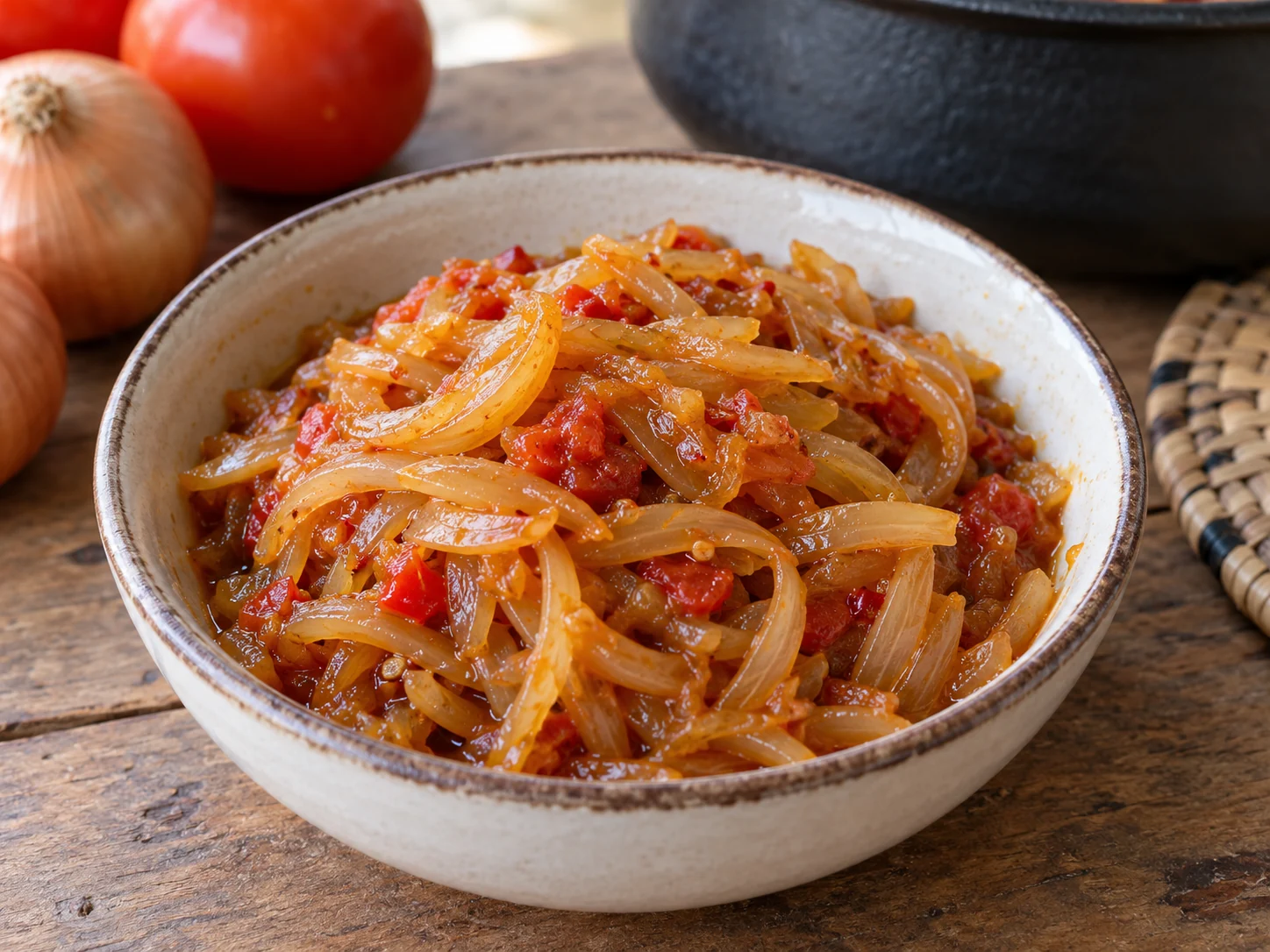
- Intensity and sweetness: the magic of cooking Onion has the remarkable property of transforming its aroma and texture when cooked. Sharp and pungent raw, it reveals an almost sweet softness when stewed for a long time or caramelized. This alchemy offers depth to African dishes, balances the heat of spices, rounds out peanut sauces, or delicately melts into rice during pilaf cooking. Caramelization of onions, sometimes sought after, enriches “red sauces” and Senegalese “yassa” (a dish where chicken or fish marinates in a mountain of onions, citrus, and mustard before being braised).
- Quantity and generosity: an African hallmark One of the notable aspects of African cuisine is the profusion of onions in dishes. Where other cuisines would use a small amount, African families do not hesitate to use half a kilo, or even more, for four or five people. This results in thick, tender sauces with a unique creaminess. This pronounced taste for onions has become, by extension, a cultural marker of abundance and conviviality.
- Versatility of preparation methods • Sliced, chopped, mixed into sauce bases. • Grilled over embers, in skewers or méchouis. • Fried as a crispy garnish, especially in some couscous or festive dishes. • Dried or “powdered”, widely used in regions experiencing seasonal supply disruptions. • Candied for accompanying meats (sometimes with dates or honey in the Maghreb).
In my books

Continue exploring the continent’s cuisines with Africa at the Table — 54 countries, 54 iconic dishes, by Alioune FALL. This book is in English.
Explore further
ECONOMIC AND SOCIAL PLACE OF ONION IN AFRICA
Beyond its culinary function, the onion plays a fundamental socio-economic role in many African countries. • Onion, a path to empowerment: In many villages in Niger, Senegal, or Mali, the production and trade of onions occupy a major place among market gardening activities. It is a promising sector, generating seasonal jobs and financial autonomy, especially for women. • Essential component of local markets: Onions are found in all African markets, from the largest urban centers to the smallest hamlets. Between harvest seasons, prices fluctuate sharply and can impact household budgets. • Export: Some countries, like Niger with the Galmi onion, export their production to neighboring coastal countries, making the onion a strategic product at the regional level. • Storage and preservation: Storing dried or bunched onions ensures household supply during the dry season, when other fresh vegetables become scarce.
NUTRITIONAL VALUES AND BENEFITS
Much more than a simple flavor enhancer, the onion has many health benefits: • Low in calories (about 40 kcal per 100 g), rich in dietary fiber. • Source of vitamin C, B6, and B9, minerals (potassium, magnesium), sulfur compounds. • Antioxidant effects: its flavonoids, especially quercetin, contribute to the prevention of certain cardiovascular diseases. • Digestive and anti-inflammatory virtues, beneficial for the immune system. • Role in diabetes prevention: regular consumption of onion (especially raw) helps regulate blood sugar levels. In most African cultures, onion is also used in decoction, combined with other plants to relieve colds, coughs, or stomach aches.
SYMBOLISM AND CULTURAL ROLE
The onion is not limited to its food function. In Africa, it evokes: • Hospitality: A dish generously garnished with onions, especially during visits, marks the respect due to guests. • Celebration and prosperity: The profusion of onions in a dish signals success, material well-being. • Family transmission: The know-how to prepare, cut, caramelize, or marinate onions is learned very young, from mother to daughter, from grandmother to grandson, and remains a key to African cuisine.
ANECDOTES AND CUSTOMS
In many regions, it is believed that cutting onions wards off the evil eye or “purifies the house,” because the tears shed, in a way, would cleanse the home. It is not uncommon, during a wedding or an important celebration, to prepare a “mountain of onions” to ensure the success of the dish.
CONCLUSION
Omnipresent, subtle or flamboyant, the onion structures African cuisine. It embodies the memory, conviviality, and creativity of the continent, while constituting an essential pillar of local economies and cultural identity. If it amply deserves its status as “king of aromatics,” it also carries, with each dish, the promise of warm reunions and a unique sensory journey, at the heart of African terroir.
In the kitchen : Onion
Recipes from the site to put your knowledge into practice:
Discover these cuisines at a restaurant
Explore our restaurant and caterer directories. Choose your destination and check the establishment’s menu to confirm which dishes are offered and available.
Continue exploring
Enjoy discovering ingredients and African cuisines? Join our newsletter. The illustrated PDF 10 sauces africaines incontournables is in French and is offered after confirming a subscription to the French or bilingual edition.