Ataya
China
Understanding : Ataya
INTRODUCTION
In the public squares of Dakar, in the sandy alleys of Nouakchott, along the beaches of Banjul, or in the shade of the granaries of Mali, a warm and sweet scent signals that a ritual is beginning: ataya. More than just a drink, ataya, a strong and frothy green tea, infused with sugar and sometimes mint, is a West African way of life, a cornerstone of conviviality, social dialogue, and even popular gastronomy. It accompanies lazy afternoons, concludes meals, seals friendships, mends sorrows, and inspires poets. Its slow, ceremonial preparation, structured in three distinct stages, symbolizes the journey of friendship: “bitter as death, sweet as life, smooth as love.” Borrowed from the Maghrebi tradition, ataya has made its own identity in the Senegalese-Mauritanian area, then spread throughout West Africa, weaving a culture of sharing and conversation among peoples. Let's explore together the world of this magical tea, between history, symbols, recipes, benefits, and anecdotes, at the heart of African life.
Prepare this speciality
Choose a detailed recipe, adjust the portions and prepare your ingredients before starting. Our cooking tips and food safety advice complement the steps described in the recipes.
Explore further: Cooking tips · Food hygiene and safety advice.
History and uses
HISTORY AND SPREAD OF ATAYA
The history of ataya is inseparable from that of tea, a centuries-old trade that connected China, the Near East, North Africa, and, little by little, the Sahel and West Africa. While the word “ataya” comes from the Arabic atai, meaning green tea or infusion, this ritual has forged its own identity in the Sahelian and coastal fringe of the continent. The introduction of tea to West Africa occurred mainly in the 18th and 19th centuries, via trans-Saharan caravans (Mauritania, Senegal, Mali), Maghrebi merchants, and European colonists. By the end of the 19th century, Chinese tea (especially gunpowder, or “poudre à canon” for its hand-rolled shape) became a currency of exchange, just like silk or fabrics, in the major West African markets. But it was from the 20th century, particularly with urbanization and the increasing mobility of populations, that ataya became an institution: essential in the male sociability of popular neighborhoods, in villages and cities, it asserted itself as a social cement, an instrument of cohesion and transmission.
DETAILED DESCRIPTION OF ATAYA
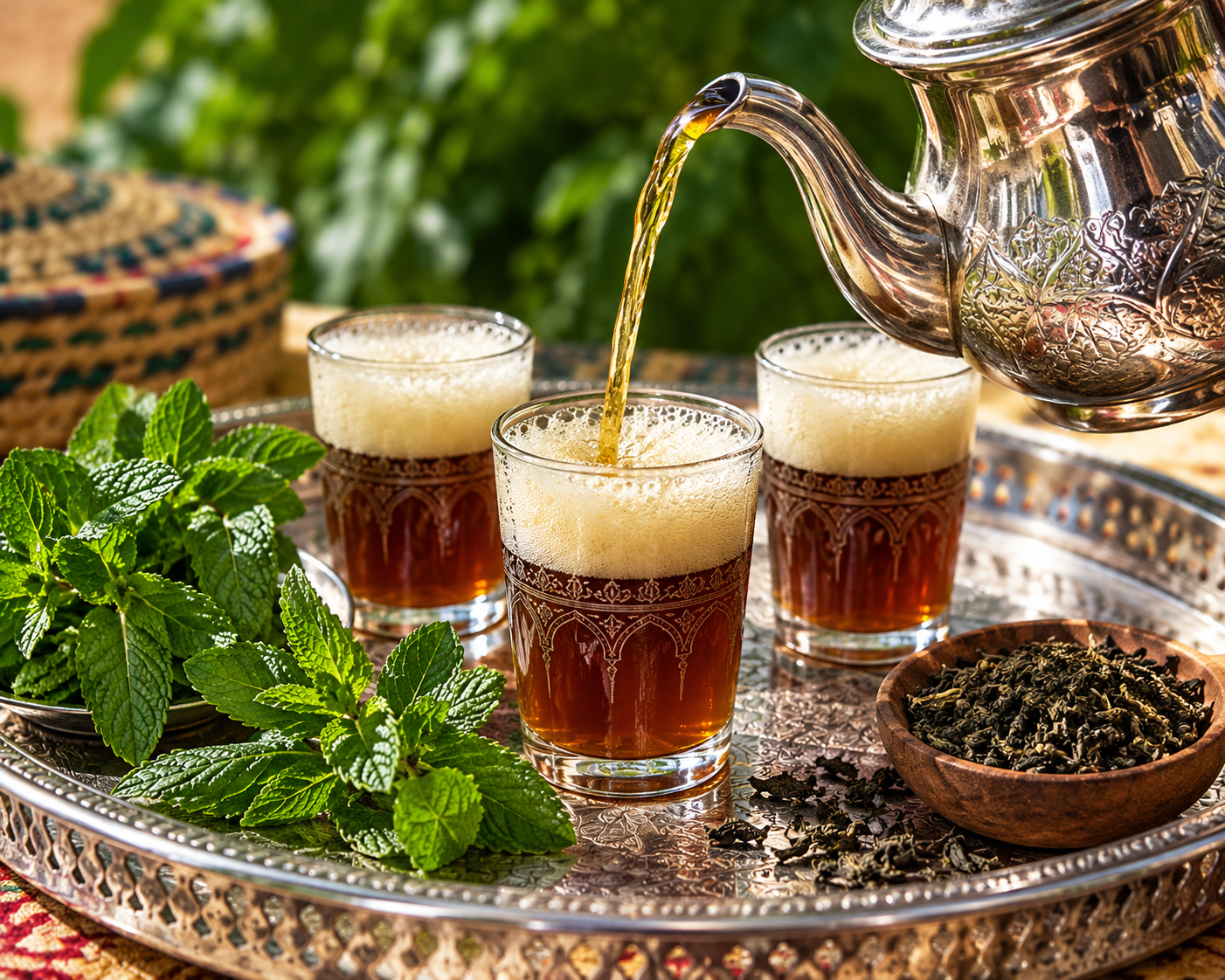
The choice of tea Ataya is prepared exclusively from Chinese green tea — gunpowder (“poudre à canon”) — for its strength, bitterness, and its ability to withstand multiple infusions. Sometimes, fresh mint is added (especially during hot periods) or, more rarely, African basil leaves. Classic ingredients (for one serving) • 1 ball or 1 heaped tablespoon of gunpowder green tea • 400 to 500 ml of water • 100 to 200 g of sugar (variable quantity according to taste) • A handful of fresh mint leaves (optional but highly appreciated) • (Sometimes, a few drops of orange blossom flavor) Traditional utensils • Berrad: A small traditional metal teapot. • Stove: Charcoal or a small fire (sometimes a gas stove). • Tea glasses: Small, thick, transparent glasses, often lined up next to the server. • Tray: To carry the teapot and glasses. • Spoon: To handle foam and sugar.
RITES AND PROGRESS OF ATAYA: a three-course ceremony Ataya is never drunk hastily or in one go: it is an art, a ritual that is both codified and joyfully shared, based on three “stages,” three successive consumptions.
- First ataya: strength and bitterness First, water is heated in the teapot. When it simmers, the gunpowder ball is added and left to infuse very strongly. Then, a significant amount of sugar (often half a glass!) is added, and traditionally also a little mint. But all the skill of the preparer lies here: they pour the tea from one glass to another, then from the glass to the teapot, repeatedly, to make the drink frothy and mix it well; the first glass, very strong, full-bodied, very frothy, is drunk slowly. It is much more bitter than sweet, symbolizing the harshness of life and the beginning of any friendship: “bitter as death.”
- Second ataya: balance The same tea leaves are watered with a little extra hot water, sugar, and mint, and brought to infusion, sometimes longer. Here, sugar takes precedence over the harshness of the tea, and the bitterness softens. The preparation is frothed again, then served. This is the stage of true conversation, of friendship settling in: “sweet as life.”
- Third ataya: total sweetness Third infusion on the same leaves, even more sugar…! Sometimes, the last stage sees the arrival of other flavors (orange blossom, sweet herbs, etc.). This last round is the smoothest, sometimes too light for some! It concludes the ritual with sweetness, symbolizing a happy outcome: “smooth as love.” It is traditional for the youngest guest or guest of honor to receive the first glass of each round.
In my books

Continue exploring the continent’s cuisines with Africa at the Table — 54 countries, 54 iconic dishes, by Alioune FALL. This book is in English.
Explore further
SYMBOLISM AND SOCIAL ROLE OF ATAYA
- Place of sociability Ataya punctuates the lives of millions of West Africans. It is in the tea circle that news, stories, political debates, spiritual questions, and intimate confidences are exchanged. Groups of young men (and increasingly women or families) gather in the street, on the beaches, after work, around the “tea master,” called “le jeuneur” (the faster) in Senegal. It is not the tea itself that is most important: it is the time spent together, the exchange, the conviviality. Drinking tea is about forging or strengthening bonds. In Senegal, it is often said: “To drink ataya is to open one's heart.”
- Rules and anecdotes • Good ataya must absolutely be frothy, proof of the preparer's dexterity. • It is better to refuse ataya than to ask to speed up the preparation: patience is its cardinal virtue. • It is not uncommon for the rhythm of ataya service to punctuate a debate, like a breath, in the discussion.
- Hospitality and social balance Offering ataya to a friend, a passing stranger, a neighbor, is a supreme mark of hospitality, just like couscous or yassa (a Senegalese dish made with chicken or fish marinated in lemon and onion, then cooked with mustard) offered during a festive meal. It is also a way to establish peace, reconcile after an argument, or even ask for forgiveness. Ataya weaves social cohesion: it alleviates effort, accompanies siestas, encourages patience, and tempers hunger between meals.
REGIONAL VARIATIONS AND DANCES
Although ataya is particularly rooted in Senegal, Mauritania, and Gambia, it has spread throughout West Africa. • Mauritania: Ataya often serves as dessert. Mint and a lot of sugar are readily added. The ceremony is sometimes even longer. • Mali: Ataya accompanies afternoon conversations. Variations sometimes include ginger or lemon. • Guinea, Sierra Leone, Ivory Coast: The ritual mixes with street food, with ataya prepared in small kiosks. It often accompanies youth activities. Some add local touches (African basil, medicinal herbs, lemon peel, etc.) or adapt the sweetness according to their regional preferences.
ATAYA IN CUISINE AND GASTRONOMY
Although a drink, ataya often beautifully concludes a meal. It aids in the digestion of hearty dishes (thiéboudienne (a traditional Senegalese dish made with fish, rice, and tomato sauce), yassa…), counterbalancing fats and chili. It is also served during grand ceremonies: weddings, baptisms, religious or secular ceremonies, neighborhood meetings. Some Senegalese pastries (lakh (a sweet yogurt and millet dish), thiacri (a sweet couscous-like dish made from millet)) or Maghrebi pastries are “sprinkled” with ataya for a soft and fragrant effect.
NUTRITIONAL AND MEDICAL BENEFITS
Ataya has real assets: • Antioxidant, stimulant, digestive: green tea is rich in polyphenols, it promotes digestion, boosts concentration and memory. • Appetite suppressant effect: appreciated during Ramadan or after a heavy meal. • Soothing: the ritual itself slows the heart rate, promotes relaxation, and combats stress. • Mint, basil, and added herbs: respiratory, calming, and antiseptic properties. It should be consumed in moderation (to avoid insomnia or gastric acidity, due to its theine and sugar content).
ATAYA, TRANSMISSION AND MODERNITY
Between generations, the know-how of ataya is transmitted through gestures and glances: every young boy (and often now every young girl) learns the art of foam, brewing, and patience. Every family, every neighborhood has its “tea master,” worthy of respect and admiration. Even today, in the age of social networks, ataya structures rural and urban social interactions: its preparation is posted on Instagram, its recipes evolve, but its unifying power remains.
CONCLUSION
More than tea, ataya is the beating heart of West African life. It embodies slowness, friendship, peace, hospitality, and the joy of being together. Through its aromas, its foam, its three flavors, it transforms every moment into a sensory adventure and every discussion into a journey. And when, in the golden light of the evening, a small group of young people shares the last glass, one understands that ataya is indeed the art of living in West Africa – a foundational art to transmit and savor, again and again.
Practical notes and Senegalese terminology
Senegalese ataya is defined by its preparation and communal serving, not merely by where the tea leaves were grown. Green tea, sugar and sometimes mint form a ritual of small glasses and conversation. Successive servings vary between households. Moroccan mint tea is a cultural neighbour, not automatically the same recipe entry.
In the kitchen : Ataya
Recipes from the site to put your knowledge into practice:
Discover these cuisines at a restaurant
Explore our restaurant and caterer directories. Choose your destination and check the establishment’s menu to confirm which dishes are offered and available.
Continue exploring
Enjoy discovering ingredients and African cuisines? Join our newsletter. The illustrated PDF 10 sauces africaines incontournables is in French and is offered after confirming a subscription to the French or bilingual edition.