Red Bean
Central and South America
Understanding : Red Bean
INTRODUCTION
Among the fundamental ingredients that structure African food, the red bean (often called “bean” in English-speaking Africa, “kosayi” in Niger, “mboum” in Cameroon, “mharicot” in Madagascar, “pois” or “haricot” in French-speaking Africa) holds a prominent place. On a continent where food security largely depends on crop diversification, this dry legume embodies history, agro-pastoral know-how, nutritional power, and culinary generosity. The red bean, from the Beninese grandmother's pot to Egyptian “koshari” and “ful”, from Ghanaian “waakye” to Swahili “maharage”, travels across Africa, adapted to all regions, all classes, all climates. It is found in the cuisine of the poor as well as in festive banquets, in the market as well as in street food, as a communal dish as well as a modern touch in contemporary African fusion gastronomy. Let's dive into the saga of the red bean, from its agrarian genesis to its thousand avatars on African plates.
Where to find it
Look for the exact food-grade form required by the recipe at markets and specialist shops. Check the product name, ingredients, condition and storage instructions.
Explore further: Cooking tips · Food hygiene and safety advice.
Search Amazon.fr — affiliate link →
Check availability and delivery on Amazon.fr. Compare ingredients, packaging and sellers.
As an Amazon Associate I earn from qualifying purchases.
History and uses
1. HISTORY, BOTANY AND SPREAD
Origin and introduction The red bean refers to different species of the genus Phaseolus, mainly Phaseolus vulgaris (common bean of American origin) and Phaseolus lunatus (Lima bean). Originally from Central and South America, the bean was introduced to Africa after the "discovery" of the Americas by Europeans. It quickly supplanted or complemented traditional local legumes such as cowpea (black-eyed pea or Vigna unguiculata), Bambara groundnut, Egyptian lentil, pigeon pea, hyacinth bean, etc. Thanks to its plasticity, short cycles, and reliable yields, the red bean has established itself throughout sub-Saharan Africa, in plains as well as in mountains, on plateaus as well as in coastal areas. It embraced the ecological diversity of African micro-territories from the 16th – 17th century, to become a major food crop.
AGRICULTURAL IMPORTANCE • An annual, semi-shrubby or climbing plant, cultivated in rotation with cereals (corn, millet, sorghum, rice) to regenerate soil nitrogen, the red bean is key to peasant crop rotations. • It comes in dozens of local varieties, adapted to drought, cold, altitude: dwarf, climbing, red, speckled, round, long, floury or melting beans. • It enhances urban vegetable gardens, small women's plots, as well as large collective fields.
2. ECONOMIC WEIGHT AND FOOD SECURITY
• Essential crop: low production cost, reliable yields, easy storage (dry grains kept for many months), rice and beans are a sure base for the African household. • Women's income: the majority of red bean production, sorting, storage, and marketing is carried out by women, major economic actors on the continent. • Element of social stability: seeds are exchanged, offered at celebrations, given as gifts at weddings, baptisms, peasant mutual aid (the bean: currency of barter and gift). • Weight in markets: in all urban or rural markets of West, Central, East, and Southern Africa, pyramids of red beans catch the eye, alongside cowpea, groundnut, corn, sorghum.
3. NUTRITIONAL RICHNESS AND ROLE FOR HEALTH
• Vegetable proteins (20-25%): essential base for populations with limited access to meat or fish. • Complex carbohydrates: for slow energy, satiety, physical performance. • Dietary fiber: transit regulation, reduction of cardiovascular risks, benefits for the microbiota. • Minerals and vitamins: iron, calcium, phosphorus, potassium, magnesium, zinc, vitamin B9, B1, B2. • Antioxidants (anthocyanins, polyphenols): protection against inflammation, aging. • Essential for: o Children (growth, prevention of deficiencies), o Pregnant women (iron, folic acid), o Sick or convalescent people o Elderly people. Limitations and precautions: The presence of lectins requires prolonged cooking to make the bean digestible and non-toxic. It is sometimes implicated in flatulence; overnight soaking, rinsing before cooking, or even a first pre-cooking are recommended to reduce this discomfort.
4. PLACE OF THE RED BEAN IN AFRICAN CULTURES
a. Rural symbol and social act In village societies, the red bean is a status marker — the more one produces, the more one guarantees food for the household during “bad seasons”. It is the subject of proverbs, agricultural songs, solidarity rituals (women's tontines, seed loans, collective donations…). In Madagascar, Rwanda, Cameroon, Benin, it is among the foodstuffs offered at funerals, religious festivals, collective work (plowing, harvesting). b. Place in memory and transmission The first pot of beans, often prepared by the grandmother, marks the entry into adult life. Cooking red beans means knowing how to measure water, sense the seasoning, manage wood or charcoal fire — a test and an art of daily life. c. Favorite of the city and the diaspora The bean travels through the large urban markets of Abidjan, Dakar, Accra, Douala, Nairobi, to the Afro-Caribbean stalls of London or New York, where it becomes an identity dish, a memory, the heart of “comfort food”.
In my books

Continue exploring the continent’s cuisines with Africa at the Table — 54 countries, 54 iconic dishes, by Alioune FALL. This book is in English.
Explore further
5. CULINARY USES: FROM TRADITIONS TO MODERN CUISINES
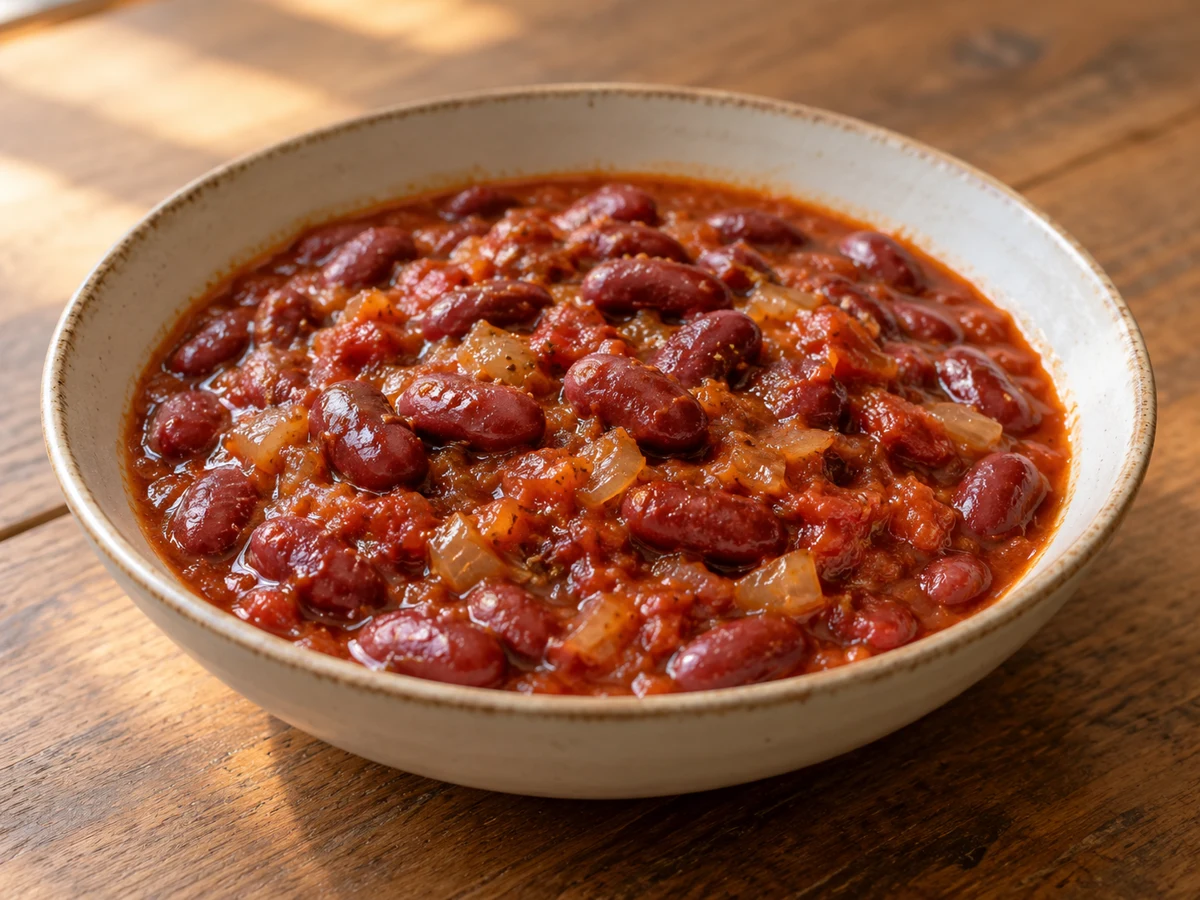
The red bean comes in a thousand ways: a) In sauce: the ornament of rice, tô (a thick porridge made from millet or corn flour), fonio (a type of grain), couscous Everywhere, it is prepared for a long time, in a base of aromatics (onion, garlic, tomato, chili, groundnut or palm oil), sometimes garnished with dried fish, fatty meat, spices. This thick sauce coats the starchy food, it satisfies and delights. Examples: • Bean sauce and white rice: Ivory Coast, Burkina, Guinea, Benin. • Mafé (peanut stew) of beans: peanut paste, tomato, beans, beef or lamb. • Ewa riro (Nigeria, Yoruba): red or white beans slowly simmered with tomato, chili, oil. b) As a base for “riz au gras” (rice cooked in fat) or communal dishes The union of rice and red (or black) beans is a model of protein balance: • “Red bean rice” (“waakye” in Ghana, “shiro” in Ethiopia, “koshari” in Egypt, “riz collé” (sticky rice) in the West Indies, “rice and beans” Caribbean style) • Jollof rice with beans or Beninese “one pot”. c) In street food, snacks and fast dishes • Red bean fritters (akara or kosai): beaten bean paste, spiced then fried, served alone or with a chili sauce, sold in markets, schools, train stations. • Moi moi: steamed flan of spiced bean paste (Nigeria). • Bean skewers, stuffed pancakes, Abidjan-style sandwiches. d) Appetizer, puree, salad • Red bean puree (spicy/lemon) as a spread, sandwich, dip for vegetables or bread rolls. • Cold salad with tomato, onion, corn, lemon, chili, olive oil. e) Regional and customary specialties • Maharage (East Africa, Swahili): red beans simmered in coconut milk, ginger, curry, rice, green banana or chapati (a type of flatbread). • Githeri (Kenya): bean-corn mixture and vegetables, national dish. • Egyptian Koshari: red beans, lentils, pasta, spicy sauces, fried onion, a popular dish par excellence.
6. RED BEAN IN CELEBRATION, TRANSMISSION, SPIRITUALITY
• Celebration food: prepared in large quantities at funerals, baptisms, weddings, tables at the end of Ramadan or Easter, end of harvest. • Symbol of hospitality: the unexpected guest is honored with well-cooked beans. • Offering and ritual: used in Vodou libations in the Gulf of Guinea, Muslim or Christian offerings during large gatherings. • Transmitted know-how: it is one of the first dishes taught to young girls and boys, a marker of culinary autonomy.
7. MODERNITY, DEVELOPMENT AND CHALLENGES
• Role in food sovereignty: response to the challenges of rising prices of rice, wheat, meat; spearhead of solar cooking, energy savings (pre-cooker, pressure cooker). • Culinary innovation: vegan burgers, brownies, protein bars, croquettes, patties, Afro-Asian and Afro-European fusion cuisine. • Biofortification programs: seeds rich in iron, zinc, calcium to combat anemia. • Value-added issues: development of small rural and urban businesses for processing (canned cooked beans, flours, snacks).
8. CHALLENGES AND PERSPECTIVES
• Cooking water quality: problem of access to clean water for soaking and cooking in some villages. • Cooking time: sometimes a barrier to daily consumption due to lack of wood or gas; innovation through solar cooking/pressure cooker. • Storage: attack by bruchids (bean weevils), need for improved storage infrastructure. • Modernization vs. Tradition: ensuring the transition to more resistant varieties without losing ancient diversity.
CONCLUSION From field to market, from village pot to a trendy restaurant plate, the red bean is much more than a source of protein for Africa: it is the backbone of a living, convivial, nourishing, inventive cuisine. It tells the story of family resilience, the diversity of terroirs, the strength of transmission, the ability to make simplicity the greatest of riches. In every spoonful of red beans, it is Africa sharing, inventing, weaving links — between past and future, between soil and society, between controlled hunger and regained dignity. Honored, celebrated, revisited, it remains — and will remain — one of the pillars of true African feasts.
In the kitchen : Red Bean
Recipes from the site to put your knowledge into practice:
Discover these cuisines at a restaurant
Explore our restaurant and caterer directories. Choose your destination and check the establishment’s menu to confirm which dishes are offered and available.
Continue exploring
Enjoy discovering ingredients and African cuisines? Join our newsletter. The illustrated PDF 10 sauces africaines incontournables is in French and is offered after confirming a subscription to the French or bilingual edition.