Camel Milk
Banks of the Nile, Sahara, Sahel
Understanding : Camel Milk
Introduction
Camel milk (or dromedary milk, depending on the subspecies) has been a fundamental pillar of life, survival, and food culture for millennia in many African lands. Present from the banks of the Nile to the vast expanses of the Sahara and the Sahel, from the arid margins of the Horn of Africa to the oases of North Africa, from Mauritania to Ethiopia, camel milk offers a quintessence of the deep connection between humans and the environment, perpetuating a pact of solidarity with the king animal of the desert: the camel. At a time when climatic, economic, and health challenges are pushing for a rediscovery of more resilient and local food models, camel milk stands out as both a heritage and a resource for the future, both in daily pastoral cuisine and contemporary agri-food innovations. It is a product that embodies hospitality, care, celebration, endurance—a true “white gold of the desert.”
Where to find it
Look for the exact food-grade form required by the recipe at markets and specialist shops. Check the product name, ingredients, condition and storage instructions.
Explore further: Cooking tips · Food hygiene and safety advice.
History and uses
1. History, domestication, and geographical spread
The domestication of camelids, more than 3000 years ago, forever transformed human destiny in the dry lands of Africa and Asia. The Bactrian camel (two humps) is rare on the continent, while the dromedary (one-humped camel, Camelus dromedarius) reigns supreme in Africa. The milk peoples Camel milk is central to: • The Tuareg, Moors, Fulani (Fulani, Bororo), Bedouin Arabs of North Africa and the Sahel, • The Afar and Issa of the Horn of Africa, the Borana of Ethiopia, the Somali, the Afar of Djibouti, • Nomadic populations of the Sahel, Chad, Niger up to the Sudanese border, • Certain Berber groups in Morocco, Algeria, Tunisia, Egypt, • Pastoral communities in Kenya, northern Nigeria, Sudan, • More anecdotally, in Madagascar, Botswana, or Southern Africa, where dromedary farming remains marginal. The “milk culture” runs through all these peoples, linking religion, economy, medicine, food, spirituality, and poetry.
2. Production, collection, and consumption methods
Ecological adaptation and specificities Camel milk production is particularly adapted to the arid climate: • She can produce up to 1,500 to 2,000 liters/year, even during dry periods, • Her lactation lasts between 12 and 18 months, often prolonged in the absence of young, • Milk is accessible without the need for fertilizer, industrial fodder, or extensive pastures—dromedaries graze on shrubs, thistles, desert grasses, while traveling long distances, • It withstands extreme climatic and water variations and remains nutritious even when the animal is undernourished. Milking and distribution • Milking is generally manual, performed by women or young girls in many cultures, • Distribution is communal: milk is first offered to children, the sick, guests, then shared among adults, • In oases or cities, milk is sold fresh, sometimes fermented or processed. Varieties of consumption • Fresh milk, drunk immediately after milking, sometimes slightly warm, • Fermented milk (shubat in Kazakhstan, gariss or leben in the Maghreb, ppendid, dhèdhè): this is the main method of preservation (natural acidification, sweet and sour, sparkling taste), • Curd or fresh cheese, • Butter, “ghî” or processed products (rarer in pastoral cuisine, traditionally difficult to churn camel milk unlike cow's), • Yogurt, industrial curdled milk, powdered milk, • Condensed milk, ice creams, modern desserts in African cities or in the diaspora.
3. Historical and symbolic place in African cuisine
Staple food and drink For nomadic or semi-nomadic herders, camel milk: • Is sometimes their only source of nutrients several months a year, • Replaces water during journeys, hydrating while nourishing, • Accompanies (or replaces) millet, sorghum, flatbreads, porridges, rice, or corn flour, • Constitutes “the first food of the morning, and the last of the day”, • Is integrated into tea (milky for guests), into porridge for children, into sweet preparations (keskes, semolina, couscous) or into certain cooked dishes. Hospitality and sacredness • Offering a bowl of camel milk to a stranger is the greatest honor. Refusal is sometimes perceived as an insult or a curse, • Milk is blessed, sometimes prayed over before being drunk. It is part of initiation rituals, healing, purification, wedding or birth blessings, • It is cited in Tuareg poetry, tales, proverbs (“camel milk does not lie, it saves from misfortune”). Traditional medicine • Remedy for thirst, fatigue, digestive disorders, infant malnutrition, • Served to women after childbirth, to the elderly, to the sick, • Recommended for infections, liver ailments, sometimes to “purify the soul” or for its “refreshing” virtues.
In my books

Continue exploring the continent’s cuisines with Africa at the Table — 54 countries, 54 iconic dishes, by Alioune FALL. This book is in English.
Explore further
4. Nutritional virtues and health
Camel milk is a “superfood”: • Low fat content (2 to 3% vs. 4% for cow's), but rich in good fatty acids, • Higher in protein and vitamin C than other milks, • Major source of calcium, magnesium, potassium, B vitamins, iron, zinc, • Presence of antibodies, lactoferrin, and immunoglobulins: antimicrobial properties, interesting against certain diseases (research on diabetes, tuberculosis, autism, allergies, etc.), • High digestibility, suitable for lactose intolerant individuals (high lactase), • Very hydrating, capable of sustaining an adult for several days, • Absence of cholesterol or very low content (compared to cow's milk). These virtues explain why, in so many African societies, camel milk is “the medicine-drink” par excellence.
5. Culinary use: dishes, drinks, innovations
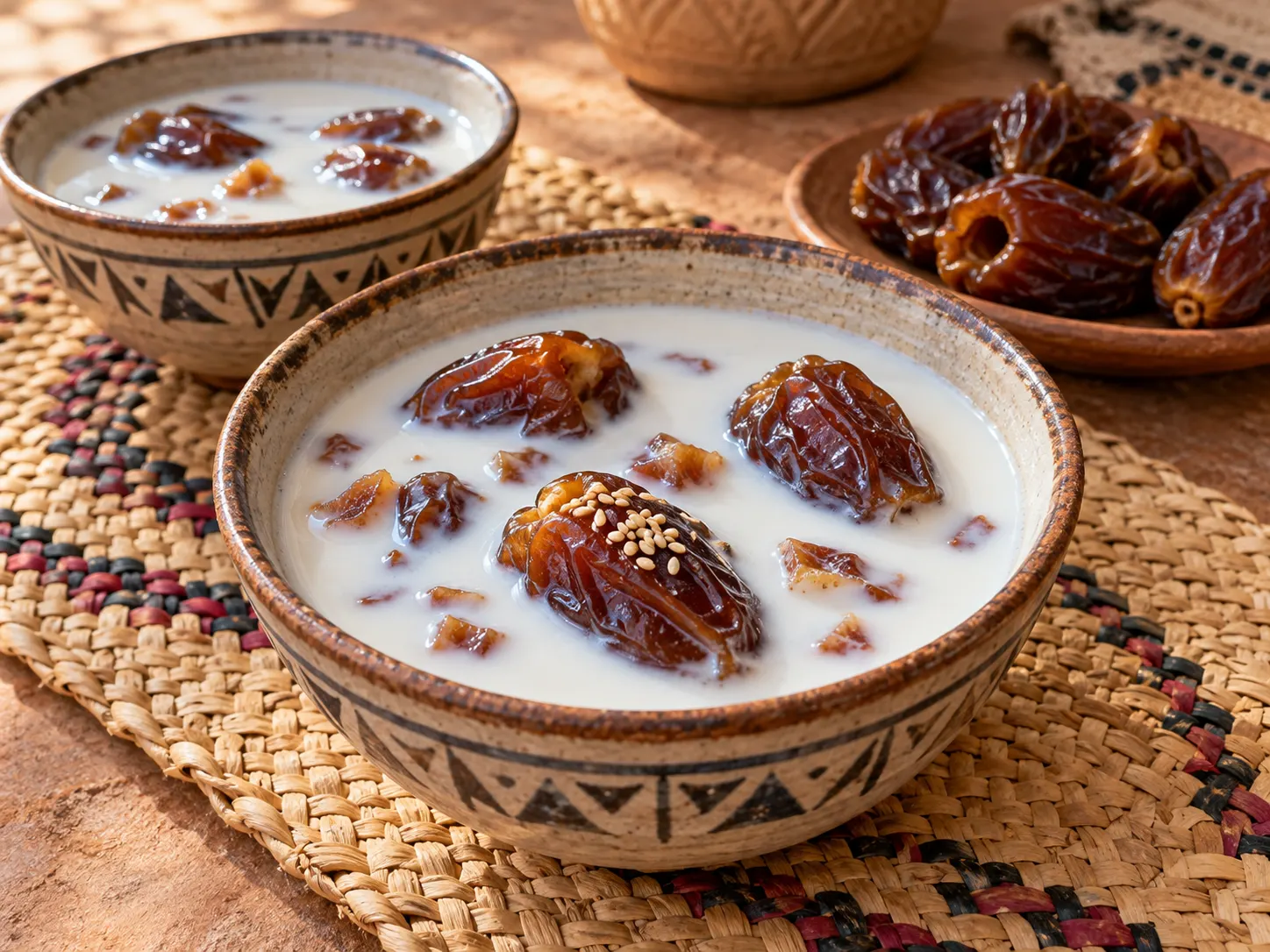
Traditional consumption • Fresh or fermented milk drunk plain, frequently in the morning, sometimes mixed with honey, dates, or cereals, • With ground millet, millet or corn flatbreads soaked in milk, • In porridge (fari, lahoh, kisra, achta) for children or the sick, • In Sahelian couscous (millet, rice, dates, melted butter, camel milk), • In “milk tea” throughout the Maghrebian Sahel, • Artisanal fresh cheese (rare, but existing among the Tuareg, some Somali). Innovative and urban cuisine With urbanization and globalization, camel milk: • Is used in yogurts, industrial cheeses, ice creams, desserts, flans, consumed in the cities of Mauritania, Morocco, Djibouti, Sudan, Egypt, now in Dubai, Paris, New York... • Serves as a base for creamy sauces for white meats, pan-fried fish, • Integrates ultra-modern drinks (shakes, smoothies, ice latte in Dubai/Nairobi), • Is found in “fusion” pastries (tartines, cheesecakes, crêpes). Export and derived products Milk (liquid, powder, cheese, or yogurt) is now exported to other continents (Europe, Asia, America) via African or Emirati companies, and “camel milk cosmetics” brands are emerging against eczema, dry skin, etc.
6. Economic weight and contemporary challenges
Local challenges • Food security: For the populations of the Sahara and the Sahel, the camel remains a “walking safe”—even in times of drought, it guarantees access to milk and sometimes income. • Women's empowerment: Women often manage the milking, sale, and distribution of milk. Many micro-projects have emerged around collection, processing (yogurts, ice creams), and innovation. • Urban market: In the cities of the Maghreb (Nouakchott, Marrakech, Algiers, Tamanrasset, especially the markets of Mauritania, Djibouti, Nairobi), fresh or fermented milk is becoming a trendy drink, prized for its health benefits. International market North African countries and the Horn are developing franchises, exports, participating in the “milk blunder” (local processing projects, elimination of powdered milk imports from Europe). Challenges • Difficult pasteurization: Aroma and texture change during industrial processing, but pasteurization is essential for health safety, • Standardization of tastes: Adaptation to urban palates, • Increasing pressure on natural resources (overgrazing, conflicts between camel herders and sedentary farmers), • Preservation: Milk keeps for a short time (12–24h without refrigeration), which still limits large-scale transport and sales.
7. Symbolism and transmission
• Oral heritage: Camel milk structures myths, legends (“Milk strengthens, milk heals, milk unites”), is the subject of many proverbs (Moorish: “There is no life without the camel”). • Education: Children learn to milk, to recognize the good camel, to share. Future brides and grooms are sometimes covered with milk during the blessing (Tuareg or Fulani initiation rite). • Local pride: A herd of good dairy camels means security, prestige, guaranteed marriage, social power.
Conclusion Camel milk is much more than a food: it is a memory of the desert, an act of care, a marker of ethos and identity. It has forged the resilience of African nomadic peoples, accompanies all stages of life, and continues to inspire researchers, chefs, entrepreneurs, families, and dreamers. A true link between tradition, the animal, women, and the community, it is the illustration, in the simplest glass or the most refined bottle, of an Africa that knows how to sublimate the harshness of the climate to offer—to itself and to the world—its share of eternal sweetness.
In the kitchen : Camel Milk
Recipes from the site to put your knowledge into practice:
Discover these cuisines at a restaurant
Explore our restaurant and caterer directories. Choose your destination and check the establishment’s menu to confirm which dishes are offered and available.
Continue exploring
Enjoy discovering ingredients and African cuisines? Join our newsletter. The illustrated PDF 10 sauces africaines incontournables is in French and is offered after confirming a subscription to the French or bilingual edition.