Sea Bass
Nile, Mediterranean
Understanding : Sea Bass
INTRODUCTION
A noble fish of the coasts, estuaries, and lagoons, sea bass (often called "loup de mer" in the Mediterranean, Dicentrarchus labrax for the European sea bass, but also Lates niloticus — the famous "Nile perch" of tropical Africa) symbolizes the diversity and excellence of African coastal cuisine. Its slender silhouette, silvery skin, firm and delicate flesh have made it one of the most sought-after dishes by fishermen, restaurateurs, and gourmets, from the Maghreb to the Cape of Good Hope, from the Ivorian lagoons to the Nile, from the beaches of Casablanca to the Niger Delta and the Swahili coast. Sea bass illustrates the richness of natural, human, and cultural exchanges on the African continent: between tradition and innovation, between artisanal fishing and modern aquaculture, between the simplicity of grilling and gastronomic sophistication.
Where to find it
Look for the exact food-grade form required by the recipe at markets and specialist shops. Check the product name, ingredients, condition and storage instructions.
Explore further: Cooking tips · Food hygiene and safety advice.
History and uses
1. BIOLOGY, SPECIES, AND DISTRIBUTION OF SEA BASS IN AFRICA
a) Diversity of "sea bass" on the continent • European Sea Bass (Dicentrarchus labrax): A coastal fish that inhabits the Mediterranean and the North Atlantic of Africa (Morocco, Algeria, Tunisia, Egypt, Mauritania). It also frequents estuaries, lagoons, temperate or warm bays. • Giant African Sea Bass or Nile Perch (Lates niloticus): Present in the Nile basin, East African lakes (Victoria, Turkana), the estuaries of the Niger Delta, sometimes considered, in internal markets, as "river sea bass." • African Black Sea Bass (Roccus chrysops): Subtropical areas of West Africa, from Guinea to Benin. • Related species: zander, marine perches, groupers: locally, these firm white-fleshed fish are sometimes offered as "sea bass" in markets. • Wild vs. farmed sea bass: Increasingly, sea bass comes from aquaculture in Mediterranean waters and lagoons (Morocco, Tunisia, Egypt) and up to large fish farming complexes in Côte d'Ivoire, Ghana, Kenya. b) Habitat and life cycle Sea bass thrives in coastal waters, estuaries, lagoons, deltas, and some brackish lakes in Africa: it hunts at dusk, feeds on small fish, crustaceans, cephalopods, mollusks, and can live for more than 15 years. It prefers nutrient-rich, oxygenated waters, offering shelter and spawning grounds.
2. FISHING, AQUACULTURE, AND ECONOMIC IMPORTANCE OF SEA BASS IN AFRICA
a) Artisanal and semi-industrial fishing • Practiced in rowing boats, motorized canoes, often in coastal areas, on lagoons, in estuaries, sometimes up to 10-20 m deep. • Uses gillnets, longlines, handlines, sometimes traps, night or morning catches. b) Sea bass aquaculture • Rapid growth since the 1990s in Morocco, Egypt, Tunisia, Senegal, Côte d'Ivoire: farming in floating cages, coastal ponds, integrated systems with rice cultivation or mangroves; controlled production for local and export markets. • Farmed sea bass is frequently found in urban fish markets and on the menus of high-end restaurants. c) Economic and social importance • Vital income for thousands of fishing families and hatchery employees, providing direct and indirect jobs (markets, fish trade, logistics, catering). • High value-added product, appreciated for export to Europe, the Middle East, Asia. • Contribution to food security: accessibility varies depending on the means, but regularly enters the diet of coastal, urban, and lake populations.
3. SYMBOLIC VALUE, SOCIAL PLACE, AND TRADITIONS
a) Symbol of celebration, abundance, hospitality • Serving whole, grilled sea bass is an act of honor towards a guest, an elder, or for the celebration of a success (baptism, academic achievement, engagement, birthday). • Best fish in the markets (and sometimes the most expensive), synonymous with refinement, assumed rarity ("You don't eat sea bass every day!"). • "Sunday dish" in urban families; present on the continent's grandest tables during large feasts. b) Transmission and heritage • Knowing how to choose fresh sea bass, clean it, grill it, marinate it, fillet it: taught from childhood, often a maternal or patrilineal skill to be passed on. • Strong symbolic significance in proverbs ("Chief's sea bass, royal fish of Lagos," "he who finds sea bass has found luck..."). c) Role in coastal and urban culture • Fishing villages (Saint-Louis-du-Sénégal, El Jadida, Sfax, Lagos, Grand-Bassam, Zanzibar...) make sea bass (and its lagoon cousins) a point of identity, a theme of many tales and songs.
4. NUTRITIONAL VALUE
• Rich in complete and easily digestible proteins. • Low in fat and cholesterol; rich in omega-3s (reputation as a "healthy fish"). • Essential source of B vitamins, D, trace elements (phosphorus, magnesium, potassium, zinc, iodine). • Suitable for all ages: babies (mousseline, poached fillets), elderly, athletes, convalescents. • Recommended for low-calorie diets and to prevent cardiovascular diseases.
In my books

Continue exploring the continent’s cuisines with Africa at the Table — 54 countries, 54 iconic dishes, by Alioune FALL. This book is in English.
Explore further
5. AFRICAN GASTRONOMY: REGIONAL VARIATIONS OF SEA BASS
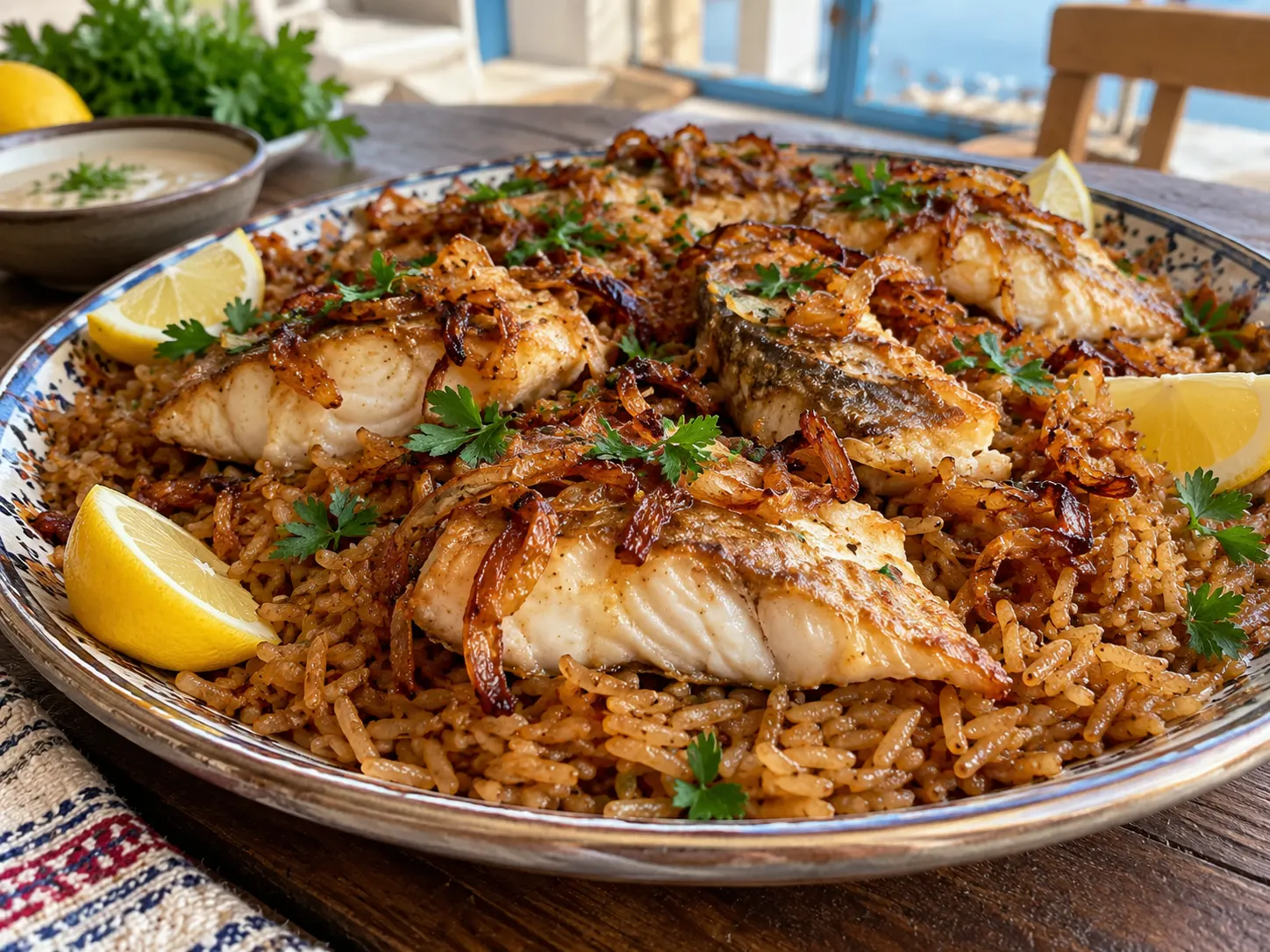
a) North & Mediterranean Africa • Sea bass with chermoula: marinated in garlic, tomatoes, coriander, cumin, paprika, olive oil, lemon; grilled whole over coals, served with vegetables, potatoes, olives. • Oven-roasted sea bass: lemon, herbs, fennel, olive oil; garnished with almonds or pine nuts on festive tables. • Fish tajine: sea bass steak simmered with tomato, saffron, root vegetables, chickpeas. • Sea bass en papillote: marinated, cooked in vine, zucchini, or banana leaves, mild aroma, natural flavor preserved. b) West Africa • Ivorian or Senegalese braised sea bass: fish washed, brushed with onion puree, garlic, ginger, herbs, chili, lemon, grilled over charcoal, served with attiéké, alloco, fresh salad. • Market fried sea bass: sliced, coated with spices or semolina, crispy fried, devoured fresh from the market; a street food queen of Abidjan, Lomé, Accra, Dakar. • Sea bass soup or spicy broth: whole fish or fish pieces in a soup of tomato, African eggplant, chili, sweet potato or cassava leaves, often eaten with bread or white rice. • Rice with sea bass: a jewel of "tiébou djeun," fatty rice, whole fish on a bed of tomato-vegetable rice. c) Gulf of Guinea & Central Africa • Sea bass in tomato sauce: daily dish, braised fish then simmered in tomato-onion-chili sauce, accompanied by cassava sticks, yam, or boiled banana. • Steamed sea bass "river style": steamed with herbs, banana leaves, ginger, lime; a healthy dish, preferred during celebrations and "dietary" cures. d) East Africa and the Indian Ocean • Swahili-style sea bass: grilled sea bass topped with coconut milk sauce, coriander, mild chili, lemongrass, served with pilaf rice or chapati. • Stuffed sea bass: aromatics, mild curry, local vegetables, baked or in jars; a star dish of Zanzibar, Mombasa, Dar es Salaam, Seychelles, Madagascar. e) Southern Africa • Cape sea bass on the braai: grilled whole, drizzled with lemon butter with wild herbs, served with chakalaka (spicy vegetables), pap, or grilled corn. • Pan-fried sea bass fillets: fruit vinegar, South African white wine sauce, butternut puree, chopped spinach. f) Fusion, urban, and street-food cuisine • Sea bass burgers: fish burger made in Africa, local bread, spicy sauce, crispy salad. • Tacos, wok, tartare, carpaccio: riding the wave of cultural blending and the inspiration of Afro-urban chefs.
6. SHARING, CONVIVIALITY, TRANSMISSION
Sea bass is at the origin of collective moments all along the coast: family meals under straw huts, beach picnics, community celebrations, post-fishing reunions, sporting evenings in the city. Every great occasion is adorned with sea bass: wedding, national holiday, end of Ramadan, club victory, patron saint festivals... Learning to cook sea bass often initiates a child into patience, precision, and sociability. The sharing of the fish, which requires being respectfully filleted and fairly distributed, illustrates the social values of solidarity, respect for elders, and generosity.
7. CONTEMPORARY CHALLENGES
• Overfishing, pollution, habitat degradation: necessity to preserve resources and artisanal practices (restoration of lagoons, stock management, fight against illegal fishing). • Tensions in aquaculture: feed, traceability, environment, coexistence with traditional fishermen. • Accessibility: sea bass, becoming a "luxury" in urban areas, prompts projects for democratization (valorization of local species, shared dishes, short supply chains...). • Sustainable innovation: modern cuisine combined with tradition for the emergence of an African "blue" gastronomy.
CONCLUSION Sea bass, a noble, versatile, and profound fish, beautifully symbolizes the alliance of nature, culture, and conviviality in Africa. Its elegant silhouette crosses all marine imaginations, all coastal languages, all creative desires. It nourishes, unites, inspires fishermen, mothers, chefs, children, and hosts from one end of the continent to the other. From the village canoe to the chic restaurant, sea bass remains a pillar of African taste, a bridge between yesterday and tomorrow, a modest but essential ambassador of African cuisine in the global gastronomic concert.
ENJOY YOUR MEAL!
© Photo credit: recettesafricaines.com. All rights reserved.
In the kitchen : Sea Bass
Recipes from the site to put your knowledge into practice:
Discover these cuisines at a restaurant
Explore our restaurant and caterer directories. Choose your destination and check the establishment’s menu to confirm which dishes are offered and available.
Continue exploring
Enjoy discovering ingredients and African cuisines? Join our newsletter. The illustrated PDF 10 sauces africaines incontournables is in French and is offered after confirming a subscription to the French or bilingual edition.