Oryx (gemsbok)
Southern Africa
Understanding : Oryx (gemsbok)
Introduction
Majestic, resilient, elegant, the oryx embodies the power and beauty of African arid spaces. Identifiable by its long, straight or slightly curved horns, its light coat contrasted with black and white, it is one of the most impressive Sahelian and Southern African antelopes. But the oryx is not only an icon of the savanna and desert: it also occupies a unique place in the traditional and contemporary cuisine of Southern Africa, where venison (game meat) is both a symbol of heritage, sustainable development, gastronomic prestige, and culinary renewal. Let's discover the oryx, from its wild world to the plate, through its ecological cycle, its ancestral uses among desert peoples, its recovery in South African and Namibian gastronomy, and its modern challenges. This is the story of an animal that links man, nature, and the table.
Where to find it
Look for the exact food-grade form required by the recipe at markets and specialist shops. Check the product name, ingredients, condition and storage instructions.
Explore further: Cooking tips · Food hygiene and safety advice.
History and uses
1. Biology, species, and ecological role
The oryx refers to several species of the genus Oryx: • Oryx gazella (scimitar oryx or beisa oryx), the East African oryx (Ethiopia, Kenya, Tanzania, Sudan). • Oryx dammah (scimitar oryx, now extinct in the wild), formerly widespread from Morocco to Egypt and Chad. • Oryx gazella (gemsbok, “gemsbok” in Afrikaans), present in the deserts of Namibia, Botswana, Kalahari, South Africa. • Oryx leucoryx (Arabian oryx): rare, reintroduced, formerly present in the Sahara. The gemsbok is the best-known and most consumed species in Southern Africa. Morphology and adaptations The oryx is massive (1.2 m at the shoulder, up to 200 kg), distinguished by its long horns (up to 1 m or more in females), its black markings on the head, flanks, and belly, its light beige coat, and its bushy tail. Its physiology allows it to survive in scorching deserts: it reduces its body temperature at night, can go several days without drinking, feeds on dry grasses, roots, and tubers, absorbs moisture from the plants it consumes, seeks shade or digs the ground to cool down. Ecosystem role The oryx shapes the landscape: it disperses seeds, tramples, grazes, and contributes to savanna regeneration. A sought-after prey for lions, leopards, hyenas, and human peoples, it embodies the vital link between dry land and life.
2. Human history, myths, and symbolism
Oryx and indigenous peoples Among the San (Bushmen) and Himba, the oryx is a totem, a mythological animal whose horns are said to be magic sticks, its flesh a source of strength, and hunting, an initiation rite. In the millennia-old rock art of the Brandberg (Namibia) and Drakensberg (South Africa) caves, the oryx appears as a hero, a guide during spiritual journeys or a symbol of survival in the desert. Among the Nama, Tswana, Ovambo, Herero, Khoisan, it is celebrated, feared, and respected for its grace and combativeness. National symbol In Namibia, the oryx (gemsbok) is the national animal, featured on coats of arms, banknotes, inspiring legends, tales, and emblems. Its silhouette adorns bush festivals and eco-lodge logos, recalling the importance of venison and the coexistence of man and nature.
3. Hunting, domestication, economy, and rural development
History of hunting and conservation Oryx hunting, once essential for survival, was long practiced with spears, bows, or lances, then regulated during colonization by quotas, permits, and then the creation of private “game farms”. The oryx, once threatened by overhunting and the reduction of wild spaces, is now experiencing a resurgence thanks to ecotourism, sustainable hunting, and semi-domestic breeding. Game farming and venison industry • Game ranching: breeding of game (oryx but also springbok, kudu, eland, zebra) on immense fenced lands, alternating photo tourism, sport hunting, high-end meat production, and community development. • Certified bushmeat: processing and labeling of oryx meat for urban butcher shops, sale in local markets, and export (Europe, Middle East, United States). • Controlled community hunting: A management method where oryx meat feeds villages, funds education or health, and encourages the preservation of live game. Economic weight • Major source of protein for arid areas where conventional agriculture is low. • Rural jobs: guides, trackers, butchers, cooks, artisans, leather craftsmen (secondary use). • Ecotourism: gastronomic tours, venison festivals, “bush dining” for tourists.
4. Social place, festive role, and sharing
• Festive food: collective oryx hunting is an occasion for large community gatherings, feasts under the stars, initiation ceremonies, weddings, funerals, elders' vigils. Ritual slaughter honors the clan chief or the guest of honor. • Transmission of knowledge: Learning to track, slaughter, skin, preserve, and prepare oryx is a coming-of-age ritual among the San, Herero, or Nama. • Fair distribution: the noblest meat goes to the elders or the chief. The tail, brain, liver, considered fortifying, are cooked during healing or protection rites. • Conviviality of the “braai” (South African/Namibian barbecue): oryx meat, grilled over an acacia wood fire, bringing together family, neighbors, friends, tourists, in an exchange of recipes and memories.
In my books

Continue exploring the continent’s cuisines with Africa at the Table — 54 countries, 54 iconic dishes, by Alioune FALL. This book is in English.
Explore further
5. Nutritional value of oryx meat
• Ultra-lean: fat content often < 2%, excellent quality protein (> 20%), ideal for athletes, children, low-calorie diets. • Rich in heme iron, zinc, phosphorus, potassium, B vitamins (B2, B6, B12). • Low cholesterol, no hormones/antibiotics (wild venison, not from industrial farming). • Delicate taste: less pronounced than wild boar, more tender than beef, woody, slightly sweet flavors, suitable for multiple spices or pairings.
6. Culinary uses of the bush – from tradition to haute cuisine
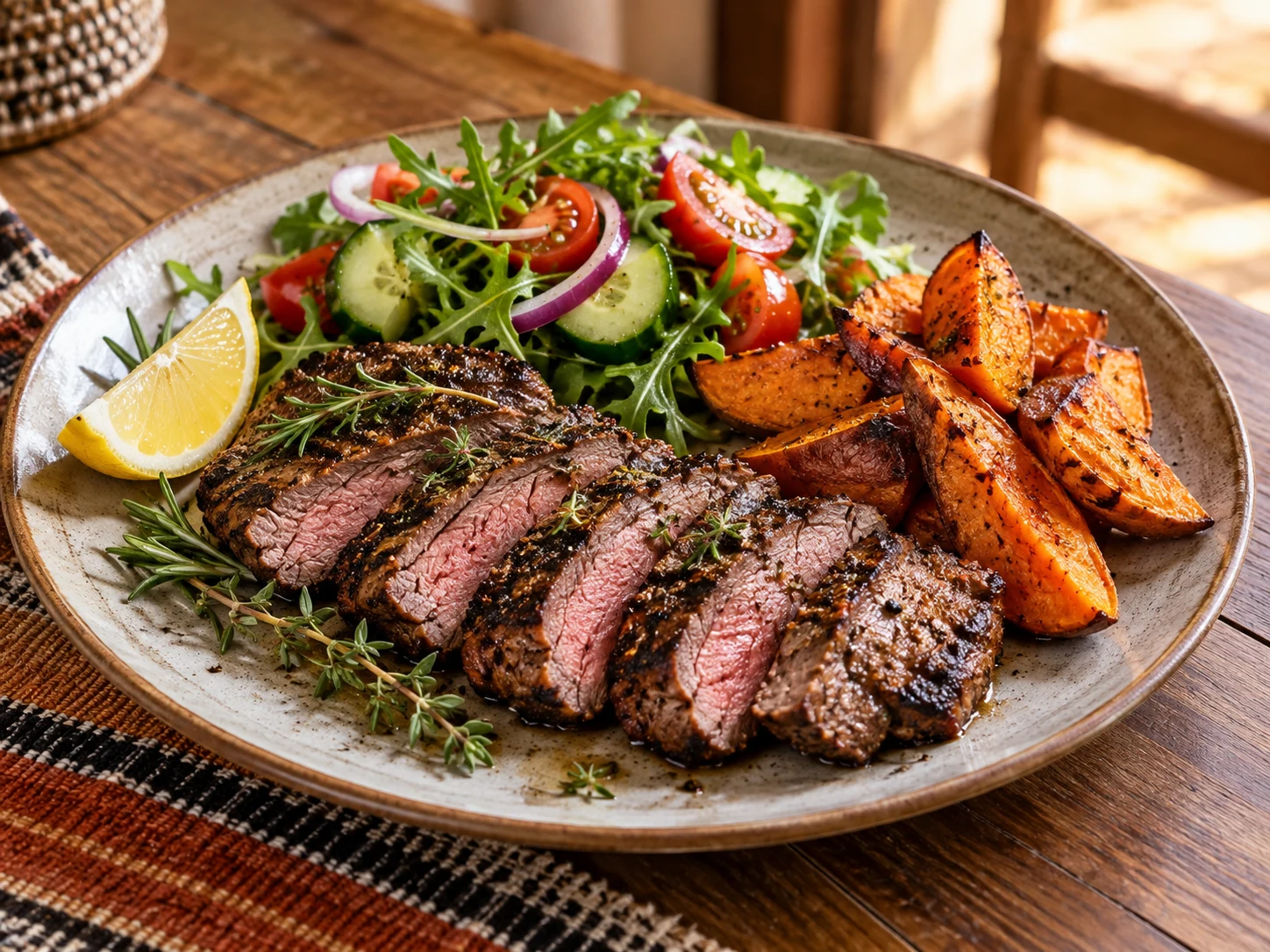
a) Grills, roasts, and braais • Oryx steak or fillet: marinated (red wine, garlic, veld herbs, juniper berries, bitter orange), grilled “rare” or “medium rare”, seared to retain juices. Served with berry reduction, sweet potato puree, market vegetables. • Oryx chops: grilled or pan-fried, seasoned with salt, pepper, coriander, served with “pap” (local polenta), grilled wild vegetables. • Skewers (“sosaties”): meat cubes and onion, dried apricot, light vinegar marinade, flame-grilled. b) Stews and potjiekos • Oryx potjiekos (a traditional South African stew cooked in a three-legged cast-iron pot over an open fire): stew with carrots, onion, squash, sweet potato, slow-cooked in cast iron over the fire. Flavored with mild spices, bush berries, local beer, or grey wine. • Oryx civet or osso buco: Creole or European adaptation: meat slow-cooked with vegetables, tomatoes, olives, red wine. c) Drying and charcuterie • Oryx biltong (a form of dried, cured meat, originating from Southern Africa): an essential of Southern Africa: spiced meat, marinated (vinegar, coriander, pepper, salt), cut then air-dried, protein snack, hunting meal, or aperitif. • Oryx droëwors (a dried sausage, similar to biltong, originating from Southern Africa): thin, dry sausage where oryx is mixed with beef, garlic, coriander. d) Haute cuisine and fusion cuisine • Oryx carpaccio: thin slices served with Cape olive oil, capers, lemon zest, or pink peppercorns. • Oryx tartare, burger, tacos: urban trends: classic or revisited preparation, with spicy African sauces or “bushveld” herbs. • Oryx fillet with exotic fruits: figs, mangoes, peaches, wine reduction, fusion inspiration from luxury lodges. e) Rural dishes • Oryx bone soup: village recipe, rich in minerals, given to children, pregnant women, convalescents. • Dried oryx meat for winter: cut into long strips, salted, smoked with acacia wood: traditional storage.
7. Modernity, ecology, and innovation
• International influence: oryx meat labeled “African venison” attracts Michelin-starred chefs from Europe, Asia, and America. Namibia and South Africa are increasingly exporting high-end venison. • Gastronomic ecotourism: “venison” lodges and tours – tastings, cooking workshops, sustainable butchery courses. • Community integration: more and more projects involve villagers in sustainable management, valorization of live game, and sharing of benefits (health, school, etc.). • Traceability labels: guarantee of ethical meat, without residues, produced in compliance with quotas, animal welfare, and social sharing.
8. Challenges and perspectives
• Fight against poaching, habitat loss, ecological fragmentation: urgent need to harmonize hunting tradition, food needs, and conservation. • Urban perception: reluctance of an elite to bushmeat, but growing enthusiasm among younger generations and tourists. • Democratization: making venison accessible (price, short supply chains, street food). • Transmission: risk of disappearance of artisanal knowledge of cutting, drying, ancestral recipes.
Conclusion The oryx, an emblematic antelope of the African deserts, is a formidable link between land and man: a model of adaptation, a source of life, a symbol of ingenuity and, now, a pillar of sustainable, inventive African cuisine oriented towards the world. Offering an oryx steak, sharing biltong at dusk, cooking meat in a potjiekos around the fire, is celebrating deep Africa: one that innovates without denying the past, that nourishes without exhausting, that transmits and unites. By its subtle taste, its nutritional nobility, its history rooted in the bush, the oryx would well deserve the title of “king of the desert” and ambassador of a modern, proud, and responsible African table.
In the kitchen : Oryx (gemsbok)
Recipes from the site to put your knowledge into practice:
Discover these cuisines at a restaurant
Explore our restaurant and caterer directories. Choose your destination and check the establishment’s menu to confirm which dishes are offered and available.
Continue exploring
Enjoy discovering ingredients and African cuisines? Join our newsletter. The illustrated PDF 10 sauces africaines incontournables is in French and is offered after confirming a subscription to the French or bilingual edition.