Herring
Atlantic coast
Understanding : Herring
Introduction
Herring (Clupeidae family, notably Clupea harengus, Clupea pallasii), a silvery fish with lustrous scales and modest size, holds a fundamental place in the diet of vast African populations. While not indigenous to all African waters, it has become, through distant fishing (especially Moroccan, Namibian), import, preservation, and tradition, an essential element of markets and cuisines from Morocco to Central Africa, from Egypt to Ivory Coast, from Angola to Nigeria. Both inexpensive, nutritious, easy to prepare, and a factor of culinary and food unity, herring has become ingrained in the eating habits of millions of Africans, often simply called “smoked fish”, “salted fish”, “dried fish” or referred to by local names: “maniguette” (a type of fish, often smoked or dried, popular in West Africa), “mbissi” (a local term for fish, often smoked, in Central Africa), “bonga fish”… A deep dive into the African journey of a universal fish that has become resolutely continental.
Where to find it
Look for the exact food-grade form required by the recipe at markets and specialist shops. Check the product name, ingredients, condition and storage instructions.
Explore further: Cooking tips · Food hygiene and safety advice.
History and uses
1. Origins, biology and spread of herring in Africa
Species and biogeography Herring encompasses several species, the most common on African markets being the Atlantic herring (Clupea harengus), caught in the North-East Atlantic, then smoked or salted, packaged in barrels or bales for export and popular African consumption. We also distinguish: • Local or related species: sardinella (Sardinella aurita and S. maderensis), mistakenly called “herring” in West Africa and widely consumed fresh, smoked or dried. • Bonga shad (Ethmalosa fimbriata), a traditional fatty fish from the Gulf of Guinea, a cousin of herring and a pillar of local consumption. • Anchovies, capelin, mackerel, sometimes called or confused with herring, due to similar preservation methods. Distribution and trade routes • Imported herrings arrive smoked, kippered (salted and lightly smoked), or simply brined, in all major ports of Morocco, Egypt, the Gulf of Guinea, Central Africa. • Fresh herring is only found in temperate waters (Morocco, Namibia, South Africa); elsewhere, it is processed products that circulate – the smoked version (“kippers”), fermented (“fessikh” of Egypt), salted or dried.
2. Economic weight and social place
Food, stability and accessibility • Herring is one of the most consumed fish in Africa, after tilapia and sardinella, thanks to its accessible price and its distribution in the bush as well as in the city. • It guarantees a reliable source of protein when fresh fish is expensive, rare or inaccessible (dry season, lean season, Lent, Ramadan…). • A “weekday” food in all social classes, from urban popular markets to rural forests. Employment and processing • The sale of imported or local herring supports tens of thousands of women: fishmongers, smokers, street vendors, restaurateurs… • The art of smoking, drying, salting, cutting, distribution are trades passed down from generation to generation. • Its packaging (smoked, salted) allows for preservation, long-distance transport, and the absence of a cold chain – fundamental in rural or semi-urban Africa.
3. Symbolism, rites and traditions
• Fish of the people because it “saved” the diet of many societies during famines, war periods or lean seasons. • It holds a special place during Christian Lent (especially in large urban centers of Central Africa), Muslim Ramadan (iftar, hearty breakfasts, evening soups in Egypt and the Maghreb). • Certain ethnic groups use it as ritual food during funerals, initiations or popular festivals (clan gatherings, poor weddings, neighborhood feasts).
4. Nutritional and dietary benefits
• Very rich in protein (18 to 22 g/100g), excellent digestibility. • Abundant Omega-3: supports brain development, cardiovascular prevention. • Vitamins B12, D, A, iodine, selenium, potassium, calcium (bones consumed in the smoked/dried version). • Low saturated fat, low calorie without skin and fatty parts; an essential ally for the dietary balance of children, pregnant women, the elderly. • Fortifying during periods of convalescence or physical exertion (field work, pilgrimages…).
5. Regional culinary uses of herring in Africa
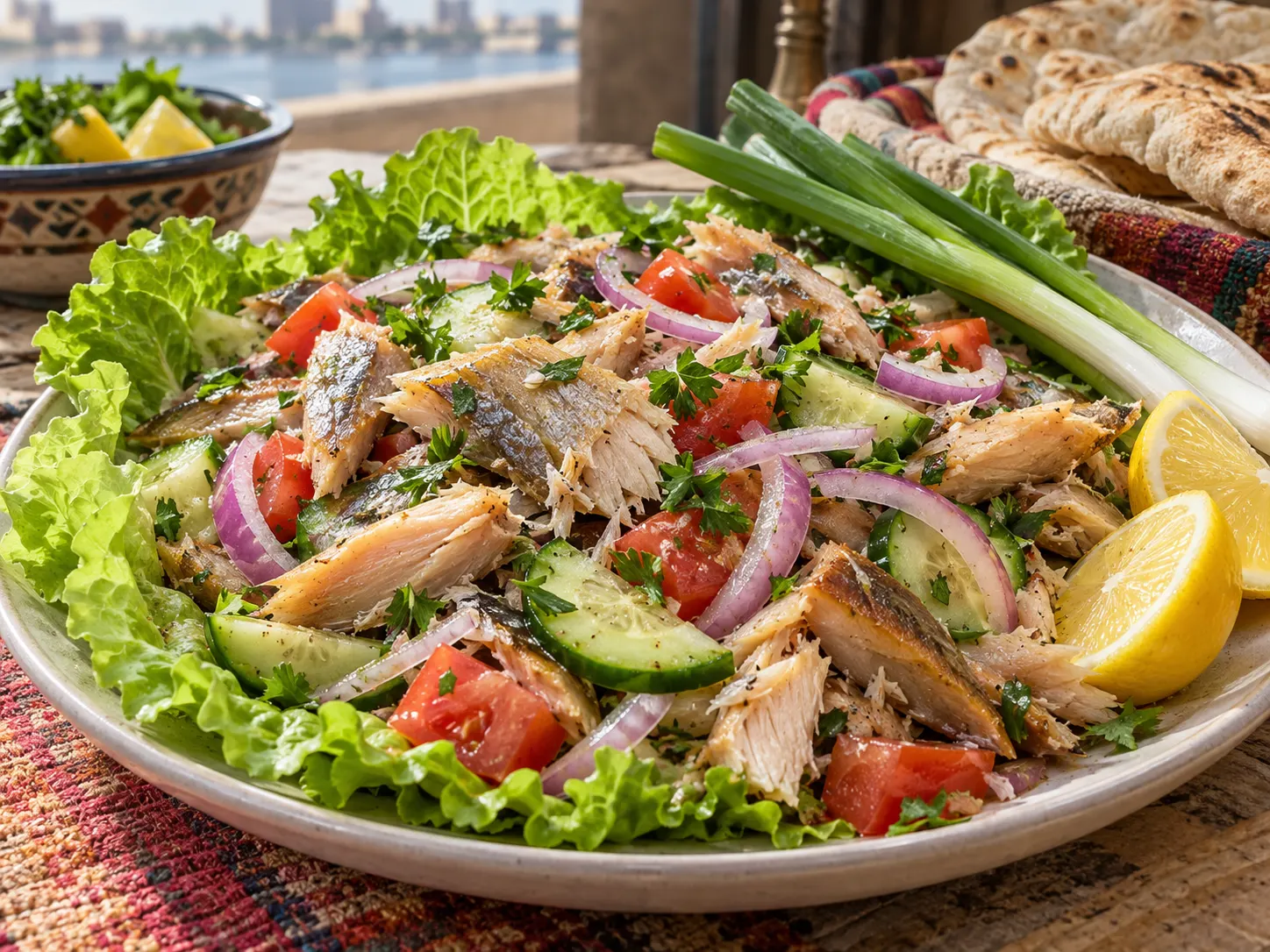
a) North Africa • Egyptian Fessikh (fermented/salted herring): served at Sham el-Nessim (spring festival), cut into pieces, drizzled with lemon, eaten on bread with onion, tomato, olive oil. • Ramadan grilled herring: kippered herring from the market, grilled or lightly pan-fried, added to tomato, onion, parsley salads, accompanied by olives, lemon. • Herring salads and “briks” (fried pastry): shredded, integrated into soups or stuffed pancakes, as mezze or as an accompaniment to vegetable tagines. b) West Africa • Smoked herring in sauces: essential for “sauce feuille” (leaf sauce), “sauces graine” (seed sauces), “mafé” (peanut stew), “gombo sauce” (okra sauce), “egusi soup” (melon seed soup), “obe ata din din” (fried pepper stew), “gboma dessi” (spinach stew)… Herring is crumbled or cut into pieces, added to the cooking of vegetables, flavors the dish and gives taste, sometimes with dried fish and crab. • Rice with fish: rice cooked with smoked herring broth, sautéed vegetables, chili, “thiébou guinar” (Senegal, a chicken and rice dish), “riz sauce” (Ivory Coast, rice with sauce). • “Pan-fried” or “companion” fish of street food: scaled smoked herring, quickly pan-fried, served with gari (cassava flour), cassava, plantain, spicy relish and tomato sauce. • Fish fritters: smoked herring paste, onion, flour, chili, fried into small patties. c) Central Africa • “Mbisi” or “niébé” fish (Cameroon, Gabon, Congo): smoked or dried herring added as a condiment in stews, vegetable soups, bean or cassava stews. • Herring broth: hot soup from popular markets (Douala, Kinshasa), desalted herring, cooked in broth with herbs, cabbage, peanut paste, fufu (a starchy staple food). • Tomato sauce and herring: daily dish, rice or cassava stick, shredded smoked herring, spicy tomato. • “Companion” herring: sold individually, very popular as a snack or “sautéed” in street buffets, accompanied by fried onions. d) Southern Africa and Islands • “Breakfast fish” (Namibia, South Africa, Angola): smoked herring, sometimes grilled, sliced, served for breakfast with corn, eggs, vegetables or millet porridge. • Smoked fish curries (Madagascar, Mauritius, Mozambique): rinsed herring, simmered with tomato, onion, garlic, ginger, coconut, chili. • “Herring biltong” (dried herring): dried fish, enjoyed as a snack or used in flakes in soups and sauces.
In my books

Continue exploring the continent’s cuisines with Africa at the Table — 54 countries, 54 iconic dishes, by Alioune FALL. This book is in English.
Explore further
6. Preservation, processing and popular ecology
• Smoking: An ancestral method, herring is hung in wood ovens or small screened huts, takes on a dark color, strong flavor, retains all its texture. • Salting: soaked in brine, sometimes pressed then dried; this technique ensures preservation for several weeks. • Natural drying: on ropes or racks, perfect for transport in the bush and quick cooking over a wood fire. • Import/distribution: large bales of kippered fish, sold retail, by the piece, in all urban or rural African markets.
7. Festivals, sharing, transmission and place in society
• Sharing ritual: a dish of smoked herring is often prepared during family reunions, it is typical of popular neighborhood meals, church or mosque banquets, funeral wakes. • Transmission of knowledge: learning to prepare herring (soaking, shredding, cooking) is to initiate the child into the secret of sauces, into respect for “the little that nourishes much”. • Urban solidarity: accessible food for students, precarious workers, often offered during solidarity actions (“common pot”, “100 CFA franc meals”).
8. Modernity, challenges and perspectives
• Sustainability issues: the growing demand for herring, the fluctuation of stocks in the North and South Atlantic, resource crises and irregular imports are pushing for the valorization of local species, encouraging responsible fishing and strengthening on-site processing. • Culinary innovation: urban dishes (pies, quiches, croquettes, pizzas, “street sandwich”), integration into fast food, creation of tapas and protein breakfasts. • Competition and hybridization: other fish (mackerel, sardine, dried tilapia) used as a replacement or supplement depending on seasons and prices. • Nutrition: key role of herring in combating child malnutrition and anemia, advocated by multiple NGOs and food campaigns. • Training of fishmongers and processors – support for women's sectors: vital for maintaining jobs and transmitting knowledge.
Conclusion Herring, a modest fish from the Atlantic and the Mediterranean, has conquered Africa through its versatility, its ability to be shared, cooked, preserved, nourishing cities as well as rural areas, enriching sauces as well as memories. It embodies the simplicity that saves from “lack”, the memory of peoples and the ability to invent a new taste, day after day. Whether found in leaf sauce in Douala, in fessikh in Alexandria, in rice sauce in Abidjan, in herring porridge in Kinshasa or in communal pots, herring summarizes practical, inventive, supportive and forward-looking Africa. Preserving its access, respecting its fishing, innovating without betraying its roots: the great African destiny of the small herring continues to unfold on all plates that dream of horizons and shared warmth.
In the kitchen : Herring
Recipes from the site to put your knowledge into practice:
Discover these cuisines at a restaurant
Explore our restaurant and caterer directories. Choose your destination and check the establishment’s menu to confirm which dishes are offered and available.
Continue exploring
Enjoy discovering ingredients and African cuisines? Join our newsletter. The illustrated PDF 10 sauces africaines incontournables is in French and is offered after confirming a subscription to the French or bilingual edition.