Chicken
Southeast Asia
Understanding : Chicken
Introduction
From the most isolated village in the Sahel to the most modern megacity, chicken alone embodies conviviality, prosperity, and hospitality in Africa. Present in all cuisines of the continent, it crosses borders, languages, social statuses, and religions. Sometimes raised freely in farmyards, sometimes imported and sold, it occupies a central place in daily and food life, both in popular cuisine and in fine modern gastronomy and sacred rituals. Celebration, gathering, party, or simple family Sunday: chicken meat is essential, carrying memory, economy, art of living, and collective identity.
Where to find it
Look for the exact food-grade form required by the recipe at markets and specialist shops. Check the product name, ingredients, condition and storage instructions.
Explore further: Cooking tips · Food hygiene and safety advice.
History and uses
1. History and symbolism of African chicken
1.1. Origins and spread Domestic chicken (Gallus gallus domesticus) has its origins in Southeast Asia. Introduced to Africa more than 2,500 years ago via ancient Egypt, it has perfectly adapted to the diverse African climates. It spread through trade: trans-Saharan caravans, Nilotic routes, Indian Ocean coasts, Portuguese, then English and French trading posts. Each African people has since “Africanized” the breeding and preparation of chicken, creating as many rustic breeds as recipes and social uses. 1.2. Symbolism and social values • Symbol of prosperity and hospitality: offering a chicken to a foreigner, a chief, a new ally, is to respect and honor one's host. • Sacrificial animal: it is the main offering during rites of passage (birth, initiation, marriage, funerals), purification rites, magico-religious ceremonies (voodoo, animism, Muslim or Christian rites). • Indicator of social status: owning a chicken coop testifies to success, management skills, and honor in the family. • Expression of femininity, motherhood, and solidarity: in many societies, women are responsible for raising and sharing chickens.
2. Diversity of African chicken farming and breeds
2.1. Traditional vs. industrial chickens • Bush chicken / peasant chicken: free-range, fed on grains, insects, and kitchen scraps. Its meat is firm, muscular, flavorful, sometimes long to cook, but highly prized for its inimitable taste. • Industrial or imported chicken (called “broiler chicken”, “white chicken”, “frangos” in Cape Verde, “frozen chicken” in Francophone Africa): fatter, less tasty, battery-farmed, consumed mainly in cities and in urban street food. 2.2. Local breeds • Each region has its favorite breed (Kabyle in Algeria, Kuchi in East Africa, Ashanti in Ghana, Rwanda indigenous, Tswana, Venda, etc.), often adapted to the climate, rustic, resistant, and contributing to local biodiversity. 2.3. Economics of breeding • Chicken is a factor of female and rural autonomy, a pillar of village microcredit, a driver of innovation (small urban poultry farming, organic chicken startups). • Sunday markets: noisy with thousands of roosters, hens, and chicks for sale, true popular exchanges.
3. Uses and social functions of chicken
3.1. Rites and ceremonies • Traditional sacrifices: offering chicken for ancestors, gods, or saints (St. Genevieve, Eid al-Adha, West African Vodoun rites, Bamileke funerals, Manding rituals…). • Weddings, baptisms, births: “chicken meal” as a marker of honor, main piece of the libation, symbol of renewal and fertility. • Reconciliation, signing of agreements: any lasting peace is sealed by shared poultry. 3.2. Sharing and daily hospitality • Even in poverty, taking a chicken from the coop for a stranger is an element of honor. The cutting (thighs for elders, wings for youngsters, offal for initiates or the chief) follows precise symbolism. • In the city, chicken is the “accessible protein”: star of family celebrations, birthdays, Sundays, “after Tafsir” snacks, Christmas or Ramadan meals.
4. Regional culinary uses of chicken in Africa
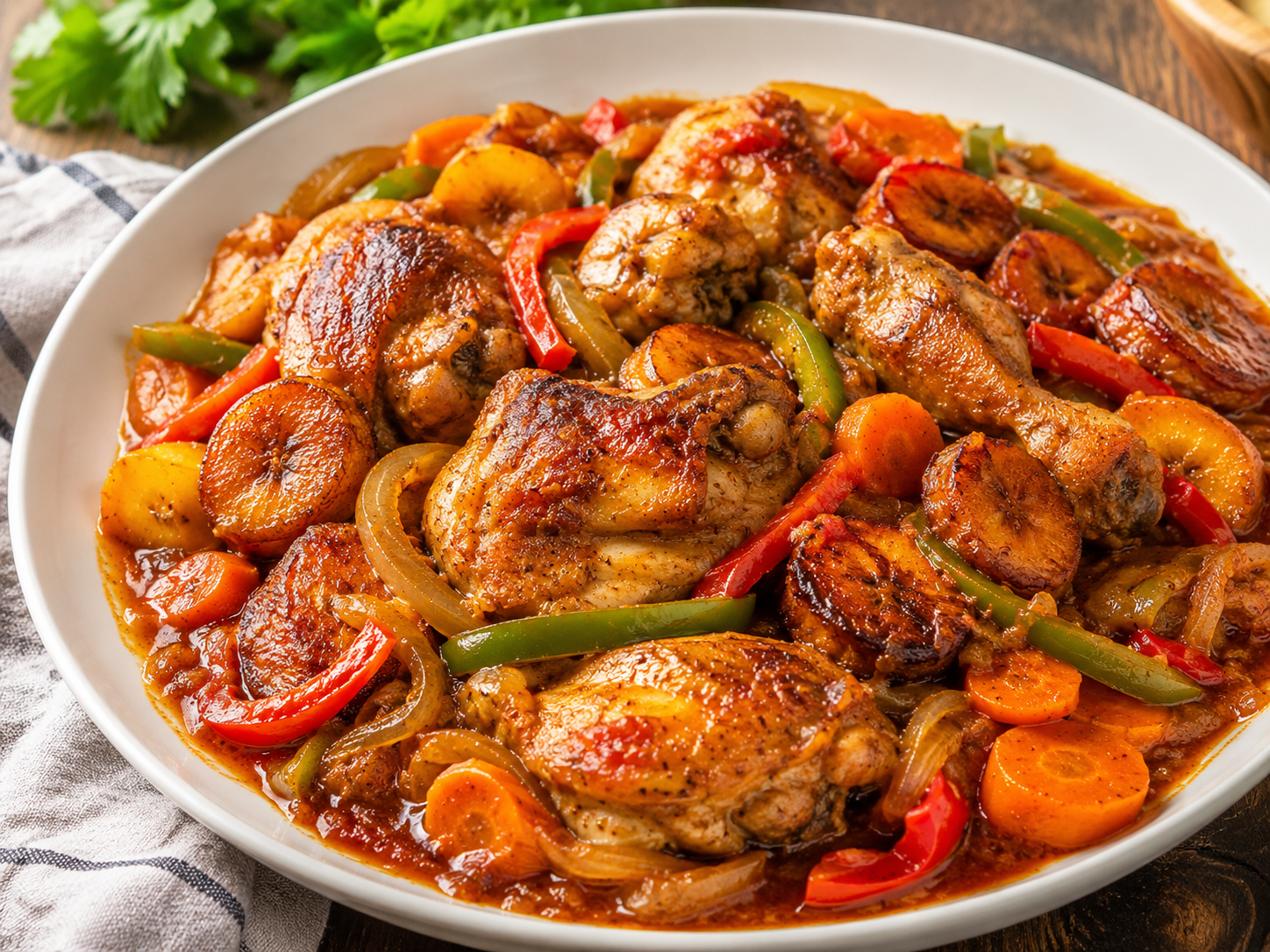
The diversity of chicken-based dishes reflects the creativity, memory, and spirit of cultural blending of the continent. 4.1. West Africa a) Senegal • Chicken yassa: emblematic dish, chicken marinated (lemon, onion, mustard, chili), grilled then simmered for a long time, served with white rice. A Casamance specialty that has become an urban and festive classic. • Chicken mafé: chicken stew in peanut sauce, carrots, sweet potato or okra. • Grills/“dibi” (Senegal, Mali, Burkina): seasoned chicken, charcoal-grilled, served with alloco (fried plantain), attiéké (steamed fermented cassava semolina), accompaniment, and hot chili. b) Ivory Coast, Benin, Togo, Ghana • Chicken kedjenou: stew cooked in a jar ("canari") with vegetables, chili, cassava, tomatoes, herbs, without added water. • Brazed chicken: street food ritual, marinated African style, cooked over embers with tomato-chili or onion sauce. • Akassa, chicken with palm nut sauce: corn or yam porridge with its chicken in red sauce. 4.2. Central Africa • Poulet DG (Director General Chicken, Cameroon): chicken stir-fry with plantain, crispy vegetables, spices, in a rich and festive sauce. • Cameroonian Ndolé: chicken simmered in a sauce of bitter leaves, peanuts, smoked fish. • Saka-saka/Congolese cassava leaves: chicken simmered in cassava leaf puree with milk or palm oil. 4.3. North Africa • Chicken couscous: semolina, garden vegetables, chickpeas, saffron chicken with cinnamon, turmeric, ginger. • Chicken tagines: marinated with preserved lemon, green olives, onions, ras-el-hanout (a North African spice blend), sometimes almonds and prunes, a ceremonial dish. • Méchoui/Grills: thighs and wings flavored with cumin, coriander, sweet pepper, lemon. 4.4. East Africa and Swahili • Kuku paka: grilled chicken, creamy coconut milk sauce, chili, lime, coriander, a specialty of Kenya/Tanzania. • Chicken pilau: spiced rice, chicken pieces, cinnamon, cardamom, cloves. • Soups, Swahili curry, biryanis: strong Indian and Arab inspiration. 4.5. Southern Africa • Potjiekos: stew cooked outdoors, in a cast-iron pot over a fire, vegetables and spices. • Botswana stew, peri-peri chicken (Mozambique, South Africa): chicken in piri-piri (hot chili) marinade, lemon, garlic, olive oil, grilled, a contemporary emblem. 4.6. Indian Ocean Islands • Chicken curry: masala, garlic, ginger, turmeric, cumin, tomato. • Rougail (a spicy tomato-based relish), chicken with vanilla (Reunion, Mauritius, Madagascar): chicken simmered in vanilla sauce, spices, tomatoes, white wine. • Creole Cantonese rice, chicken “bouchons” (steamed dumplings)/dim sum.
In my books

Continue exploring the continent’s cuisines with Africa at the Table — 54 countries, 54 iconic dishes, by Alioune FALL. This book is in English.
Explore further
5. Economic, social, and nutritional role
5.1. Rural and urban economy • Chicken farming is a major source of income for millions of rural families. Chicken markets (live, cut, grilled, fried, braised) structure village life, street food, and the urban informal economy. • In the city, industrial chicken supplies fast food, promoting access to animal protein for working-class people. • The rise of “new African poultry” (organic, farm-raised) is an issue of pride, quality, and public health. 5.2. Health and nutrition • Lean protein, low in fat, rich in micronutrients: iron, zinc, B vitamins. • Cheaper, more accessible, more digestible than beef or mutton in most regions. • Allows for a balanced diet for children, pregnant women, and the elderly. • Offal, gizzard, liver, heart: consumed for their specific contributions (iron, vitamin A), often at celebrations or by athletes. 5.3. Community and urban dimension • The cutting of chicken brings together all ages, all social strata. • On the go, at the table, at the market, during ceremonies, chicken is a unifying element, for sharing, for rejoicing. • A driver of urban integration, a link from country to city, from tradition to modernity.
6. Challenges, transmission, and modernity
• Threats: rise of imported industrial chicken (“frozen chicken”), destabilization of local sectors, rarity of certain rustic breeds. • Response: promotion of African farm-raised chicken, short supply chains, training, valorization of culinary heritage. • Oral and gestural transmission: each family has its secret marinade, cooking method, gestures learned from mother or father, its variations of cutting according to the rite or celebration. • Modern gastronomy: new chefs, food trucks, fast food or Michelin-starred restaurants, revisit African chicken in burger, wrap, tartare, “fusion” skewer versions without ever losing the soul of the childhood dish.
Conclusion Chicken is much more than an animal or meat in Africa: it is memory, identity, a challenge for the future, and a shared celebration. It embodies the art of living together, respect for others, and inventive, beautiful, and supportive cuisine. In the rural pot, over urban embers, at the ceremonial buffet, or in the trendy bistro, it remains the unifying ambassador of a warm, audacious, and always festive Africa. Preserving the place of chicken, defending its rural and urban channels, transmitting recipes and know-how, means betting on the taste and dignity of the continent, from the village courtyard to the global banquet.
In the kitchen : Chicken
Recipes from the site to put your knowledge into practice:
Discover these cuisines at a restaurant
Explore our restaurant and caterer directories. Choose your destination and check the establishment’s menu to confirm which dishes are offered and available.
Continue exploring
Enjoy discovering ingredients and African cuisines? Join our newsletter. The illustrated PDF 10 sauces africaines incontournables is in French and is offered after confirming a subscription to the French or bilingual edition.