Peanut oil
Central and South America
Understanding : Peanut oil
Introduction
Peanut oil is one of the true pillars of food in sub-Saharan Africa, particularly in West and Central Africa, but also in vast regions of the continent ranging from the Sahel to the urban markets of the Gulf of Guinea, from islands to savannas. Present in all kitchens, omnipresent in markets, it crosses all social strata – from the village courtyard to the gourmet restaurant – and accompanies both daily life and major festivities. More than just a fat, peanut oil is an agricultural issue, a symbol of female ingenuity, a cultural marker, and a source of pride and challenge in modern African food.
Where to find it
Look for the exact food-grade form required by the recipe at markets and specialist shops. Check the product name, ingredients, condition and storage instructions.
Explore further: Cooking tips · Food hygiene and safety advice.
Search Amazon.fr — affiliate link →
Check availability and delivery on Amazon.fr. Compare ingredients, packaging and sellers.
As an Amazon Associate I earn from qualifying purchases.
History and uses
1. History, origin and spread
1.1. Origins of the peanut The peanut (Arachis hypogaea), also called “earth pistachio”, originating from Central and South America, was introduced to Africa by the Portuguese in the 16th century. Quickly adopted for its adaptability (poor soils, arid or semi-arid climate, short cycle), its nutritional value and its multifunctionality, the plant spread massively in the territories of Senegal, Mali, Nigeria, Chad, Niger, Burkina Faso, Ghana, Benin, Cameroon, and other regions. 1.2. The development of an oil economy The emergence of a true peanut oil economy accompanies the rise of peanut cultivation, particularly from the 19th century with colonization and the globalization of agricultural trade: • Colonization and export: the “peanut sector” became a pillar of colonial economies (e.g., Senegal, which was the world's leading peanut exporter). • Artisanal, semi-industrial or industrial processing became widespread: village oil mills, women's markets, state-owned companies, then multinationals.
2. Production and processing
2.1. Peanut to oil: from seed to liquid Peanut oil is obtained from ripe and dried peanut seeds, by process: • Artisanal: manual crushing, pestle, then extraction by cold pressing or hot cooking, decantation, sometimes minimal filtration. The oil then has a golden to amber color, a sustained aroma, notes of roast or earth depending on the variety and method. • Industrial: mechanical pressing or solvent extraction, refining, neutralization of odors and lighter color, more neutral taste. 2.2. Variety of products • Crude oil: unrefined, aromatic, highly sought after in village kitchens or for street food. • Refined oil: suitable for mass urban consumption, less fragrant, more stable for cooking. • By-products: protein cakes for animals, peanut paste (“pâte d’arachide”, “kuli-kuli”), flour, cakes for fertilizer. 2.3. Place of gender and transmission • Women: often masters of artisanal production and trade, managing the neighborhood mill, local sales networks. Manual extraction requires strength, know-how, patience and organization, creating village solidarities and robust female micro-economies.
3. Central place in African cuisine
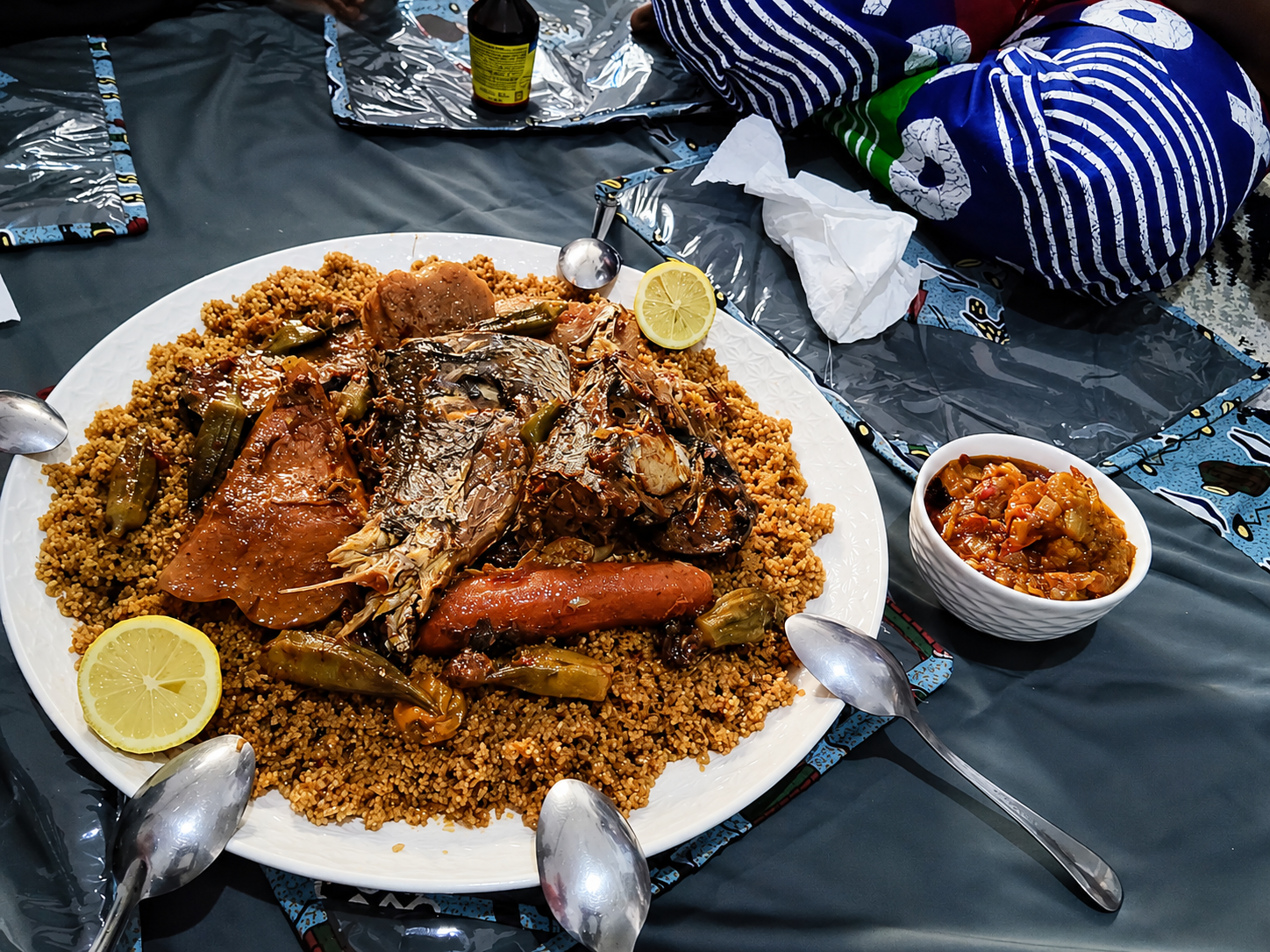
3.1. Peanut oil, basis of the continent's cuisine Peanut oil is the main cooking oil or one of the basic ingredients in dozens of major dishes. a) West Africa • Mafé: “national” dish of Mali, Senegal, Guinea, Burkina – stew of meat or fish, various vegetables, peanut broth (paste and oil), onions, tomatoes. • Peanut sauce from Ivory Coast, Guinea, Benin, Nigeria (groundnut soup): meat or fish simmered in a thick sauce of peanut paste and oil, served with rice, yam or cassava. • Tieb bou dien (thieboudienne, Senegal): rice with fish, vegetables and a peanut oil base that gives it its unparalleled shine and flavor. • Sauce graine (palm nut soup), sauce gombo (okra soup), soups, fonio, bean fritters (“akara”, “kosai”): everything starts with a good heating of peanut oil. • Frying: ideal oil for fritters (puff-puff, mikaté, chin chin, fried plantains, yam, fries). b) Central Africa • Ndolé (Cameroon): dish of bitter leaves, peanut paste and oil, meat or fish, shrimp or crustaceans. • Saka-saka (cassava leaves): peanut oil accentuates the flavor of pounded cassava, softens bitterness, enriches the dish. • Sauce jaune (yellow sauce), Mbongo tchobi (Cameroon, Gabon): caramelized colored oil, essential aromatic base, signature of “mamtis” (chef mothers). c) East, Southern Africa and islands • Less central than coconut or palm oil, but present in street food, fried foods, some curries inspired by the West African diaspora and even in urban innovation. 3.2. Ritual and culinary memory • The addition of peanut oil (“smoking the oil”) marks the beginning of the meal; the aroma of hot oil is often associated with childhood, home, and big celebrations. • Gesture of transmission: each generation learns to “touch the oil”, respect the temperature, avoid splashes, dose between economy and generosity. 3.3. Companion of daily life and celebration • Ordinary meal: the family pot for lunch, the next day's fritters, the wok of the small neighborhood shop, the delicacy of wedding or baptism sauces, welcoming dishes for foreigners. • Festive meal: the profusion of peanut oil on the table is a sign of generosity, wealth, respect for the guest.
In my books

Continue exploring the continent’s cuisines with Africa at the Table — 54 countries, 54 iconic dishes, by Alioune FALL. This book is in English.
Explore further
4. Economic, social and cultural dimension
4.1. Rural and urban engine • Peanuts, then their oil, provide a livelihood for millions of families: from producing farmers to processors, from selling traders to urban restaurateurs. • Currency of exchange (“my pot for your bottle of oil”), dowry tool (like salt or flour), requested gift when returning from the city or for religious holidays. 4.2. Influence on culinary art and innovation • Street food: any eatery worthy of the name owes its success to the quality of its oil. • Modern gastronomy: African chefs revisiting mafé, peanut vinaigrette, peanut oil emulsion, revisited couscous, desserts where the roasted flavor of this oil is found. • Packaging, branding, supermarket appearances, presence throughout the diaspora. 4.3. Heritage and identity • Peanut oil carries know-how, anecdotes (proverbs, bargaining songs, memories of scarcity or abundance, popular poems). • Rural identity (“whoever has no peanut oil, has no kitchen”), national identity (Senegal, Nigeria, Mali…).
5. Nutritional aspects and health
5.1. Composition and benefits • Fatty acids: oil rich in monounsaturated fatty acids (oleic acid), composition similar to olive oil, good for the heart, circulation, cholesterol (when consumed in moderation). • Rich in vitamin E (antioxidant), phytosterols, minerals. • Not prone to rapid rancidity: ideal for frying, high smoke point. 5.2. Limitations and contemporary issues • Risks if overconsumption (like any oil), especially cardiovascular diseases. • Caution for people allergic to peanuts (rare but increasing). • Risk of adulterated or “cut” oil in the informal market: necessary awareness of purity and quality. 5.3. Modern health issues • Trend towards importing cheaper and refined oils (palm, sunflower, soy), to the detriment of local peanuts. • Problems of adulteration (fraudulent mixtures), loss of taste, nutritional quality and local memory.
6. Contemporary challenges and perspectives
6.1. Preserving the local sector • Support for local production, short supply chains, organic sectors, traceability, modernization of production units. • Consumer education on quality, conservation, recognition of the “true” African taste. 6.2. Valorization and gastronomy • Promotion in haute cuisine, among urban youth, through festivals, culinary workshops, recipe competitions. • Export to the diaspora, “authentic Africa” branding. 6.3. Role in sustainability and food resilience • Low-demanding plant, nitrogen-fixing, ideal for degraded lands, factor of food sovereignty. • Conversion of co-products into animal feed or compost.
Conclusion Peanut oil is much more than just an ingredient in Africa: it embodies the collective memory of rural and urban cuisines, ancestral know-how and daily strength, the cooking of happiness and the richness of sharing. In every golden drop, one finds the courage of women, the genius of farmers, the gourmandise of families and the honor of a living heritage. Preserving, valuing, transmitting and modernizing peanut oil means guaranteeing both food balance, rural economy, hospitality and the creativity of an Africa which, in its pot, knows how to unite taste, health, dignity and celebration.
In the kitchen : Peanut oil
Recipes from the site to put your knowledge into practice:
Discover these cuisines at a restaurant
Explore our restaurant and caterer directories. Choose your destination and check the establishment’s menu to confirm which dishes are offered and available.
Continue exploring
Enjoy discovering ingredients and African cuisines? Join our newsletter. The illustrated PDF 10 sauces africaines incontournables is in French and is offered after confirming a subscription to the French or bilingual edition.