Guava
Central and South America
Understanding : Guava
Introduction
Guava (Psidium guajava) is one of the most versatile and appreciated fruits in many regions of Africa. Originating from the American tropics and the Caribbean, it has been acclimatized for centuries in African landscapes – from the bustling markets of Abidjan to the Creole gardens of Madagascar, from the orchards of the Ivorian coast to the plateaus of Kenya, and to the shores of the Maghreb. Its fragrant flesh, nutritional richness, its role in subsistence economy, and its culinary pleasure make guava a flagship ingredient, respected in both rural traditions and modern urban cuisine. Sometimes called “golden apple” or “tropical apple”, guava embodies the genius of botanical cross-breeding, family sharing, and culinary creativity, so characteristic of contemporary Africa. It is at once a childhood treat, a health asset, a pillar of fruit craftsmanship, and a vector for integrating global gastronomic trends.
Where to find it
Look for the exact food-grade form required by the recipe at markets and specialist shops. Check the product name, ingredients, condition and storage instructions.
Explore further: Cooking tips · Food hygiene and safety advice.
History and uses
1. Origins, spread, and variety of guava in Africa
1.1. American origins and African introduction Psidium guajava guava originates from Central and South America, where it has been cultivated for over 3,000 years. It arrived in Africa as early as the 16th century, via Portuguese, Spanish, and French navigators. Quickly, the first plants found their place in the Atlantic islands (Cape Verde, Canaries, Sao Tome), then in the major coastal regions of the continent: Gulf of Guinea, East Africa, Indian Ocean islands, Southern Africa, and the Red Sea. Subsequently, it spread to forests, roadsides, home gardens, and market gardens. 1.2. Botanical diversity Different species and varieties adaptable to Africa are distinguished: • Psidium guajava: the main one, common guava, round fruit with green, yellow or pinkish skin, white, pink or salmon-colored flesh, rich in seeds. • Psidium cattleianum (strawberry guava): smaller, purple-red or yellow, tart flesh (abundant in Madagascar and the Mascarene Islands). • Local varieties: white guava, apple guava, giant guava called “Baronne de Cap” (Madagascar), “Ruby Supreme” (South Africa, Kenya). • Numerous natural hybrids proliferate, sometimes considered wild species or “bush” fruits. 1.3. Growing conditions and adaptation • Climate: Guava is a plant of tropical/subtropical zones, but it adapts to warm temperate zones, up to 1,500 m altitude. • Soil: It tolerates poor, sandy, slightly acidic or alkaline soils, resists moderate drought, but performs best in rich, well-drained, and irrigated soil.
2. Cultivation, harvesting, and rural economy
2.1. Family and market garden cultivation • In Africa, guava is widely cultivated as a homestead fruit tree: it adorns domestic gardens, field borders, schools, hospitals, roads, sometimes as a defensive hedge. • It is both a “subsistence” fruit (no village in Benin, Côte d'Ivoire, Mauritius, Madagascar without guava) and a major fruit in urban markets. 2.2. Producers and economic sectors • Main African producing countries: Egypt, Kenya, South Africa, Ghana, Nigeria, Côte d'Ivoire, Madagascar, Morocco, Mozambique, Zimbabwe, Cape Verde, Reunion. • African guava is rarely exported (except to Southern Europe and the Middle East) but is conquering urban markets and local processing (juices, jams, purees…). • Growing market for women (gathering, selling in markets): remunerative activity or seasonal bartering, exchanges between villages, festivals, and ceremonies.
3. Culinary uses of guava in Africa
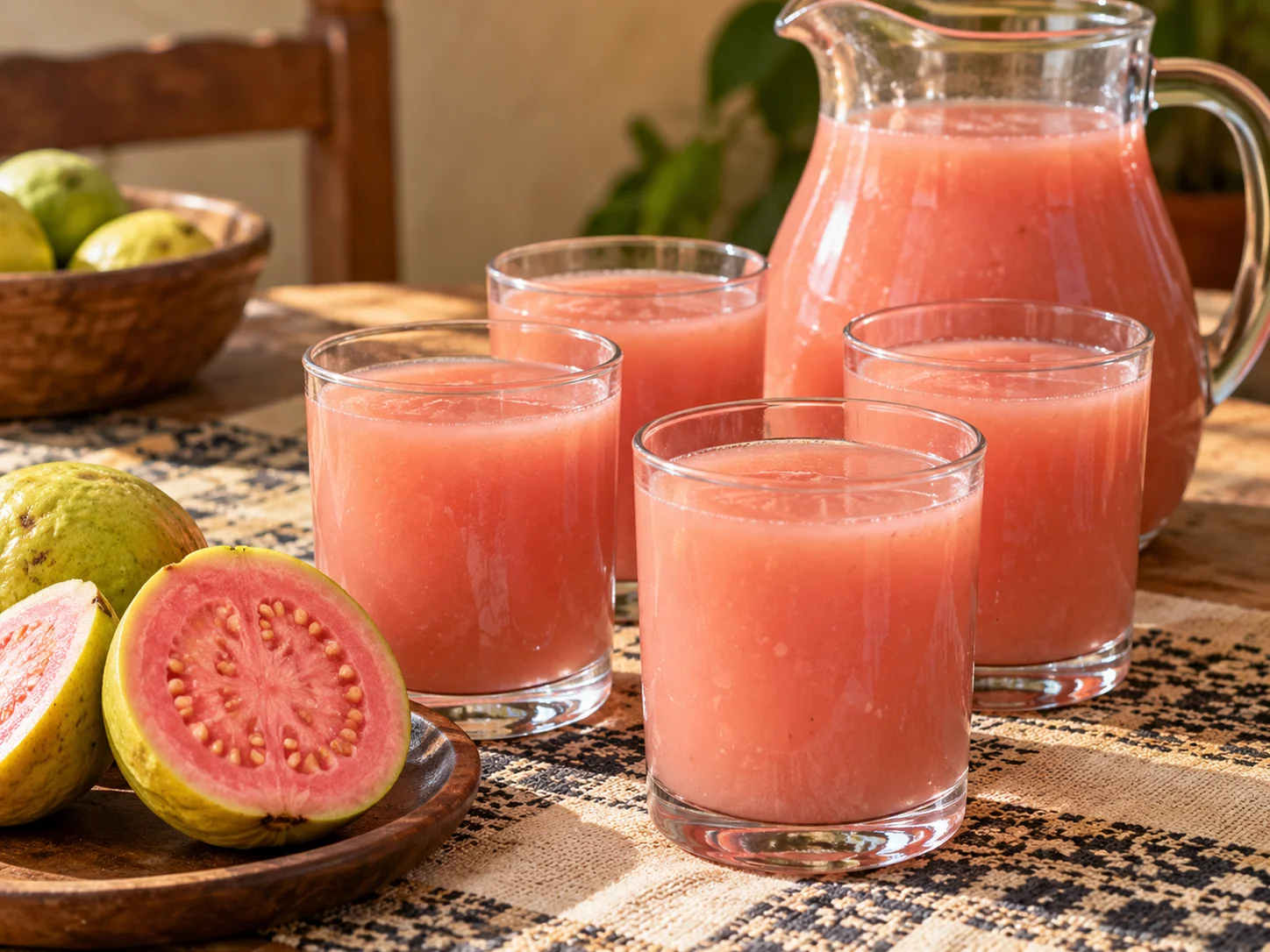
3.1. Consumption of fresh guava • To bite into: guava is eaten with or without skin, whole, split or cut into quarters, sometimes sprinkled with a little salt, chili, or sugar depending on the region. • Schoolchildren's snack: “peasant” fruit, cheap or even free, a delight for afternoon tea or the market, sold by the slice or by the piece. • Street snack: cut into thin slices, offered on the trays of itinerant vendors, seasoned with lemon, chili, salt, or icing sugar (Côte d'Ivoire, Nigeria, Ghana, Senegal, Madagascar, Kenya). 3.2. Juices and drinks • Guava juice: one of the most popular in Africa. Blended pulp, filtered or not, with added sugar, lemon, sometimes mint, ginger, or orange blossom water. • Smoothies and cocktails: mixed with banana, mango, papaya, condensed milk, lime. • Fermented drinks: in some areas, artisanal processing of guava into guava wine, punch, liqueur, or sweet vinegar. • Syrup: concentrated sweet syrup to dilute, base for children's drinks, frozen desserts. 3.3. Jams, jellies, fruit pastes, and desserts • Guava jam: an essential for urban breakfasts, sold in markets, or homemade by families. • Jelly (“guava jelly”): dessert or topping for toast, donuts, pancakes, cakes; a tradition inherited from Cape Verde, South Africa, Mauritius, Senegal, Ghana, Nigeria. • Guava paste: sweet, dried, sliced paste – snacked on as a treat. • Pies, crumbles, cakes: Afro-Western recipe combining tradition and modernity, very present in capital city pastries or in Afro-European fusion gastronomy. • Guava mousse, ice creams, sorbets, guava yogurts: gastro-industrial innovation for urban youth and the diaspora. 3.4. Savory dishes and condiments • Mixed salads: diced guava, with avocado, shrimp, onion, cucumber, lemon, sweet chili. • Chutney or pickles: grated green guava, vinegar, chili, syrup, onion, green mango (Indian influence on the east coast and islands). • Sauce for meat or fish: guava cooked with chili, tomato, ginger (marinade or exotic sauce for chicken, grilled fish, pork). • Sambos (savory pastries), samosas, accras (fritters), batbouts (Moroccan flatbreads) filled with sweet or spicy guava puree. 3.5. Use in street food and urban cuisine • Fruit skewers, “guava grills”: roasted or caramelized guava on beaches or markets. • Topping on donuts, pancakes, porridges. • Children's porridges enriched with guava pulp for vitamins, particularly in rural families.
In my books

Continue exploring the continent’s cuisines with Africa at the Table — 54 countries, 54 iconic dishes, by Alioune FALL. This book is in English.
Explore further
4. Nutritional and health benefits
4.1. Exceptional nutritional profile • Rich in vitamin C: guava surpasses orange, 100g can cover more than 200% of daily needs. • Source of dietary fiber: promotes transit, satiety, prevents constipation. • Vitamins B, A (beta-carotene), E, K: good for skin, eyes, immune system. • Potassium, magnesium, calcium, phosphorus, iron: useful for growth, muscle tone, blood pressure regulation. • Powerful antioxidants: lycopene, polyphenols – prevention of cardiovascular diseases, cellular aging, and even diabetes. • Low in calories, almost fat-free, suitable for diabetics and children. 4.2. Medicinal and ritual uses • Guava leaves: infusions against diarrhea, coughs, sore throats, as a mouthwash, or against wounds and skin infections (rural and urban use, recognized by WHO). • Used during purifications, in post-partum decoctions for its astringent properties. • Sometimes considered a “protective fruit”: carried in pockets by children to “protect themselves from diseases” (rural belief). • “Miraculous” rural recipe to calm fever in children.
5. Symbolism, transmission, and culture
5.1. Guava, fruit of sharing and memory • Fruit of generosity: guava is offered to visitors, at parties, to the neighborhood chief, to children during “school outings”. • Symbol of childhood: wild picking, memories of “guava hunting” at the market or beach, end-of-year festivities, religious celebrations. 5.2. Family transmission and know-how • Grandmother's knowledge: the art of choosing a ripe guava, cooking jam, preserving puree, drying slices in the sun. • Jam or “grandmother's jelly” competitions in some markets and villages (Cape Verde, Madagascar, Benin, Reunion).
6. Economic place and contemporary challenges
6.1. Rural development and employment • Interest in local processing: jams, juices, pulps, compotes, syrups: creation of female micro and small enterprises (MSEs), inclusion of guava in canteens, urban markets. • Introduction into public school food or health policies (for its nutritional properties). 6.2. Modernity, export, and innovation • Place in gastronomic catering: desserts, entremets, sauces, artisanal drinks, “fusion” innovation. • Growing offer of organic products, farmer labels, protected geographical indication (PGI) for certain guavas from West and Southern Africa. • Low but growing export to Europe and Southeast Asia. 6.3. Challenges • Vulnerability to certain diseases (flies, anthracnose, etc.), necessity of ecological and sustainable cultivation. • Conservation management, fight against waste (very perishable fruit), innovation in drying, pasteurization, valorization of “surplus” in artisanal/industrial processing.
Conclusion Guava, long considered a “modest” or wild fruit, is now recognized as a major asset of African cuisine: from childhood snacks to haute cuisine recipes, from village pots to festive buffets, from homemade jam to urban “healthy” drinks, it connects generations and spaces, strengthens health, and enriches the gastronomic diversity of the continent. Preserving, valuing, and transmitting the culture, uses, and processing of guava means celebrating a vibrant, audacious Africa, attached to its terroirs, always inventive – and eager, through this sun-kissed fruit, to offer the world the best of its flavors and traditions.
In the kitchen : Guava
Recipes from the site to put your knowledge into practice:
Discover these cuisines at a restaurant
Explore our restaurant and caterer directories. Choose your destination and check the establishment’s menu to confirm which dishes are offered and available.
Continue exploring
Enjoy discovering ingredients and African cuisines? Join our newsletter. The illustrated PDF 10 sauces africaines incontournables is in French and is offered after confirming a subscription to the French or bilingual edition.