Cashew nut
Brazil
Understanding : Cashew nut
Introduction
The fruit of patient labor in tropical orchards, the cashew nut is one of the rising stars of African agriculture. Originating from Latin America, acclimatized and then magnified in West Africa, Central Africa, and Madagascar, it embodies a modern narrative of agricultural conquests, economic resilience, culinary innovation… and gourmet pleasure. Crunchy, slightly sweet, subtly buttery, the cashew nut (or anacardium, or cashew apple nut) permeates daily African life: from the local market to street food, from the traveler's energy snack to the fusion dish of a cosmopolitan bistro, from fair trade to continental gastronomy. Over the years, it has established itself not only as a source of income and modernization for millions of rural families but also as an ecological, healthy, and unifying ingredient in African cuisine.
Where to find it
Look for the exact food-grade form required by the recipe at markets and specialist shops. Check the product name, ingredients, condition and storage instructions.
Explore further: Cooking tips · Food hygiene and safety advice.
Search Amazon.fr — affiliate link →
Check availability and delivery on Amazon.fr. Compare ingredients, packaging and sellers.
As an Amazon Associate I earn from qualifying purchases.
History and uses
1. Origins and history of the cashew nut in Africa
1.1. From the Caribbean to Africa Originally from the Brazilian Northeast, the cashew tree (Anacardium occidentale) arrived in Africa with Portuguese navigators in the 16th century. Appreciated for its rapid growth, drought resistance, and utility (wood, shade, erosion prevention, sweet-juiced cashew apple), it was first introduced in Lusophone colonies (Guinea-Bissau, Mozambique, Angola, Cape Verde), then spread to Francophone, Central, and East Africa from the 19th and 20th centuries. 1.2. Growing dominance and economic revolution It was only in the 1970s-1990s that the cashew nut entered its period of industrial and commercial boom, driven by global demand (USA, Europe, India, China). Production and processing became crucial economic stakes for Benin, Burkina Faso, Ghana, Ivory Coast, Nigeria, Mali, Tanzania, Guinea, Senegal, Mozambique, Madagascar… Today, West Africa alone produces more than 50% of the world's raw cashew nuts. Ivory Coast ranks first (over 1 million tons/year), followed by Nigeria, Benin, Guinea-Bissau, Ghana, Mozambique, etc.
2. The tree, the fruit, the nut: botany and production
2.1. The cashew tree and its products • The cashew tree is a resistant tropical tree, tolerant to drought, widely used for shade, soil stabilization, and reforestation. • The cashew “fruit” is double: the cashew apple (a juicy false fruit, golden yellow or red, rich in vitamin C, consumed fresh or as juice) and the nut (a reticulated seed housed in a hard, toxic-to-handle shell, hence the importance of artisanal or semi-industrial processing). • After drying, roasting, shelling, and peeling, the nut becomes the famous cashew kernel: crunchy, rich, golden. 2.2. Producers, rural issues, and sectors • Small family farms, rural cooperatives, and agro-industrial companies all invest in cultivation, manual harvesting, solar drying, and processing. • Long and sometimes arduous work, but it creates jobs for women (shellers, sorters, packers) and food-producing activities. • Annual harvests spread from February to June depending on the country, transforming villages and small towns into vibrant centers of commerce and life. 2.3. Local processing and challenges For a long time, almost all African nuts were shipped raw to Asia (especially India and Vietnam) to be shelled there, depriving Africa of added value. Today, the rise of local processing units, organic and fair trade labels, and regional trade is changing the situation: from Benin to Ivory Coast, more and more nuts are shelled locally, creating jobs, promoting “made in Africa,” and diversifying food.
3. Nutritional value and health benefits
• Very rich in unsaturated fats (good for cardiovascular health), vegetable proteins (18%), magnesium, phosphorus, iron, zinc, copper, potassium, vitamins E, K, B6. • High intake of antioxidants, flavonoids, arginine (beneficial for circulation). • High calories (around 550 kcal/100g), but low glycemic index, satiating and energizing effect; perfect for athletes, children, pregnant women, in addition to African cereals. • Cholesterol-free, gluten-free: suitable for many specific diets.
4. Place in African cuisine: tradition, modernity, innovation
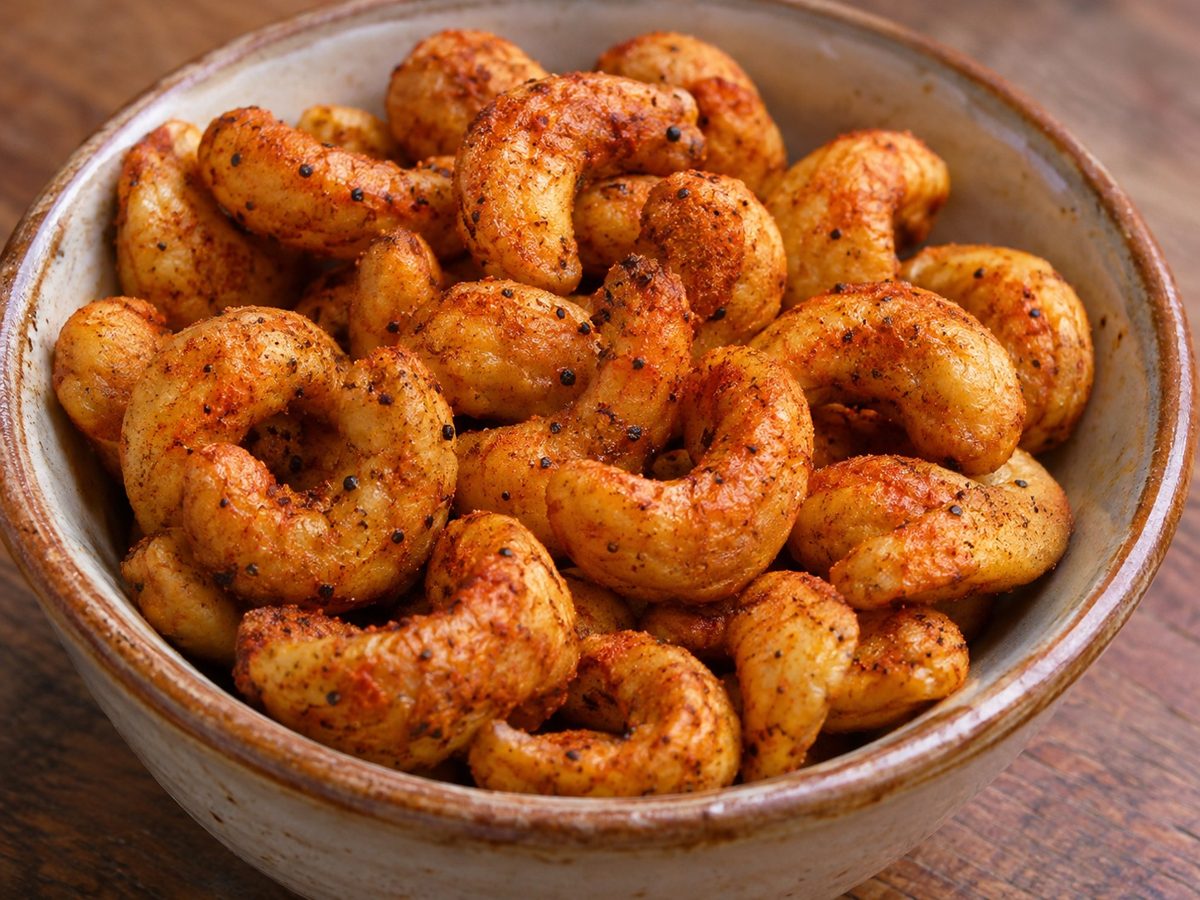
4.1. Snack and street food • Salted or plain roasted cashew nuts: sold by the handfuls in markets, on beaches, during transport (bush taxis, urban buses), in festive areas, or urban gas stations. • Spicy: mixed with chili, brown sugar, ginger, black pepper (“spicy,” “sweet,” “caramelized” cashew). • Coated: with some vendors, caramelized nuts, with chocolate, cinnamon, powdered milk, urban innovation inspired by Asian or Brazilian street food. 4.2. Aperitif, celebration, hospitality • Appetizers at weddings, baptisms, traditional festivals (Eid, Christmas, Ramadan): platter of dried fruits, cashew nuts, peanuts, almonds, raisins, dried bananas. • Welcome offering: symbol of refinement, abundance, openness. • Social gift: offered to neighbors, upon return from travel, family gatherings, a sign of respect. 4.3. Ingredient in modern African recipes a) Salads and bowls • Crunchy salads: chopped cashew nuts in salads of tomatoes, avocado, mango, citrus, shrimp, alloco (fried plantain), fonio (a type of grain), attiéké (cassava couscous). • Poké bowls, vegetarian bowls: combined with pineapple, moringa, African quinoa, sweet potato. b) Hot dishes and stir-fries • Rice stir-fries (Ivorian “Cantonese rice,” West African fried rice). • Cashew chicken or fish: whole or crushed cashew nuts in the sauce (sometimes inspired by Indian cuisine). • Couscous or Moroccan tagine: cashew nuts combined with lamb, dates, raisins, carrots, spices. • Revisited Yassa (a spicy marinated poultry or fish dish), Mafé (peanut stew), or Vagy Nyam Pilé (a traditional dish), with a touch of crushed cashew to thicken and flavor. c) Spreads, pesto, butters • Cashew butter: local alternative to peanut butter, used on bread, in sauces and curries, in pastries. • African pesto: crushed cashew nuts, local basil, olive or peanut oil, garlic, chili: spread for skewers, grilled fish, or raw vegetables. d) Pastries and desserts • Cakes and cookies: whole or powdered cashew nuts, cakes, cookies, combined with plantain, African cocoa, coconut. • Energy bars, granolas, healthy snacking in schools, canteens, businesses. • Ice creams, entremets, homemade confectionery: vanilla-cashew ice cream, cashew nougatine, shortbread. 4.4. Modern street food and fast food • African hamburger: cashew mayonnaise, crispy topping of nut pieces, cashew ‘veggie burgers,’ attiéké-cashew tacos. • Afro-urban bowls: fonio, avocado, crunchy vegetables, chopped cashew, and ginger vinaigrette. • Cashew dips: creamy sauce for samosas, fritters, skewers. 4.5. Integration into international/diaspora cuisines • African diaspora: Afro-Parisian, Londonian, New Yorker chefs magnify cashew in fusion dishes: risottos, curries, creams, truffles, “cashew-miso” or “cashew-bissap” sauces.
In my books

Continue exploring the continent’s cuisines with Africa at the Table — 54 countries, 54 iconic dishes, by Alioune FALL. This book is in English.
Explore further
5. Social, symbolic place, and local economy
5.1. Employment, empowerment, equity • Women and youth use the cashew sector as a springboard (picking, processing, selling, crafts, export). • Fair trade markets, producer cooperatives, organic labeling, and “fair price” are gaining momentum and improving rural resilience. 5.2. Contemporary symbolism • Cashew is increasingly seen as a “fruit of modernity,” economic integration, African excellence, and culinary creativity. • Offering cashew nuts at a wedding or celebration is to “wish success, fertility, prosperity.”
6. Contemporary issues and challenges
6.1. Environmental and social problems • Deforestation, monoculture, water pressure: the need for agroecological practices (rotation, agroforestry, permaculture, reasoned management). • Exploitation of women, worker safety, fight against precariousness in the informal sector against large foreign exporters. 6.2. Industrialization and added value • Increase local processing (shelling, roasting, packaging), investment in quality, international standards, professional training. • Invest in its “co-products”: juice, jam, vinegar, cashew apple alcohol (the "caju"), kernel oil (cosmetics, cooking), use of pomace for animal feed or fertilizer. 6.3. Awareness and nutrition • Place cashew at the heart of the fight against malnutrition (children, pregnant women, athletes). • Promote cashew as a local “superfood” among urban youth, in schools, collective catering, NGO nutritional programs.
Conclusion The cashew nut embodies more than the simple pleasure of a crunchy snack: it symbolizes the African capacity to welcome, acclimatize, cultivate a global product to transform it into local wealth, a family pillar, an employment driver, a culinary icon of well-being and celebration. Rooted in the bush, celebrated in the city, innovative in dishes as well as in processing, it opens the horizons of African cuisine to innovation, export, and the dream of a nourishing, equitable, bold food future. Preserving and developing the cashew sector, cooking, transmitting, and celebrating its thousand uses means guaranteeing Africa the pride of its lands and the joy of its tables.
In the kitchen : Cashew nut
Recipes from the site to put your knowledge into practice:
Discover these cuisines at a restaurant
Explore our restaurant and caterer directories. Choose your destination and check the establishment’s menu to confirm which dishes are offered and available.
Continue exploring
Enjoy discovering ingredients and African cuisines? Join our newsletter. The illustrated PDF 10 sauces africaines incontournables is in French and is offered after confirming a subscription to the French or bilingual edition.