Bicycle Chicken
West and Central Africa
Understanding : Bicycle Chicken
Introduction
In the gourmet and social imagination of West and Central Africa, bicycle chicken occupies a unique place, both familiar and mythical. Behind this mischievous name lies a farm chicken, raised outdoors, embodying rusticity, authentic flavor, and conviviality. Much more than a simple food, bicycle chicken is a symbol of an Africa attached to its land, to traditional agro-pastoralism, to celebration, to hospitality, and to community generosity. Raised in villages, markets, or family compounds, trained to peck freely, bicycle chicken is in every way opposed to industrial “broiler” chicken: it is smaller, muscular, firm, and its meat develops a powerful taste and an inimitable texture. It is found at the heart of all major celebrations – baptisms, weddings, religious festivals – but also in daily life, street food, family cooking, or African haute cuisine which proudly reinvents it.
Where to find it
Look for the exact food-grade form required by the recipe at markets and specialist shops. Check the product name, ingredients, condition and storage instructions.
Explore further: Cooking tips · Food hygiene and safety advice.
History and uses
1. Origin and meaning of the term “bicycle chicken”
1.1. Linguistic and sociocultural origins The expression “bicycle chicken” finds its roots mainly in Francophone West Africa (Côte d'Ivoire, Senegal, Guinea, Mali, Burkina Faso, Benin, Togo, Cameroon, Congo, Gabon…). It comes from the traditional method of transporting this chicken, which was often carried alive, tied to the handlebars or luggage rack of a bicycle from villages to markets or large cities. But above all, the name evokes the contrast between this “country” chicken – raised outdoors, always on the move to peck, run, jump – and the “broiler” or “industrial chicken”, battery-farmed, often fatter, with less developed muscles and blander flesh. 1.2. Identity and valorization of rural heritage For many, bicycle chicken refers to “real African life”: that of the fields, the farmyard, respect for traditions, food self-production, the central role of the family in raising and transmitting flavors, far from food globalization and its excesses.
2. Biological characteristics and breeding
2.1. Morphology and rusticity • Non-hybrid local breed: it does not belong to varieties selected by the agro-industry. • Small to medium size (1-2 kg adult). • Varied plumage (black, white, red, variegated), bright comb. • Natural aptitudes: great mobility, disease resilience, heat resistance, diversified diet (grains, insects, greenery, household waste, etc.). • Firm and muscular meat, low in fat, robust bones. 2.2. Breeding methods • Extensive and semi-extensive farming: freedom of movement, no suffocating enclosures or artificial light. • Mixed diet: meal leftovers, corn, millet, cassava, leaves, tubers, sometimes natural supplements (worms, ants, termites). • Slow growth cycle: slaughtered at 6 months or more (compared to 6-10 weeks for broiler chicken). • Transhumance: chickens sometimes entrusted to children, or even women during travel or field work. • Social role of the female breeder: transmission, economic, prestige and family know-how.
3. Place in African society, economy and symbolism
3.1. Medium of exchange and social capital • Dowry, ceremonies, funerals, weddings, hospitality: offering a bicycle chicken, both alive and cooked, is a sign of deep respect. • Barter (for flour, millet, fabric, livestock), gift during disputes or reconciliations. • Source of empowerment: women raise and sell chickens to pay for schooling, care or equipment. • Village savings: the chicken as a “living bank”, a safe haven against unforeseen events. 3.2. Cultural pride and identity • Appears in proverbs, songs, tales (“the village rooster”, “the bride's hen”). • Embodies resilience, resourcefulness, the ability to feed even in times of crisis. • Participating in the slaughter of a bicycle chicken is an initiation ritual for children and adolescents.
4. Gastronomy and culinary uses
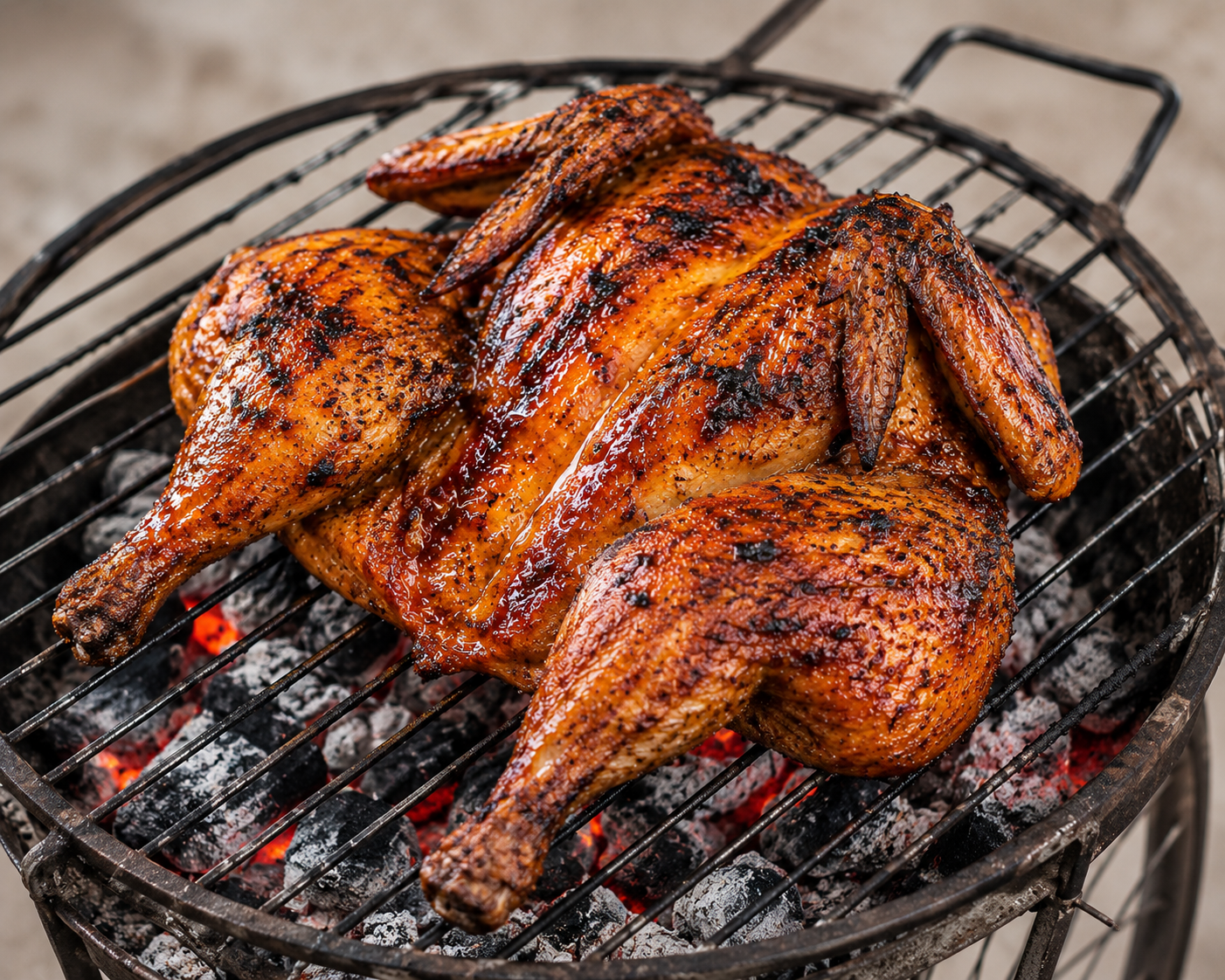
4.1. Emblematic preparations a) Braised chicken (most popular) • Preparation: the bicycle chicken, gutted, deboned (sometimes kept whole), marinated for several hours in a mixture of garlic, ginger, chili, mustard, lemon juice, bouillon cubes, onions, herbs (parsley, thyme, basil). • Cooking: slowly grilled over charcoal, sometimes covered with hot sauce or flavored oil, turned to brown each side, basted at the end of cooking, often served very dry to contrast with the juiciness of broiler chicken. • Accompaniments: alloco (fried plantain), attiéké (cassava semolina), rice, chili sauce, raw vegetable salad, caramelized onions. b) Yassa chicken (Senegal, Guinea, Mali, Côte d'Ivoire) • Long marinade in lemon, mustard, garlic, onion. • Slow cooking over charcoal, then simmered with caramelized onions, olives, carrots, white rice. • Bicycle chicken specificity: the firmness of the meat gives a “festive” dimension to the dish and allows for a particularly flavorful sauce. c) Chicken DG (Directeur Général, Cameroon, Gabon) • Bicycle chicken cut, fried then simmered with tomato sauce, peppers, ripe plantain, herbs, sometimes carrots or potatoes. • Symbolizes the “prestige” of the dish, social success, often reserved for special occasions. d) Chicken in peanut sauce (mafé, kedjenou, sauce graine) • Adapted from traditional recipes, where the texture of the bicycle chicken, which does not fall apart and absorbs the intense flavors of the sauce well, is appreciated. e) Chicken in broth, stew, soup • Often prepared for the elderly or sick, as the marrow provides restorative virtues, the firm flesh encourages chewing and slowness. 4.2. Street food and convivial hotspots • Chiccos, maquis (open-air restaurants), open-air grills: grilled bicycle chicken, cut with a machete, served piping hot on a board or plastic plate, shared among friends, colleagues, families during lively evening hours, to the sound of music and discussions. • Culinary festivals, competitions: best marinade, best braising, neighborhood or women's association contests. 4.3 Urban gastronomy and diaspora • Many African chefs revisit bicycle chicken: tagines, confits, broths, skewers, revisited spring rolls or tacos, drawing inspiration from its firmness and inimitable taste to sublimate modern African or “Afro-fusion” cuisine in Paris, Abidjan, Dakar, London or Montreal.
In my books

Continue exploring the continent’s cuisines with Africa at the Table — 54 countries, 54 iconic dishes, by Alioune FALL. This book is in English.
Explore further
5. Nutritional value
• Lean meat, high protein content, low in saturated fats. • Rich in essential amino acids, trace elements (zinc, iron, phosphorus). • Richer in taste, collagen, certain B vitamins, than “broiler” chicken meat.
6. Issues, challenges and perspectives
6.1. Preservation of local breeds and village economies • Fight against the disappearance of bicycle chicken in the face of more profitable imported agro-industrial channels (broiler chicks, rapid growth). • Promotion of short supply chains, traditional farming, quality labels (“farm chicken”, “terroir label”), economic incentives, rural microcredit programs for women. 6.2. Food security, biodiversity and consumer health • Preserve genetic diversity against epidemics, increased resilience. • Healthier meat, few antibiotic or hormone residues. • Better adaptation to climate change. 6.3. Modernity, transmission and innovation • Inclusion in modern restaurants, food trucks, fusion gastronomy. • Education of young generations in traditional farming and cooking, culinary workshops, village festivals honoring bicycle chicken. • African diaspora promoting this emblematic chicken internationally (chicken festival, cooking shows, trending food social networks).
Conclusion Bicycle chicken is not just an animal or just a fiercely appreciated dish: it embodies the strength of everyday life, the memory of African land, family warmth, the creative modernity of an Africa that draws on its agriculture, its traditions and its actions to innovate and shine. A symbol of sharing, authentic flavor, resilience and conviviality, it continues to unite youth, families, restaurateurs and culinary creators from here and elsewhere. Preserving, cooking, transmitting and valuing bicycle chicken means defending a plural food identity, supporting rurality, biodiversity and equity, and offering the world a living, gourmet, inimitable gastronomy, proud of its roots and oriented towards the future.
In the kitchen : Bicycle Chicken
Recipes from the site to put your knowledge into practice:
Discover these cuisines at a restaurant
Explore our restaurant and caterer directories. Choose your destination and check the establishment’s menu to confirm which dishes are offered and available.
Continue exploring
Enjoy discovering ingredients and African cuisines? Join our newsletter. The illustrated PDF 10 sauces africaines incontournables is in French and is offered after confirming a subscription to the French or bilingual edition.