Carrot
Central Asia
Understanding : Carrot
Introduction
The carrot (Daucus carota subsp. sativus), with its vibrant color, crunchy texture, and bittersweet flavor, has become an essential vegetable in Africa. While its historical roots lie in Central Asia, it was trade routes, migrations, and agricultural conquest that brought it, over centuries, to African markets, gardens, tables, and cooking pots. Today, the carrot symbolizes the balance between tradition and modernity, healthy eating and gourmet pleasure, rurality and urbanity. Present in everyday dishes, family feasts, street food, and festive meals, it embodies the ability of African cuisines to absorb, adapt, magnify the external, and make it a local resource. Let's explore the history, uses, nutritional values, symbolism, and modernity of the carrot in Africa.
Where to find it
Look for the exact food-grade form required by the recipe at markets and specialist shops. Check the product name, ingredients, condition and storage instructions.
Explore further: Cooking tips · Food hygiene and safety advice.
History and uses
1. Origins, history, and spread in Africa
1.1. From Asia to Africa: a traveling root The carrot originated in Central Asia (Afghanistan, Iran), where it grew wild. Already cultivated 2000 years ago, its initial dark purple, eggplant, or yellow form bore little resemblance to the modern orange carrot. Through exchanges between East and West, via Persia, the Mediterranean, and then thanks to the Arab conquest, the carrot reached North Africa in the Middle Ages. It adapted perfectly to the irrigated gardens of the Maghreb, then gradually descended towards the Sahara, the oasis areas, and finally crossed the Sahel and spread to the mountainous and temperate regions of sub-Saharan Africa. European colonists, in the 19th and 20th centuries, reinforced its spread to West and East Africa, introducing popular orange varieties: Nantes, Chantenay, Touchon... Today it is cultivated across most of the continent, seasonally or under irrigation. 1.2. Adaptation and varietal diversity In addition to the majority orange varieties, Africa also cultivates: • the white or pale yellow carrot (North Africa, Sudan, Uganda), • the purple or violet carrot, a legacy of ancient varieties or a remnant of oriental introductions, • in oases, short, massive carrots, adapted to aged sands and early or repeated harvesting. Climate, soil types, irrigation techniques – or the simple practice of urban terrace farming – have forged a surprising palette of “carrot terroirs”, from the mountains of Rwanda to the oases of the Sahara, from the Nile valleys to the peri-urban gardens of Dakar, Casablanca, Nairobi...
2. Cultivation routes and economic impact
2.1. Cycle and cultivation techniques • Sown directly or transplanted, the carrot has a short cycle (2-3 months for early varieties), suitable for crop successions or associations: it is sown in association with onion, turnip, leek, lettuce, zucchini. • Requires light, loose soil, regular irrigation, tolerates the coolness of desert or high-altitude nights. • In urban market gardening areas (Ivory Coast, Nigeria, Senegal, Morocco, Ethiopia, Kenya...), it is cultivated all year round, germination and harvesting are facilitated by the use of hybrid or local seeds. 2.2. Socio-economic importance • Profitable product per kilo, short cycle, stable prices in urban and rural markets – an asset for tens of thousands of small market gardeners, women, young entrepreneurs. • Often a transitional resource: it provides seasonal income, secures diversification against climatic or economic hazards. • Income for cooperatives, early vegetable growers, street vendors who sell it peeled, grated, in sachets at market crossroads.
3. Nutritional value: the carrot, a healthy root
3.1. Nutritional profile • Rich in beta-carotene (a precursor to vitamin A), which gives it its orange color and provides recognized benefits for night vision, immunity, skin, and growth. • High fiber content (soluble and insoluble), which promotes digestion, satiety, and transit regulation. • Good source of vitamins C, B6, K, folic acid, and minerals (potassium, iron, manganese, calcium). • Low caloric intake (35 kcal/100g), low glycemic index, an asset for diabetics, seniors, overweight or at-risk individuals. • Lutein, zeaxanthin, anthocyanins (for purple carrots), protective antioxidants. 3.2. Health benefits and therapeutic uses • Popular “remedy” to strengthen eyesight, post-illness recovery, prevention of childhood blindness (widely used by NGOs fighting malnutrition and vitamin A deficiency). • Grated or cooked carrot given to children during weaning or to relieve diarrhea. • Traditional carrot broth for convalescence, detoxification, fasting, and Ramadan cures.
In my books

Continue exploring the continent’s cuisines with Africa at the Table — 54 countries, 54 iconic dishes, by Alioune FALL. This book is in English.
Explore further
4. Culinary uses and regional expressions
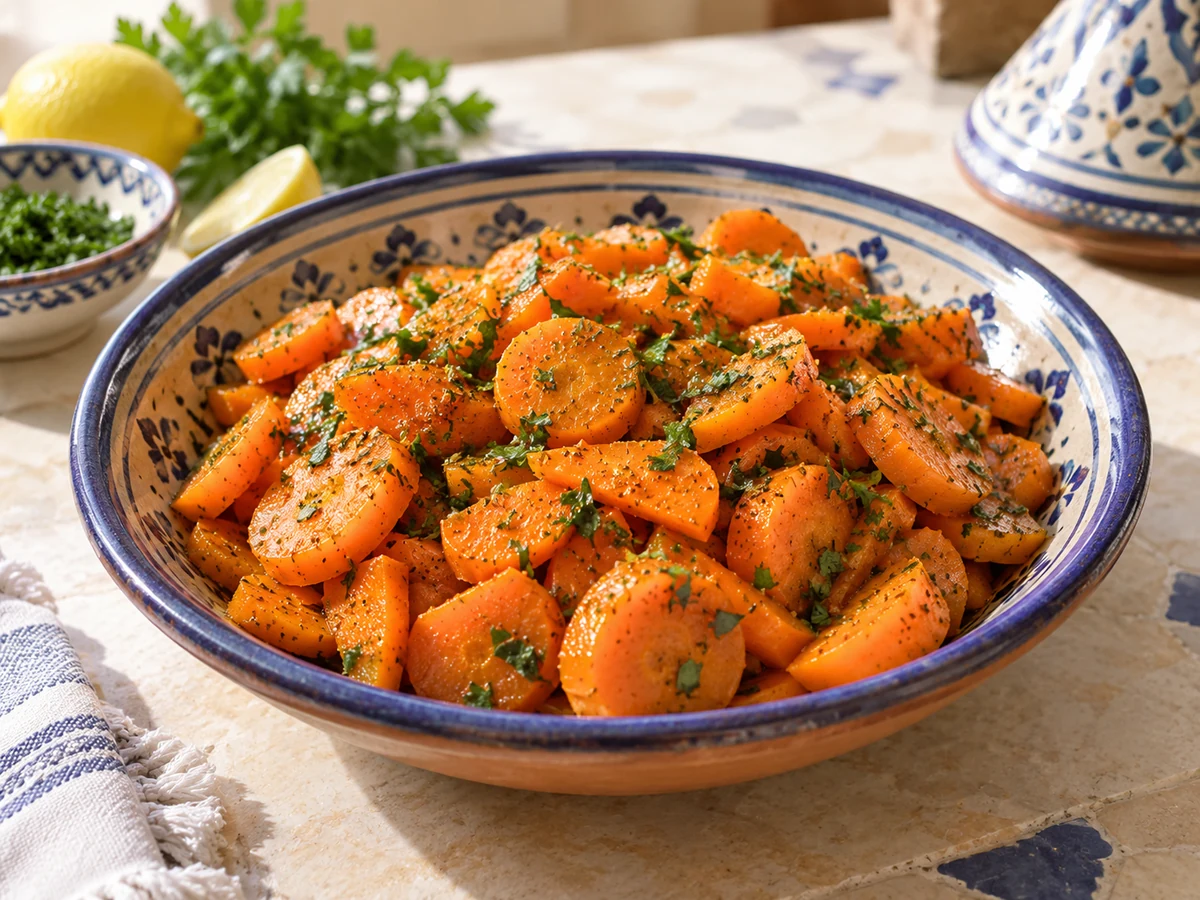
4.1. North Africa: from couscous to street-salad • Maghrebi couscous: the carrot, with turnips, zucchini, potatoes, chickpeas, is a pillar of couscous vegetables, slow-cooked in saffron or spiced broth. • Tagine (lamb, chicken, fish, minced meat): it provides tenderness or crunch depending on the cut. • Candied carrots: sautéed in cinnamon, cumin, honey, ginger, a side dish during Ramadan, Jewish holidays, weddings. • Cold salads: grated carrot with lemon, cumin, coriander, and olive oil, a refreshing appetizer from markets in Casablanca, Fez, Tunis, Algiers. • Street food: sachets of grated carrot, lupin, olives near schools, sold as a healthy snack by itinerant women vendors. 4.2. West and Central Africa: a root of conviviality • Tomato-chili sauce: from Abidjan, Lomé, Cotonou, Dakar, the carrot accompanies rice, cassava, fonio (a type of grain); simmered, it melts into the sauce, mixing with fish, chicken, beef, lamb. • Stews (mafé (peanut stew), peanut sauce, leaf sauce): carrot chunks for color, sweetness, texture, the base of the “Sunday sauce”. • Alloco-carrot: urban variation (Abidjan), fried carrot combined with plantain. • Purees and patties: in school canteens, early childhood cuisine, spiced carrot patties with local cereal or sweet potato. • Snacks and “croquettes”: carrot mixed with potato, onion, parsley, fried or baked, sold in markets. • Riz au gras (fatty rice), jollof rice, attiéké (cassava couscous) garnished with vegetables: the carrot, an essential ingredient in Ivorian and Senegalese festive dishes. 4.3. East Africa, islands, Madagascar • Swahili curries: carrot with potato, onion, coconut milk, turmeric, spiced broth. • Samosas, fritters: grated carrot mixed with meat, chickpeas, potatoes, spices, stuffed into a crispy pastry. • Soups and broths: carrot puree, light velouté, “carrot soup” from hotel brunches in Nairobi, Addis Ababa, Antananarivo. • Malagasy stews: carrot with meat, garden vegetables, onions, tomato, boiled for a long time in "romazava" or "ravitoto". 4.4. Urban modernity and contemporary gastronomy • Juices and smoothies: pressed carrot, pure juice, mixed (ginger, orange, apple, moringa). • Mixed salads, tartares, dips, tapenades: carrot in thin slices, julienne or cubes, essential for corporate buffets, schools, hotels. • Cakes and pastries: imported “carrot cake”, reinterpreted African-style with cashews, macadamia, coconut, hibiscus jam, spices.
5. Social role, transmission, and symbolism
5.1. Collective food and bonds of solidarity • Often integrated into the family pot, it allows a meal to be “stretched”, adding color and consistency to the sauce, to feed a larger number of guests. • In villages, children and women participate in harvesting, peeling, preparation, transmitting taste and gestures. • Expression of “cuisine of generosity”: a large pot of carrot sauce to celebrate, welcome, feast. 5.2. Transmission and know-how • Knowledge of how to plant and recognize a good carrot (“crunchy, not hollow, sweet”) passed down from generation to generation; cooking secrets (not overcooking, maintaining color), the art of cutting, seasoning. • Carrot as the first vegetable given to children to taste, weaning puree. 5.3. Symbolism and proverbs • Symbol of patience ("He who plants the carrot is sure to see color in his pot"). • Proverbs of economy ("He who mixes carrot and potato never lacks sauce") or prevention ("Carrot in the sauce chases away village illness").
6. Innovation, sectors, and perspectives
6.1. Modern sectors and development • Urban agriculture: cultivation of carrots on rooftops, in bags, in community gardens for youth and women. • Diversification of products: carrot chips, frozen puree, jam and pastry creams, carrot oil (cosmetics). • NGO initiatives: inclusion in school canteens, distribution in areas at risk of malnutrition. 6.2. Gastronomy and “fusion food” • Panafrican chefs reinvent the carrot: carrot gazpacho with bissap (hibiscus drink), sweet and savory tagine, carrot tartare, carrot-coriander-pineapple couscous. • Present in “finger food”, appetizer bites, healthy hunger suppressants. • Place in modern “flexitarian”, vegan, or nutritious cuisine.
Conclusion The carrot, a root from elsewhere that has become a local pride, has become central to African cuisine due to its versatility, nutritional richness, vibrant color, and ability to bring people together. It accompanies celebrations, heals, satisfies, teaches patience, and recalls the intelligence of African terroir in the art of nourishing, innovating, and sharing. Family cuisine or haute gastronomy, canteen or street food, the carrot embraces the thousand faces of nourishing Africa – open, joyful, inventive, and focused on health and pleasure. Preserving, transmitting, and magnifying the place of the carrot means investing in the vitality, diversity, and food genius of the continent, for today and for tomorrow.
In the kitchen : Carrot
Recipes from the site to put your knowledge into practice:
Discover these cuisines at a restaurant
Explore our restaurant and caterer directories. Choose your destination and check the establishment’s menu to confirm which dishes are offered and available.
Continue exploring
Enjoy discovering ingredients and African cuisines? Join our newsletter. The illustrated PDF 10 sauces africaines incontournables is in French and is offered after confirming a subscription to the French or bilingual edition.