Yovo Doko
Benin
Understanding : Yovo Doko
INTRODUCTION
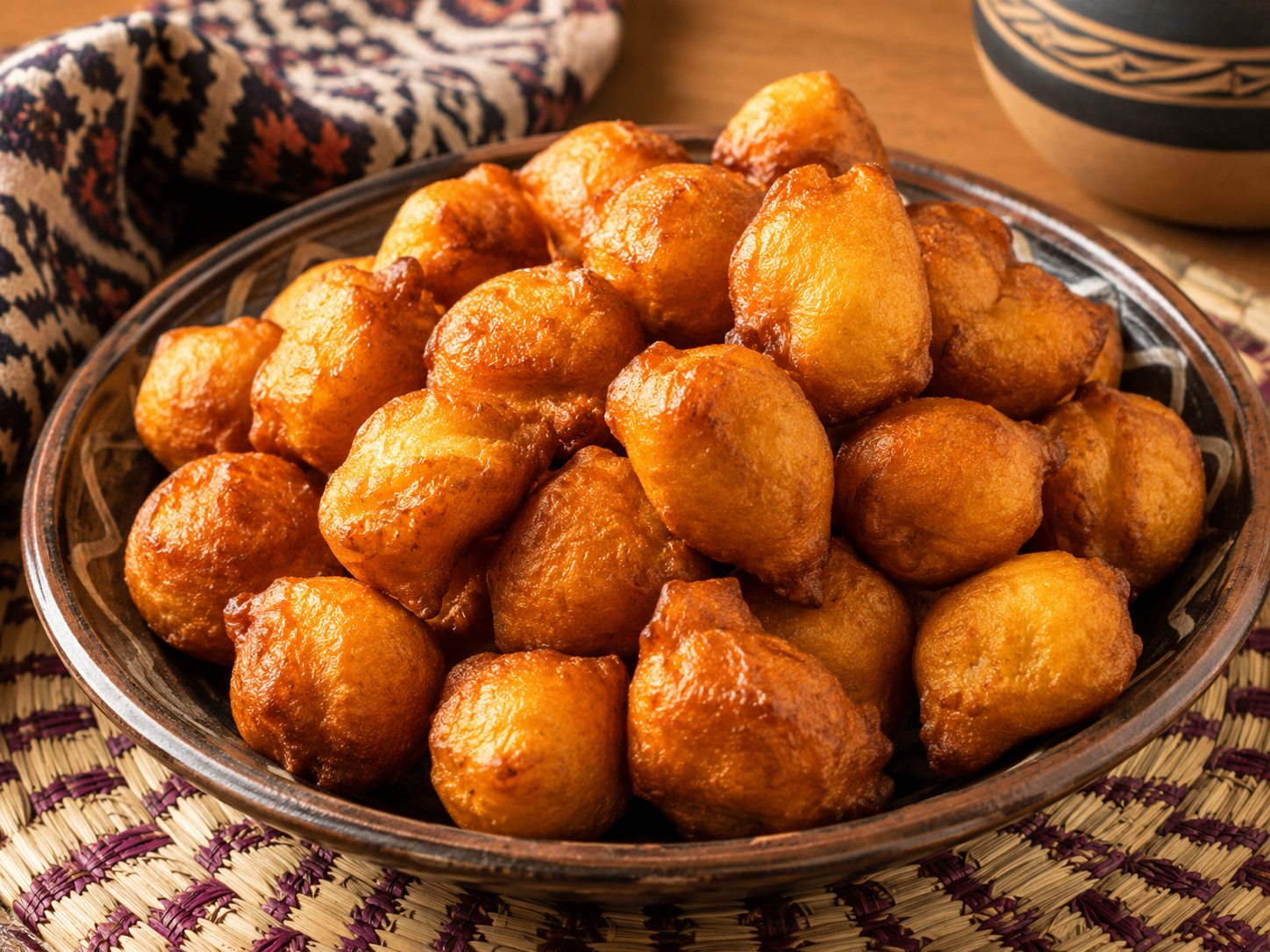
In the bustling landscape of small African street food delights, the yovo doko holds a special place. This doughnut (often known by other regional names: botokoin in Togo, bofrot in Ghana, puff-puff in Nigeria and Cameroon, mikate or sweet doughnut in Congo, gbofloto in Ivory Coast, etc.) embodies simplicity, generosity, creativity, and popular roots. It is a must-have for breakfast, breaks, parties, or gatherings with friends. More than just a treat, it crystallizes values of sharing, economic resilience, and inventiveness, carving out its space in urban modernity and rural transmission.
Prepare this speciality
Choose a detailed recipe, adjust the portions and prepare your ingredients before starting. Our cooking tips and food safety advice complement the steps described in the recipes.
Explore further: Cooking tips · Food hygiene and safety advice.
History and uses
1. HISTORY, ORIGINS AND SPREAD
1.1. One name, multiple roots The term “yovo doko” comes from southern Benin, mainly in the Fon and Goun areas of Cotonou, Porto-Novo and surroundings, and literally means “white man's doughnut” (yovo = European/foreigner, doko = doughnut). This appellation, full of irony and self-deprecation, recalls that the recipe hybridized from imported pastry, to which African cooks brought their know-how and adapted according to available local ingredients. 1.2. A pan-African recipe Even if “yovo doko” evokes Benin, the recipe, its variations, and its culture are common to many West and Central African countries, each region having appropriated it: botokoin (a type of doughnut) in Togo (literally “mixed leftovers”), bofrot (a type of doughnut) in Ghana, puff-puff (a type of doughnut) in Nigeria and Cameroon, gbofloto (a type of doughnut) in Ivory Coast, mikate (a type of doughnut) in Congo. This doughnut spread with urbanization, trade, and internal and regional migration, becoming a staple at bus stations, markets, schools, ceremonies, and urban brunches. 1.3. From home to street: the yovo doko craft Originally produced in families for children or during celebrations, the yovo doko quickly became an informal pillar of urban breakfast and popular snacking, embodying the dynamism of street food, mainly run by women.
2. INGREDIENTS, TECHNIQUES AND VARIATIONS
2.1. Basic ingredients Ingredients are simple and widely available: • Wheat flour (white, sometimes mixed with corn or millet in rural areas) • Sugar • Baker's yeast (dry or fresh) • Lukewarm water (sometimes milk or powdered milk) • Salt • Vegetable oil (for frying) • Optional flavoring: ground nutmeg, vanilla, lemon zest, sometimes a hint of ginger or anise depending on the family Some enrich the recipe with an egg or a little butter/margarine for a “luxury” version. 2.2. Traditional preparation technique Success lies in mastering the dough and cooking:
- Knead the dough: mix flour, salt, sugar, yeast previously activated in lukewarm water (and possibly milk). Some add the egg or butter at this stage.
- Rest: the dough, once homogeneous and supple, must rise away from the air, sometimes under a cloth at warm temperature, for one to two hours until it doubles in volume.
- Shaping: the dough is taken by hand, in small balls or with a wet spoon, dropped directly into the oil.
- Frying: the secret is to have hot but not smoking oil so that the cooking is golden, crispy outside, soft and airy inside.
- Draining: remove the golden balls onto absorbent paper or into bamboo baskets. A good yovo doko should be round, puffed, airy inside, sweet, and still tender after cooling. 2.3. Regional variations • Flavoring: addition of grated coconut (Congo, Angola), sweet pepper, mashed ripe banana (Ghana, Nigeria, Sierra Leone). • Size: balls the size of a large walnut (Benin), larger “balloons” (Togo, Ghana), mini-doughnuts for snacking (Cameroon, Congo). • Rice or cassava: in some remote regions, partial substitution of wheat flour with rice, cassava, or corn flour, making the texture denser. • Savory version: rare, but some add dried shrimp, onions, or crushed chili for a savory snack version.
3. NUTRITIONAL VALUE AND DIETARY ROLE
3.1. Contributions and moderation Yovo doko, like any fried doughnut, is rich in: • simple carbohydrates (sugar, flour) • lipids (frying oil, depending on absorption) • modest proteins (if egg or milk is present) • calories (quick feeling of satiety, energy, good appetite suppressant for the worker or student) It is therefore an ideal energy food to start the day or combat hunger in urban areas, but its consumption should be moderate, especially for sedentary adults or people concerned about metabolic health. 3.2. Women's condition and public health Many health programs now emphasize the quality of the oil used (prefer “new” and non-recycled oil), limiting added sugar, integrating local cereals for more fiber, and respecting hygiene during preparation – all improvements supported by women's associations and local social entrepreneurs.
In my books

Continue exploring the continent’s cuisines with Africa at the Table — 54 countries, 54 iconic dishes, by Alioune FALL. This book is in English.
Explore further
4. ECONOMIC AND SOCIAL ROLE
4.1. Women, solidarity and urban economy Yovo doko is, par excellence, a pillar of women's empowerment: • Immediate source of income, accessible to any woman with a little flour, oil, and a pan. • Dense network of doughnut sellers (sometimes combined with the sale of porridge, red beans, bread, or other snacks), present on every street corner, school, market, station, or office. • Minimal investment, light logistics, constant availability — it allows children to be schooled, other activities to be financed, and urban and rural solidarity to be supported. 4.2. Living space and collective memory • Children's breakfast: to dip in porridge (aklui (a type of porridge) in Benin, koko (a type of porridge) in Ghana), with sugar, honey, or jam. • Moment of sharing: a purchased bag, shared by several people, strengthens friendship, fraternity, the “sweet palaver” of the morning or afternoon. • Worker or student break: the yovo doko feeds workers, sellers, students, and teachers who do not have time for a real meal. • Festivals, rituals, and rites: a dish appreciated during baptisms, weddings, funerals, school, or community celebrations. 4.3. Gift, transmission and diaspora • “Return doughnut”: across West Africa, someone traveling often brings back a bag of yovo doko “from the market” or from the capital for the family remaining in the village. • Intergenerational transmission: learning from childhood, traditional “hands-in-the-dough” gesture, oral transmission of the art of shaping and cooking.
5. URBANIZATION AND MODERNITY
5.1. Street food and innovation • Yovo doko is the star of street food, revitalized by urban food trucks, trendy brunches, artisan markets. • Innovation: addition of modern fillings (cream, jam, chocolate, caramel, praline), mini-doughnut or maxi-doughnut format, colorful decoration, attractive packaging. • Inclusion in digital food-sharing: delivery via motorcycles, online sales. 5.2. Diaspora, identity and global fusion • Present in African restaurants in Paris, London, New York, Montreal, Brussels, the recipe rises to become a trendy dessert or snack in global Afro-fusion cuisine (puff-puff balls with chocolate sauce, gbofloto ice cream, mikate burger). • Yovo doko becomes an ambassador of African conviviality, revisited simplicity, and shared gourmet pleasure.
6. SYMBOLISM, MEMORY AND POPULAR CULTURE
6.1. Popular identity and cultural roots • The doughnut embodies resourcefulness, joy of life, the quiet strength of street food. • It is found in tales, proverbs (“A shared doughnut is worth a thousand words”, “He who offers a yovo doko will never bear a grudge”), songs, African cinema (market scene, childhood memories, reunion moment). 6.2. Social link and space of tolerance • The queue in front of the “doughnut seller” transcends social, ethnic, or religious differences: everyone gathers there for a moment of waiting, discussion, humor, or mutual aid. • Place of exchange and informal education: children learn to count, to bargain, to wait their turn, to respect those who “were there before”.
7. CHALLENGES, IMPROVEMENT AND PERSPECTIVES
• Sanitary quality: continue to train in good oil management, hygiene, and the fight against counterfeit or dangerous products. • Nutrition: encourage diversification (local flours, sugar reduction), moderation, baked alternatives for public health. • Economic valorization: support for women's groups, microcredits, structuring of the sector, international promotion.
CONCLUSION Yovo doko is never just a simple doughnut: it is the morning smile, the warmth of the street, the family bond, the discreet sharing between children and adults, the key to vibrant and courageous female entrepreneurship. It connects the memory of yesterday's Africa to its urban modernity, transcends eras, and renews itself with each generation. Preserving, valuing, and innovating around yovo doko is celebrating the spirit of inventiveness, hospitality, and joy of the African continent – a simple, universal pleasure, rooted and open to the world.
In the kitchen : Yovo Doko
Recipes from the site to put your knowledge into practice:
Discover these cuisines at a restaurant
Explore our restaurant and caterer directories. Choose your destination and check the establishment’s menu to confirm which dishes are offered and available.
Continue exploring
Enjoy discovering ingredients and African cuisines? Join our newsletter. The illustrated PDF 10 sauces africaines incontournables is in French and is offered after confirming a subscription to the French or bilingual edition.