Falafel
Near and Middle East
Understanding : Falafel
INTRODUCTION
Few vegetarian foods have achieved such international renown as falafel. This golden, crispy ball, made from legumes and herbs, evokes the exuberance of the street market, the generosity of home cooking, and the rich cultural blending of the peoples of the Levant, North Africa, and the Arab world in general. While little known in some parts of the African continent, it is an integral part of its culinary heritage, particularly in Egypt, Sudan, the Maghreb, and many other territories influenced by the history of trade and migration. In this development, we will precisely explore what falafel is, the secrets of its preparation, its different variations, the myths surrounding its origin, and the unique role it plays in African cuisine — both as a heritage, a popular dish, and a food for conviviality.
Prepare this speciality
Choose a detailed recipe, adjust the portions and prepare your ingredients before starting. Our cooking tips and food safety advice complement the steps described in the recipes.
Explore further: Cooking tips · Food hygiene and safety advice.
History and uses
I. ORIGINS AND HISTORY OF FALAFEL
The roots of falafel are lost in the meanders of Afro-Oriental history. It is a food whose paternity is the subject of passionate debates among several countries in the Near and Middle East. The word “falafel” is said to come from the Arabic “filfil,” meaning pepper, but in Egypt, this dish has been known for several centuries as “ta’miyya.” The oldest and most widespread version in Africa consists of a patty made from dried fava beans (fava, or “foul” in Egyptian Arabic). This preparation is attested since ancient Egypt, in the Nile Delta region, where Coptic Christian populations developed a vegetarian dish respecting the dietary restrictions of certain religious periods. History also suggests that falafels may have reached the Near East during Ottoman rule, or even during the commercial influence of the port of Alexandria. Through diaspora, emigration, and globalization, falafel has conquered the entire world, becoming a symbol of vegetarian cuisine, street food, and Mediterranean and African conviviality.
II. DETAILED DESCRIPTION OF FALAFEL
- Composition and ingredients Traditionally, African falafel, especially Egyptian, is made from hulled dried fava beans. Over time, the Levantine version, using chickpeas, spread — particularly in the Maghreb under Syrian and Lebanese influence. Some even offer mixtures of chickpeas and fava beans. The main ingredients are therefore: • Dried fava beans or chickpeas (soaked for a long time then ground) • Fresh onion, fresh garlic • An abundance of fresh herbs (coriander, flat-leaf parsley, sometimes dill or mint) • Spices according to tradition (cumin, ground coriander, pepper, paprika, cardamom, chili) • Salt and pepper • Sometimes, a pinch of baking soda to aerate the texture • Sesame seeds, in some regions, coat the balls The absence of egg in the original recipe makes falafel a naturally vegan dish. The mixture is coarsely ground to retain a slight texture. The mixture must remain consistent to hold together during cooking, without crumbling or being pasty.
- Preparation Unlike other croquettes, the fava bean/chickpea is not boiled. It is the long soaking times (at least overnight) that soften the legume. It is then coarsely ground with its herbs, condiments, and spices until a paste that is neither too coarse nor too smooth is obtained. After a resting period, the paste is shaped by hand or with a spoon, into balls of varying sizes depending on traditions (in Egypt, they can be slightly flattened). The falafels are then deep-fried in hot oil until golden brown. Nothing should leak into the oil: the success of a falafel lies in its ability to hold its shape during cooking.
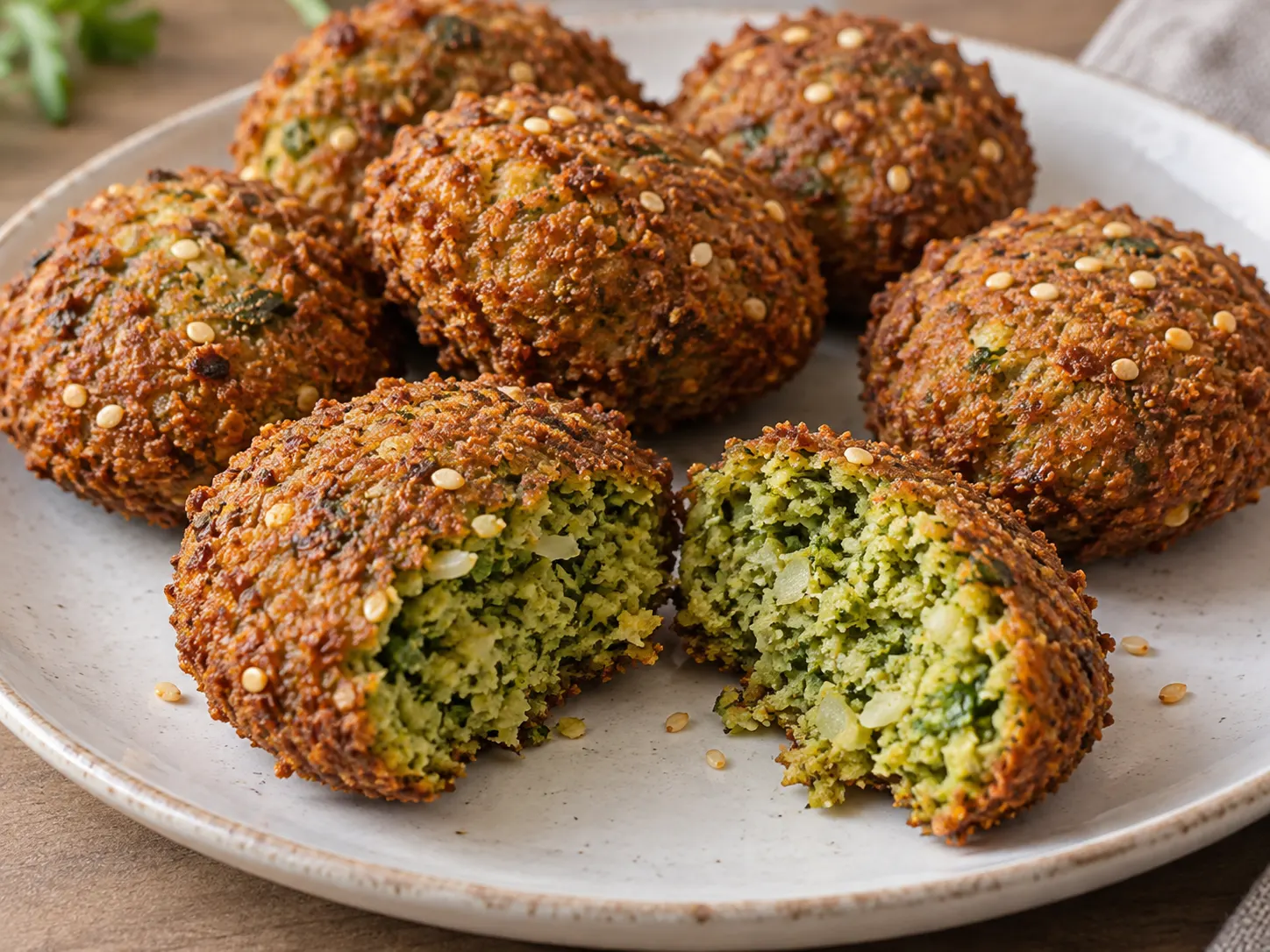
- Texture and taste Well-made falafels offer a crispy, golden, almost crumbly coating, while the inside remains tender, slightly granular, enhanced by a bouquet of aromatic herbs and spices. The mouthfeel oscillates between herbaceous freshness, the roundness of the fava bean or chickpea, and the diffuse warmth of the spices. The flavor is frank, rustic, but easily adapted to suit all palates, from the spiciest to the mildest.
- Typical accompaniments In North Africa and the Middle East, falafel is mostly eaten in a sandwich, rolled in pita bread or a thin flatbread like Egyptian baladi, accompanied by fresh raw vegetables (lettuce, tomato, onion, cucumber), tahini sauce, hummus, or even zalsouk (a spicy sauce made from chili peppers and garlic). It is also served on mezze platters, during communal meals or celebrations.
In my books

Continue exploring the continent’s cuisines with Africa at the Table — 54 countries, 54 iconic dishes, by Alioune FALL. This book is in English.
Explore further
III. FALAFELS AND THEIR PLACE IN AFRICAN CUISINE
- Egypt, the African cradle of falafel Egypt remains the leading African territory for falafel, known locally as “ta’miyya.” It is in the streets of Cairo, Alexandria, and the towns of the Nile Delta that street vendors offer this popular dish par excellence. Egyptian falafel, prepared mainly from dried fava beans, is distinguished by its green color inside (thanks to the abundant herbs) and its intense flavor. Egyptians consume ta’miyya for breakfast, in sandwich shops, or as an appetizer. Thanks to its low cost, its richness in vegetable protein, and its satiety, it nourishes all social classes. It can also accompany festive tables during Ramadan or Coptic Christian religious ceremonies.
- Development and adaptations in North Africa In North Africa, the presence of falafel is real, although less ancient than in Egypt. It is essentially due to Lebanese-Syrian influence, migrations from the Near East, and the success of oriental cuisine establishments in the major cities of Morocco, Tunisia, and Algeria. It can be found in some stalls, urban markets, or specialized restaurants alongside other mezzes (hummus, baba ganoush, tabbouleh). The mixture used is then often based on chickpeas, sometimes enriched with cumin, fresh coriander, parsley, and served with various sauces (based on yogurt, tahini, or harissa).
- Uses, symbolism, and sociability Falafel is not just a food: it is a powerful social and symbolic object. In Egyptian and Sudanese societies, homemade preparation is synonymous with family sharing and conviviality. People gather to make the balls together that will constitute the day's meals. The inexpensive, large-scale production allows for feeding a large table, or sometimes even the entire neighborhood during parties or celebrations. Its place in African street food is undeniable: it symbolizes a quick, healthy, economical meal, capable of supporting the working classes in their daily lives. But it has also risen to the rank of a symbol of trendy urban cuisine, in a context of returning to vegetarian, healthy foods adapted to the modern pace of city life. This is how falafels are now found on the tables of gourmet restaurants or contemporary African fast-food establishments.
- Nutritional and symbolic value Falafels have many nutritional benefits: no meat, rich in vegetable protein, fiber, minerals, vitamins (B, iron, magnesium). In African contexts, where access to meat is not widespread, they constitute an ideal, satisfying, and delicious substitute. They also respect many dietary restrictions (Coptic Christian cuisine during fasts, meat restrictions in certain faiths, vegetarian diets). As a result, they appear during all periods requiring vegetable exuberance — Ramadan, Lent, rural spring festivals.
IV. VARIATIONS, CREATIVITY, AND HYBRIDIZATION
African creativity did not stop at the classic version. Sometimes falafels are made from pigeon peas, local beans, or enriched with sweet potato or cassava, depending on the available products. In North Africa, the addition of coriander and cumin is almost systematic; some sprinkle the dough with sesame seeds or add fresh chili for a spicy note. There are also, during ceremonies or weddings, larger falafels, or those stuffed with a hint of cheese, marinated vegetables, or fine herbs. These hybridizations bear witness to the vitality of the culinary blending specific to the African continent.
CONCLUSION
Falafel, although associated with Levantine cuisine, has become an institution of African cuisine, through adoption but also adaptation. It symbolizes the encounter of terroirs and peoples, the versatility of village and urban cuisine, and the common attachment to values of sharing, generosity, and culinary inventiveness. Vegetarian, nourishing, steeped in history, adaptable to desires and resources, it nourishes the body while connecting generations. Thus, at the crossroads of tradition and modernity, from the popular market to revisited gastronomy, falafel remains a standard-bearer of African culinary heritage, continually enriched by the diversity and creative genius of its inhabitants.
In the kitchen : Falafel
Recipes from the site to put your knowledge into practice:
Discover these cuisines at a restaurant
Explore our restaurant and caterer directories. Choose your destination and check the establishment’s menu to confirm which dishes are offered and available.
Continue exploring
Enjoy discovering ingredients and African cuisines? Join our newsletter. The illustrated PDF 10 sauces africaines incontournables is in French and is offered after confirming a subscription to the French or bilingual edition.