Watermelon
Nile Valley
Understanding : Watermelon
INTRODUCTION
An undisputed symbol of freshness, conviviality, and abundance, watermelon has established itself across the African continent as a flagship fruit, appreciated by everyone, from children to the elderly. Its imposing appearance, vibrant red flesh, and sweet flavor make it not only irresistible but also central to many African culinary and cultural uses. More than just a fruit, it embodies, depending on the region, the prosperity of the field, hospitality, celebration, and the creativity of local cuisines. Behind its apparent simplicity lies a product with a very ancient history, multiple uses, and powerful symbolism.
Where to find it
Look for the exact food-grade form required by the recipe at markets and specialist shops. Check the product name, ingredients, condition and storage instructions.
Explore further: Cooking tips · Food hygiene and safety advice.
History and uses
I. ORIGIN, HISTORY, AND BOTANY OF WATERMELON
Watermelon (Citrullus lanatus) belongs to the Cucurbitaceae family, just like melon, squash, or cucumber. Its history begins in Africa, probably in the Nile Valley, the regions south of the Sahara, and present-day Sudan, where related wild plants were already harvested in antiquity. Archaeological traces of watermelons or watermelon seeds have been found in Egyptian sites over 4,000 years old; frescoes in the tomb of Khnumhotep show elongated watermelons being carried during feasts. The progressive domestication of the plant made it one of the oldest cultivated fruits in the world. Watermelon spread first throughout Africa, then into the Mediterranean basin and as far as Asia and Europe, thanks to trade, exchanges, and the strength of travelers. Today, it is cultivated in all regions of the world with a warm or temperate climate, but Africa remains its ancestral epicenter and the continent where the diversity of forms and varieties is richest. Botany and varieties Watermelon is a large creeping or climbing plant, with soft, leafy stems that can spread over several meters. The fruit, spherical or elongated, commonly reaches 3 to 10 kg, but some African specimens can exceed 20 or even 30 kg. Its thick, hard skin presents a palette of greens and striped patterns, while the flesh varies from bright red to pink, but can also sometimes be yellow or white depending on the variety. There are many African varieties; some are intended for direct consumption, others only for oil extraction from the seeds (like the Egusi watermelon of West Africa).
II. SENSORY AND NUTRITIONAL DESCRIPTION
Watermelon is immediately recognizable by its voluminous size, its light and dark green striped appearance, and its cut revealing juicy, vibrant red flesh, with or without black or white seeds depending on the cultivars. Texture and taste The flesh of the watermelon is fine, extremely juicy thanks to its high water content (over 90%). When tasted, it first offers an intense sensation of freshness, then a sweet, slightly fragrant, very subtle taste. Its crunchy, thirst-quenching texture makes it an ideal food during the hot African weather. Nutritional value Watermelon is rich in water, low in calories (about 30 kcal per 100 g), making it a hydrating and light food. It contains vitamins (C, B6, A), minerals (potassium, magnesium), lycopene (an antioxidant pigment that gives it its red color), and citrulline, an amino acid beneficial for cardiovascular health. The seeds, rich in protein and oils, are also used (roasted, ground, or for oil extraction).
III. WATERMELON AND AFRICAN CULTURES: USES AND SYMBOLISM
- Traditional uses Watermelon is consumed throughout Africa, primarily as fresh fruit, cut or by hand, during hot seasons when it provides welcome hydration. It holds a place of honor during village festivals, markets, traditional ceremonies, and family gatherings. Its presence evokes welcome, generosity, and joy. In West Africa, some local varieties – notably Egusi watermelon – are not consumed for their flesh, but for their seeds which are used in many soups, thick sauces (like the famous Egusi soup in Nigeria or Benin), or are pressed for their oil. The pulp of these watermelons, which is not sweet, is used as animal feed or, in some Sahelian regions, as a supplementary water source during the dry season. In the Saharan regions, watermelon (also called desert watermelon or “Kalahari melon”) has long been a vital resource for surviving drought: its fruits, buried in the sand, retained their water and nourished people and livestock for weeks. Throughout Central and East Africa, watermelon plays a social role, refreshing guests and visitors during rest times, mourning, or weddings, and during festive gatherings. In markets, it is sold whole or sliced, often at the exit of schools, train stations, or taxi stands.
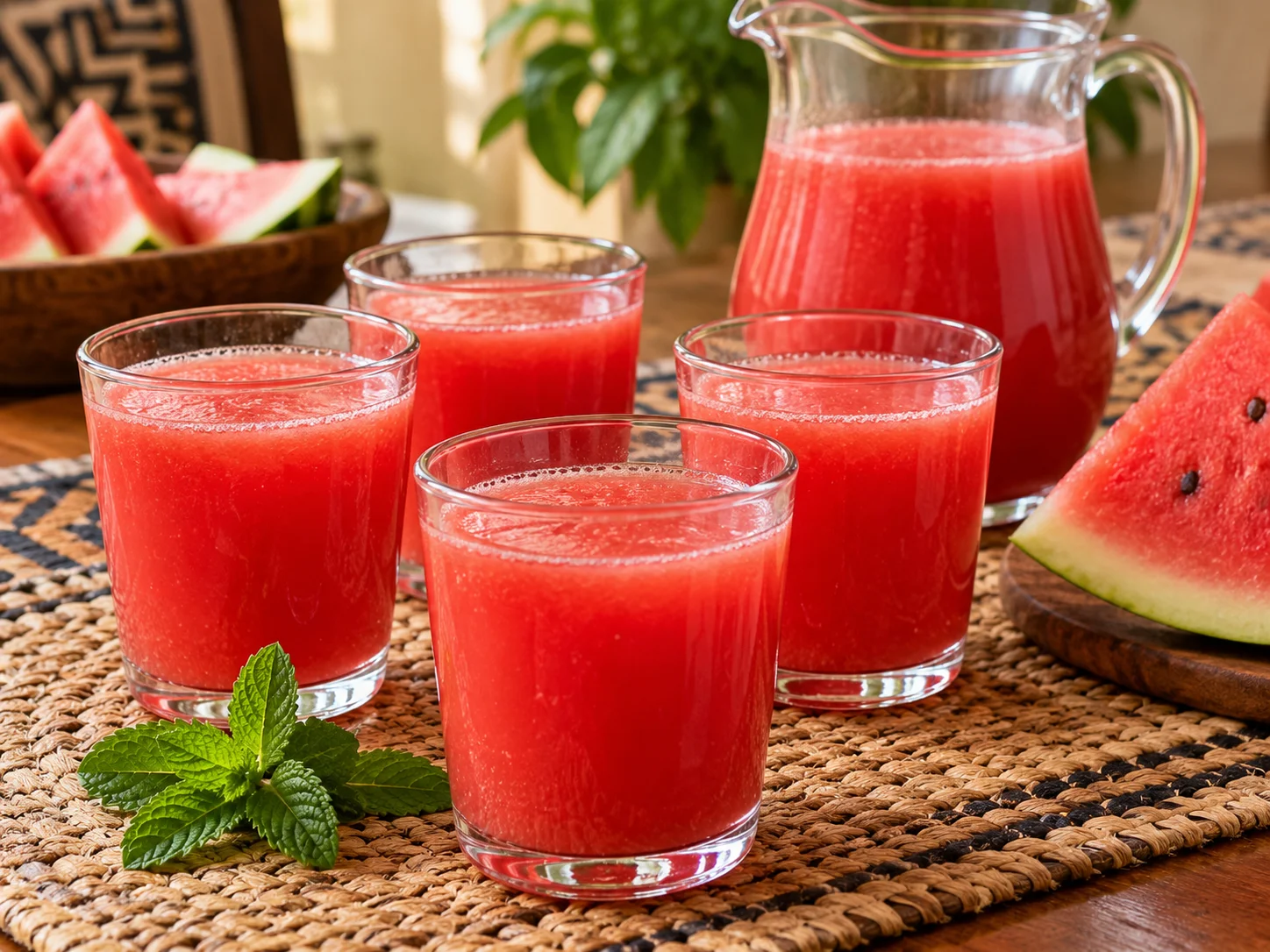
- Role in popular and family cuisine While direct consumption of watermelon dominates, many secondary uses exist, both in cooking and in folk medicine. • Drinks and desserts: Increasingly common, watermelon can be pressed to offer an ultra-refreshing natural juice. In some urban areas, it is also transformed into sorbet, granita, fruit salad, or jam, or served with a squeeze of lemon and mint leaves. It garnishes festive dishes, is invited to wedding buffets, and enhances family brunches. • Roasted or ground seeds: In West Africa, the seeds (Egusi) are a major food staple. They are roasted to be eaten as is, or ground to serve as a binder and protein source in thick soups and sauces. • Preservation and processing: Some ethnic groups practice fermentation of watermelon flesh or seeds, producing specific foods whose flavor is reminiscent of cheese or sauerkraut. • Watermelon paste: In some villages, the flesh is dried and reduced to a paste for culinary or medicinal use (treatment of dry heat, body washes, etc.).
- Symbolism and conviviality In all regions where it grows, watermelon appears in many traditional stories, proverbs, and popular expressions. It evokes abundance, fertility, peace, high nutritional value, and sometimes humility (in contrast to the “largeness” of the fruit compared to the delicacy of its flesh). It is often associated with hospitality: offering a slice of watermelon during a visit is a sign of openness and sharing. During the rainy season, its harvests are an occasion for celebrations, collective feasts, lively markets where its spectacular cutting attracts children and adults.
In my books

Continue exploring the continent’s cuisines with Africa at the Table — 54 countries, 54 iconic dishes, by Alioune FALL. This book is in English.
Explore further
IV. WATERMELON AND AFRICAN CULINARY CREATIVITY
Although simple at first glance, watermelon continues to inspire the creativity of cooks across the continent. In addition to its raw consumption, it is the subject of various culinary adaptations. • Mixed salads: Mixed with mint, lemon, ginger, red onion, or local cheese (such as “wagashi” in Benin), watermelon plays the sweet and savory card and even finds its way into main dishes, for example, paired with grilled meat. • Juices and cocktails: Particularly in urban areas, the trend for smoothies and healthy juices has elevated it to the rank of a key ingredient, alone or combined with other exotic fruits like baobab, ginger, or bissap. • Cold soups and gazpachos: Inspired by Mediterranean cuisines, cold watermelon soups, sometimes spiced, refresh summer menus. • Confectionery, jellies, and pastries: Although less common, recipes for watermelon jellies, tarts, or jams exist, especially in areas where storage or sale of the fruit necessitates processing.
V. WATERMELON: ECONOMIC AND SOCIAL STAKE
Watermelon cultivation has become a strategic asset for many small rural African producers. Its profitability, the speed of its cultivation cycle, and the robustness of local varieties give it major economic importance. In both rural and urban markets, watermelon is a valued resource, especially during the hot months. It also plays a social role: its harvest and sale are often carried out by women and young people, thus contributing to the subsistence and diversification of family incomes. The seasonal trade of watermelon sometimes structures village life and punctuates annual festivities.
CONCLUSION
Watermelon is much more than just a fruit in African cuisine: it embodies a millennial history, diverse uses, a source of sustenance and hospitality. At the crossroads of cultures, terroirs, popular traditions, and culinary innovation, it accompanies all ages and social classes. With its sweet flesh, nourishing seeds, potential for transformation, and symbolic significance, watermelon testifies to Africa's agricultural and creative genius. Thus, from West Nigeria to the beaches of the Indian Ocean, from the Nile Valley to the markets of the Maghreb, it will long remain an emblem of sharing, freshness, and abundance on the continent.
In the kitchen : Watermelon
Recipes from the site to put your knowledge into practice:
Discover these cuisines at a restaurant
Explore our restaurant and caterer directories. Choose your destination and check the establishment’s menu to confirm which dishes are offered and available.
Continue exploring
Enjoy discovering ingredients and African cuisines? Join our newsletter. The illustrated PDF 10 sauces africaines incontournables is in French and is offered after confirming a subscription to the French or bilingual edition.