Ubugari
Africa
Understanding : Ubugari
INTRODUCTION
Among the large family of "pastes" or "thick porridges" in sub-Saharan Africa, ubugari holds an essential place. Often referred to simply as "cassava porridge" or "cassava paste," ubugari is deeply rooted in the culinary traditions of Central and East Africa – particularly in Rwanda, Burundi, the Democratic Republic of Congo, Tanzania, Kenya, and to a lesser extent, Uganda. Nourishing, simple, and unifying, this dish testifies to the close link between people and the continent's root plants, of which cassava is a pillar. Beyond the recipe, ubugari also embodies conviviality, patience, ritual, and community sharing. But it also reflects modernity, African agricultural resilience, and the adaptation of cuisine to family and festive contexts. Let's discover the complete world of ubugari together.
Where to find it
Look for the exact food-grade form required by the recipe at markets and specialist shops. Check the product name, ingredients, condition and storage instructions.
Explore further: Cooking tips · Food hygiene and safety advice.
History and uses
I. ORIGIN AND HISTORY OF UBUGARI
- Ancestral roots of cassava in Africa Cassava (Manihot esculenta), originally from South America, arrived in West Africa in the 16th century, brought by Portuguese navigators. Quickly adopted due to its hardiness, it spread within decades throughout Central and East Africa. Resistant to drought, productive, and adaptable to all soil types, cassava replaced traditional cereals during periods of food crisis and soon supplanted many other sources of starch. In the Great Lakes region (Rwanda, Burundi, DRC, Uganda, Tanzania), cassava became the main food crop, after sorghum and millet. The transformation of its roots into flour, then into a thick paste (ubugari), quickly became a pillar of daily diet. Ubugari established itself over generations as a national dish, symbolizing identity, health, and abundance.
- Ubugari and kinship with other similar dishes Ubugari is not an isolated dish: it belongs to the large family of African "unleavened pastes," such as: • Foufou (West Africa) • Ugali (Kenya), posho (Uganda), nshima (Zambia, Malawi) • Banku/gari (Ghana, Nigeria), etc. But, unlike Kenyan ugali made from corn, ubugari is exclusively prepared with cassava flour, which gives it different nutritional and culinary qualities.
- A dish of history and identity In many societies in the region, ubugari is more than food: it is a heritage, transmitted and perfected from generation to generation. It structures family meals, brings people together during community rituals, funerals, weddings, harvests, or holidays. A symbol of humility, belonging to the agricultural community, and sharing, ubugari accompanies both difficult times (famines, population displacements) and moments of collective joy.
II. DETAILED DESCRIPTION OF UBUGARI: composition, appearance, sensation
- Basic ingredients and preparation Authentic ubugari is based on simplicity: • Pure cassava flour: sometimes called "cassava flour" or "gari" depending on the region and preparation method. The flour must be well sifted, free of hard pieces or fibers. • Water • Salt (optional) In some regional variants, cassava is sometimes mixed with other flours (corn, sorghum, millet) when the harvest allows or to vary the texture.
- Traditional manufacturing process Preparation, though simple, requires perfect mastery of technique and heat:
- Boil water in a large pot.
- As soon as it boils, pour in the cassava flour in a steady stream, stirring constantly with a wooden spatula (often a long spoon called "umwiko" in Rwanda).
- The paste begins to thicken quickly; cooking requires strength and regularity to avoid lumps and burning.
- Continue to stir and "crush" the paste against the sides until the mass becomes firm, homogeneous, smooth, very pliable, and non-sticky.
- Depending on the desired consistency, a drizzle of water can be added at the end of cooking, then cover and let it swell over low heat for a few minutes.
- Finally, the ubugari is molded (by hand or with a ladle) onto a dish or a basket lined with banana leaves for aeration and fragrance. Caution: Ubugari should be eaten hot or warm; once cooled, it becomes denser and less pleasant to taste.
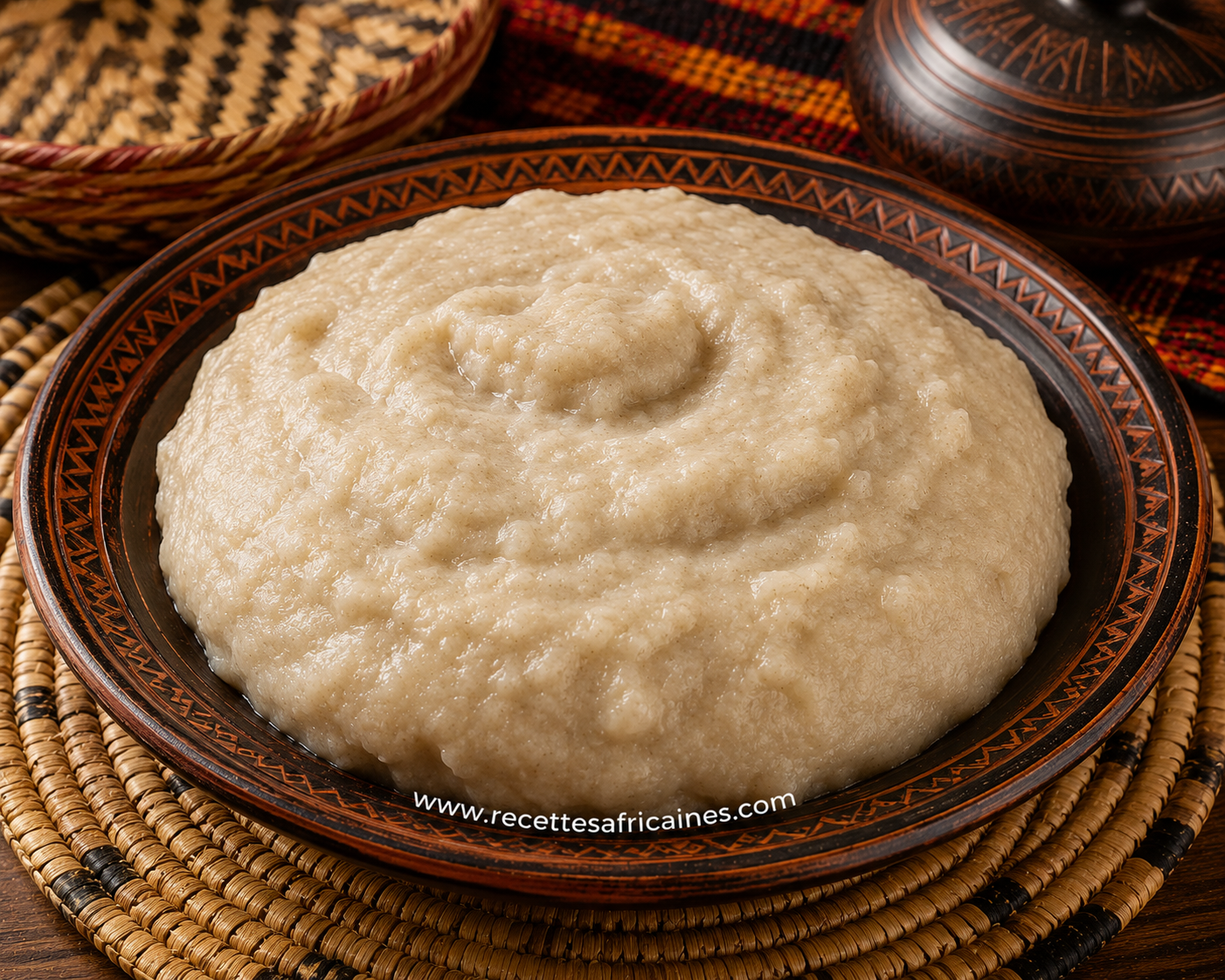
- Texture, appearance, and flavor The ubugari paste has a white, cream, or slightly translucent color depending on the cassava variety and flour quality. Its texture is soft, slightly elastic, but dense. In taste, ubugari is rather neutral and very mild, making it the ideal side dish for spicy sauces, braised vegetables, fish, or meat in sauce. The subtlety of this paste lies in its ability to "carry" other flavors: it is a base, a caloric reservoir, but also a receptacle for the aroma of the main dish.
In my books

Continue exploring the continent’s cuisines with Africa at the Table — 54 countries, 54 iconic dishes, by Alioune FALL. This book is in English.
Explore further
III. UBUGARI AND THE AFRICAN MEAL: place, rituals, and table etiquette
- A pillar of family and community meals In Rwandan, Burundian, or Congolese societies, the main meal is structured around ubugari. The presentation is ritualized: the ubugari, placed on a large dish or basket, sits in the center. Everyone serves themselves with their right hand, taking a piece, rolling it into a small ball, and making a well to "scoop" the sauce or side dishes. This gesture, repeated in family intimacy as well as at larger banquets, symbolizes harmony, modesty, and equity (everyone eats according to their need). In the countryside or during ceremonies, elders bless the ubugari, which "nourishes and connects." Sharing ubugari, often under the benevolent gaze of elders, contributes to social integration and a sense of belonging.
- Ubugari in ceremonies and festivities • Weddings: during wedding meals and sharing with extended families, ubugari accompanies sauces, green vegetables, meats, and poultry. • Agricultural festivals: at the end of the harvest, ubugari is offered with fish/goats or beans, a symbol of gratitude to the earth. • Funerals or births: the simplicity of this dish emphasizes humility and solidarity in hardship or joy. • Religious celebrations: it accompanies Lent, Christian, Muslim, or traditional holidays.
IV. REGIONAL VARIANTS AND MODERN ADAPTATIONS
While pure ubugari remains predominant, various cultural and agricultural contexts have given rise to variants:
- Flour mixtures • Ubugari y’ibigori (Rwanda, Burundi): integration of corn flour for a slightly milder taste and a firmer polenta-like texture. • Cassava-millet or cassava-sorghum mixture depending on agricultural availability.
- Textures and shapes • Firmer or softer: The consistency varies according to local preferences: a very firm paste that can be cut with a knife in the DRC, softer and rollable by hand in Rwanda or Burundi. • Shapes: More decorative moldings during ceremonies (in mounds, small individual balls, patterns made with a spatula).
- Enriched version • Sometimes, the paste is enhanced with a little vegetable oil (peanut, sunflower) or margarine. • Use of broth to flavor the cooking water during large meals.
V. TYPICAL SIDE DISHES AND DRINKS
Ubugari, with its neutral flavor, is always enjoyed with a rich-tasting sauce or side dish: • Red or white bean sauce (a classic throughout the Great Lakes region) • Peanut sauce (peanut paste, "isombe" or cassava leaves, palm oil, spices) • Sautéed green vegetables: amaranth, sweet potato leaves, African spinach • Braised meat: chicken, beef, goat, rabbit, especially during festive meals • Fried or grilled fish (often lake tilapia) • Spicy tomato sauce, with garlic and chili peppers • Wild mushrooms, in mountainous regions Associated drinks: • Fresh water, essential • Natural juices (bissap/hibiscus, mango, lemon, papaya) • Local beers during festivities • Fermented milk or plain yogurt in pastoral areas
VI. TIPS, COOKS' SECRETS, AND MODERN USES
• Always use fresh, well-sifted cassava flour to avoid lumps. • Stir vigorously with a suitable spoon, ideally wooden, for a perfectly smooth and pliable paste. • Cover at the end of cooking to finish steaming: this softens the paste. • To reheat ubugari, simply add a few drops of water and stir in a saucepan. • Prepare ubugari just before serving: its texture and warmth are incomparable straight from the pot. The African diaspora sometimes modernizes ubugari: grilled tofu, sautéed beef, roasted vegetables, mushroom-based sauces, and even "healthy" variants with gluten-free flours, quinoa, or fortifying seeds.
VII. NUTRITIONAL BENEFITS
Ubugari is primarily an energy food, rich in complex carbohydrates (starch), highly satiating, and perfectly digestible. • Moderate glycemic index; ensures lasting satiety. • Very low in lipids and proteins: hence the importance of consuming it with sauces rich in vegetable proteins (legumes, beans, peanuts) or animal proteins. • Gluten-free: an alternative for gluten-free diets. • Rich in crude fiber if artisanal flour: promoting intestinal transit. • Good source of potassium and minerals, varying by cassava variety. But: • Ubugari is poor in micronutrients, hence the importance of always complementing it with other food groups (leafy vegetables, protein sources, quality oils).
CONCLUSION
Ubugari, a matrix of nourishing, humble, and convivial food, embodies the quiet strength of African cuisine. A historical heritage, the center of family and social life, it crosses ages, borders, and upheavals, carrying memory, identity, and sharing. An inexhaustible source of energy and creativity, it reinvents itself with modernity, without ever losing its soul or its primary function: to bring people together around the table, to empower the body, and to perpetuate the spirit of African togetherness. Preparing and serving ubugari is therefore telling the story of Africa, from field to plate, and celebrating the indissoluble link between land, family, and celebration.
In the kitchen : Ubugari
Recipes from the site to put your knowledge into practice:
Discover these cuisines at a restaurant
Explore our restaurant and caterer directories. Choose your destination and check the establishment’s menu to confirm which dishes are offered and available.
Continue exploring
Enjoy discovering ingredients and African cuisines? Join our newsletter. The illustrated PDF 10 sauces africaines incontournables is in French and is offered after confirming a subscription to the French or bilingual edition.