Gambas
Africa
Understanding : Gambas
INTRODUCTION
Among seafood, gambas (large prawns) hold a special place on African tables. Famous for their impressive size, refined marine flavors, and firm flesh, gambas (Penaeus spp.; genus Penaeus or Parapenaeus) appeal to demanding gourmets and traditional families alike. Present along the entire Atlantic coast, in mangroves, estuaries, and markets of major cities on the continent, gambas have earned an emblematic place in African cuisine, ranging from Senegalese street grills to the Mediterranean refinements of Morocco, passing through the rich sauces of Central Africa or the steaming stalls of Cameroonian markets. They alone symbolize the living dialogue between local produce, the sea, and the culinary cultures of Africa. To understand the richness of gambas in the continent's cuisine, one must look at their biology, fishing, gastronomic value, but above all, the abundant variety of preparations and how they have integrated as both a festive dish and an everyday protein, depending on the region.
Where to find it
Look for the exact food-grade form required by the recipe at markets and specialist shops. Check the product name, ingredients, condition and storage instructions.
Explore further: Cooking tips · Food hygiene and safety advice.
History and uses
WHAT IS A GAMBAS?
The term “gambas” is used in various ways in French depending on the regions and markets. In French-speaking Europe, it refers to large tropical prawns — generally Penaeus species from the warm waters of the Atlantic, Indian Ocean, and Pacific. In West and Central Africa, gambas almost always refers to the African tiger prawn (Penaeus monodon), the pink shrimp (Penaeus notialis), or the famous Penaeus kerathurus. Their common points: size (often between 12 and 25 cm), robustness, firm flesh, and a deep flavor very different from the so-called “grey” or “bouquet” shrimp of Europe. Gambas inhabit coastal waters, lagoons, and mangroves, abundant in areas where rivers flow into the Atlantic — the mouth of the Senegal River, Guinean estuaries, the Niger basin, Gabonese rivers, the Nile delta… A true food chain, they serve as both a natural resource, an aquaculture crop (increasingly common in West Africa since the 2000s), and an economic currency on international markets.
HISTORY AND PLACE OF GAMBAS IN AFRICAN DIET
From ancestral fishing to urban markets Gambas fishing has existed in Africa artisanally for centuries. Guinean, Senegalese, Beninese, or Gabonese fishermen still use traps, gillnets, and traditional canoes to catch these crustaceans, at night or at dawn. On the coast, wild gambas are considered a noble delicacy — long reserved for festive days, weddings, or celebrating the return of a lucky fisherman. The arrival of international trade, freezing, and farming (aquaculture) gradually democratized their presence in urban markets, from Abidjan to Douala. Today, they can be enjoyed both in fine dining and street food, and are among the ingredients sought after by expatriates and the urban middle class. Symbolism and social status Gambas, due to their superior size, are often associated with abundance, success, or celebration. They grace wedding dinners, official receptions, and sometimes religious festivals. Offering gambas during a meal is perceived as a sign of consideration and generosity. In some Ivorian or Senegalese circles, gambas also have a reputation as a natural aphrodisiac, which enhances their aura during couple's meals and fertility celebrations.
CULINARY PREPARATIONS OF GAMBAS IN AFRICA
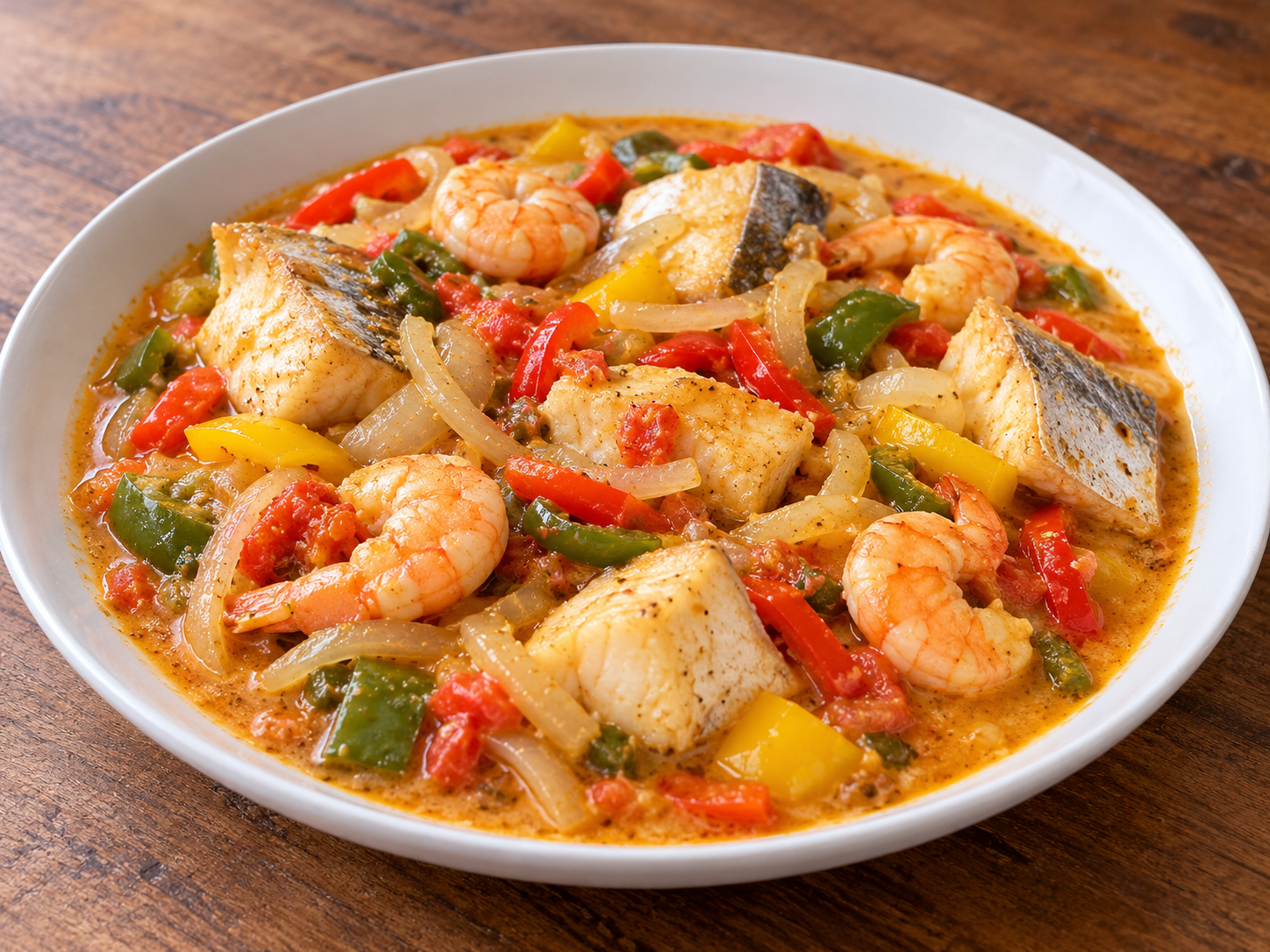
WEST AFRICA In the countries of the Gulf of Guinea (Senegal, Ivory Coast, Ghana, Benin, Togo, Nigeria), gambas are often cooked simply, to let the freshness of the product speak for itself. Gambas are often: • Grilled over a wood fire, seasoned with a mixture of crushed garlic, chili, lime, oil, or peanut butter. On the beaches of Lac Rose in Dakar or Saly, they are served with bread and a mustard or sweet chili sauce. • Skewered, with bell peppers, onions, tomatoes, sometimes marinated in ginger and lemon before being cooked over hot coals. They can be found in Ivorian “maquis” (local eateries) or on the quays of Conakry. • In red sauces, accompanied by rice or attiéké (cassava couscous), where they simmer in tomato, garlic, ginger, red chili, often accompanied by smaller shrimp and fish. • Palm nut sauce (sauce graine or moambé sauce), especially in southern Nigeria and western Cameroon. Whole gambas are simmered in a palm pulp sauce with spices, onions, and sometimes leafy greens. • Sautéed or fried in street food, with “green chili” and coriander, or in stuffed fritters (the famous “pourma” of Benin). CENTRAL AFRICA (Cameroon, Gabon, Congo, Equatorial Guinea) Cameroonian ndolé (one of the country's flagship dishes) perhaps offers the most respected recipe: amaranth leaves or ndolé, peanut paste, shrimp, fish, but also whole gambas, seafood, which are simmered for a long time in palm oil. In Gabonese cuisine, gambas are used in “nyembwe” sauce (with palm nut), or accompanied by mashed plantain, cassava, or fragrant rice. In the forest, they are also found dried or smoked, a traditional method of preservation and inland transport, sometimes even exported to Ivory Coast and Chad. EAST AFRICA (Mozambique, Tanzania, Kenya) In East Africa, gambas find their place in a cuisine strongly influenced by Portuguese and Arab traditions: • Matapa de gambas (Mozambique): gambas simmered in a sauce of cassava leaves, coconut milk, garlic, onions, crushed peanuts. • Gambas au piri-piri: grilled or roasted with a very spicy sauce made from red chili, garlic, lemon, sometimes with a hint of fresh coriander. • Curries or coconut sauce dishes, paired with fish, squid, often served with ugali (a stiff porridge made from cornmeal) or fragrant rice. NORTH AFRICA While gambas are not as traditionally rooted in Moroccan, Tunisian, or Egyptian dishes, they are nevertheless highly appreciated: enjoyed grilled with chermoula (a Moroccan marinade), or in a tagine flavored with spices (coriander, cumin, preserved lemon) or incorporated into festive couscous dishes of coastal cities.
In my books

Continue exploring the continent’s cuisines with Africa at the Table — 54 countries, 54 iconic dishes, by Alioune FALL. This book is in English.
Explore further
GAMBAS, FROM LOCAL PRODUCE TO PLATE: CULINARY VERSATILITY
Gambas offer an exceptional base for African culinary creativity: • Steamed, then peeled and incorporated into fresh salads with mango, avocado, citrus leaves. • In tartare or ceviche, in modern versions, with lime, chili, and coriander. • Skewered in a yassa sauce (onions, mustard, lemon, pepper) in Senegal or Gambia. • Stuffed, in the high-end restaurants of Nigeria or Ghana: each gambas opened on the back, stuffed with garlic, chives, chili, breadcrumbs, before being seared in a pan. • In African broths, with tomato, okra, fish, shrimp, and crayfish, for a comforting dish.
FOOD, NUTRITION AND BENEFITS
Gambas have an excellent nutritional reputation: • Low in calories and fat: 100g of cooked flesh offers approximately 90-100 kcal, less than 2g of lipids. • Rich in protein: nearly 22g/100g, with all essential amino acids. • Natural source of minerals and trace elements: iodine, zinc, phosphorus, magnesium, vitamin B12 and E, necessary for vitality, cognitive function, and children's growth. • Rich in astaxanthin, a powerful antioxidant, which notably protects cells against oxidative stress. • Low in cholesterol compared to old misconceptions: regular consumption has no negative impact on healthy individuals. • Healthy alternative to diversify protein intake in diets where red meat should be moderated. Of course, the cooking method makes a difference: grilled, steamed, or poached, they retain all their qualities; frying or accompanying with fatty sauces increases the caloric density.
GAMBAS AND THE AFRICAN ECONOMY
Beyond their place in the diet, gambas have become a major economic issue for various African coastal countries. Gabon, Senegal, Ivory Coast, Nigeria, and Mozambique are developing their aquaculture sector to meet local and international demand, creating jobs and sometimes improving food security. Markets, hotels, and exporters rely on traceability (labels like “organic”, “wild caught”) to differentiate themselves from Asian competition.
SYMBOLISM AND SOCIAL CONNECTION
Gambas are often associated with celebration, unity, and sharing. Family gatherings where they are grilled, lively exchanges around the barbecue, weddings or birthdays where they are the main dish… Gambas embody the idea of accessible luxury, a moment of coming together. In cultures where the sea and fishing are central, they symbolize the courage of the fisherman, the generosity of the sea, and culinary creativity.
CONCLUSION
Gambas, much more than a simple crustacean, bring together the richness of the sea, the flavor of African terroirs, and the magic of sharing. Versatile, popular, and festive, they have conquered all African cuisines, from the most rustic to the most sophisticated, bringing sometimes tenderness, sometimes character, but always the assurance of a great moment of pleasure. Whether braised on the beach, cooked in a fragrant stew, or disguised as a spicy skewer, gambas are both a memory and a promise of the African table: a continuous invitation to discovery, simple happiness, and… indulgence.
In the kitchen : Gambas
Recipes from the site to put your knowledge into practice:
Discover these cuisines at a restaurant
Explore our restaurant and caterer directories. Choose your destination and check the establishment’s menu to confirm which dishes are offered and available.
Continue exploring
Enjoy discovering ingredients and African cuisines? Join our newsletter. The illustrated PDF 10 sauces africaines incontournables is in French and is offered after confirming a subscription to the French or bilingual edition.