Xima
Southern Africa
Understanding : Xima
INTRODUCTION
Xima is one of Southern Africa's most iconic staple foods, particularly in Angola, where it holds a similar place to ugali in East Africa or fufu in Central and West Africa. Prepared mainly from cornmeal and water, sometimes with a little salt, xima is a thick, smooth or slightly grainy paste depending on the grind, which accompanies almost all daily dishes. Much more than a simple starch, it is a symbol of satiety, simplicity, sharing, and cultural identity. To understand xima's place in African cuisine, one must consider its history, nutritional function, culinary versatility, social dimension, and symbolic significance.
Where to find it
Look for the exact food-grade form required by the recipe at markets and specialist shops. Check the product name, ingredients, condition and storage instructions.
Explore further: Cooking tips · Food hygiene and safety advice.
History and uses
WHAT IS XIMA?
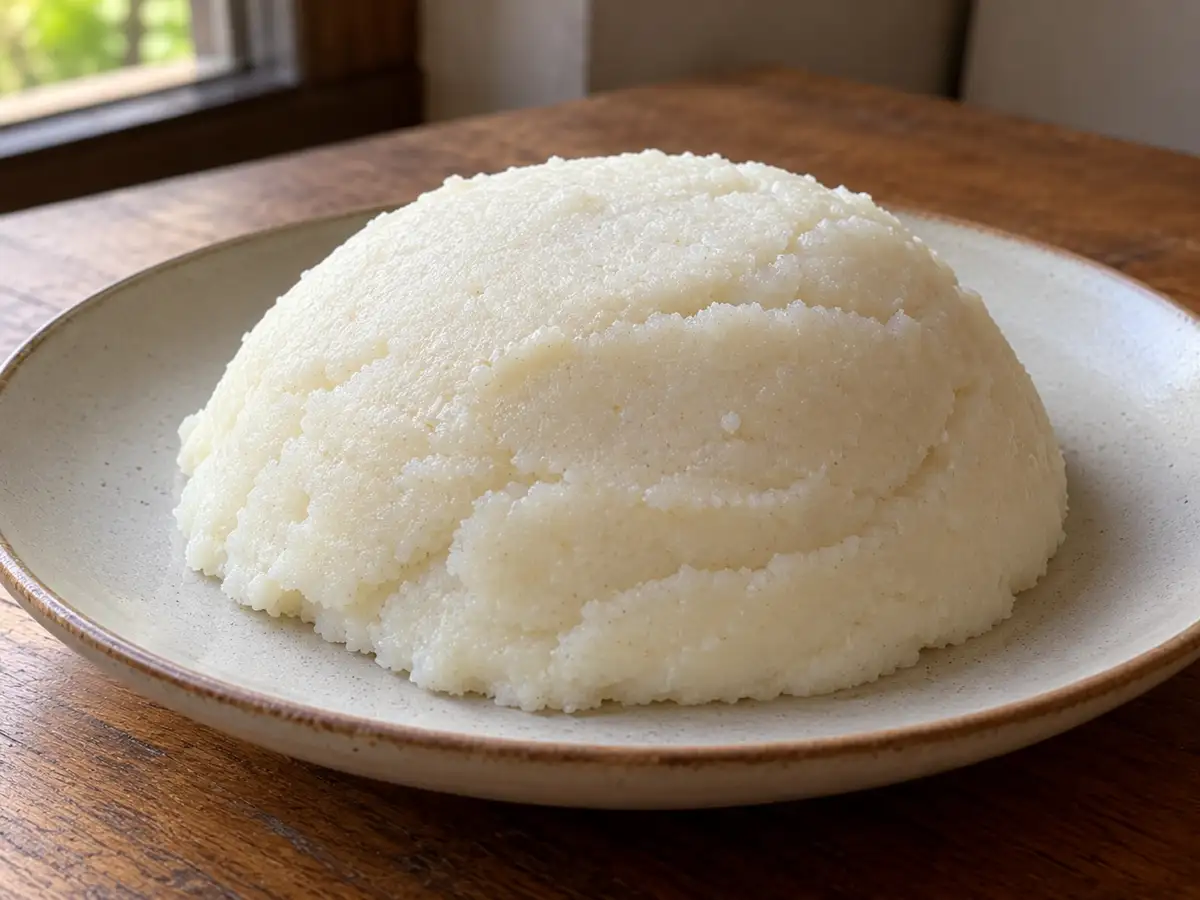
Xima is a corn-based preparation, very similar to various thick porridges or cereal pastes found in several regions of Africa. Its texture varies according to preference: some want it firm and compact, others softer and slightly creamy. It is cooked in boiling water by gradually adding the flour, stirring vigorously, until the paste detaches from the pot and becomes homogeneous. The simplicity of its composition is deceptive. Even if the ingredients are few, the preparation gesture is essential: it requires rhythm, patience, and a certain know-how to avoid lumps and obtain the desired texture. Xima is not just an “accompaniment”; it is often the very basis of the meal. It is used to collect sauces, balance saucy dishes, and provide the energy needed for daily activities.
XIMA IN ANGOLAN CUISINE
In Angola, xima is deeply rooted in eating habits. It is consumed at home, in popular restaurants, and during many family meals. It is usually served with rich sauces based on fish, meat, chicken, vegetables, beans, or peanuts. Its function is twofold: to provide consistency and satisfy hunger. Xima is often compared to other African staple foods, but it has its own cultural personality. In Angola, it is both an everyday food and a marker of belonging. In many households, knowing how to prepare good xima is an important culinary skill. It should be neither too liquid nor too firm, with a texture that allows it to be shaped by hand without breaking too easily. Angola is a country where cuisine is marked by Bantu, Portuguese, Atlantic, and regional influences. In this context, xima naturally fits in as the neutral base that enhances the sauces. It pairs very well with dishes such as moamba de galinha (Angolan chicken stew with palm oil), calulu (Angolan fish and vegetable stew), fish stews, or sautéed leafy greens.
HISTORICAL PLACE OF XIMA IN AFRICAN DIET
Corn arrived in Africa after transatlantic exchanges, then spread rapidly because it adapts well to many climates and agricultural yields. In several regions of Africa, it gradually replaced or supplemented older local cereals such as millet, sorghum, or fonio. Xima is part of this broader food history: that of an imported cereal that has been adopted, transformed, and Africanized. Xima's place in African cuisine extends beyond Angola. Related preparations are found: • ugali in East Africa, • nsima in parts of Southern Africa, • pap in South Africa, • sadza in Zimbabwe, • posho in Uganda, • and other local variations of corn paste. This kinship shows that xima is not an isolated case, but one of the faces of a pan-African culinary culture based on cereal, slow cooking, and conviviality.
SOCIAL AND SYMBOLIC DIMENSION
Xima has a strong social value. In many households, it is the dish that truly “fills” the meal. One can have a very simple sauce, but if it is served with xima, the meal becomes complete. It often represents food comfort, family economy, and the ability to feed several people with limited means. In daily life, xima plays a unifying role. It is often eaten with family, sometimes from a large shared dish, where everyone takes their portion by hand. This mode of consumption reinforces the sense of community. Food is not just a caloric intake; it becomes relationship, sharing, and family or social hierarchy. Xima is also linked to a form of memory. Many adults associate its taste and texture with childhood, with parents' or grandparents' cooking, with meals after school or after work. It is a comforting, familiar, almost universal dish in some African societies.
In my books

Continue exploring the continent’s cuisines with Africa at the Table — 54 countries, 54 iconic dishes, by Alioune FALL. This book is in English.
Explore further
NUTRITIONAL VALUE AND DIETARY ROLE
From a nutritional point of view, xima is primarily a source of complex carbohydrates. It provides energy in a simple and effective form. Prepared from cornmeal, it also contains some protein, B vitamins, and, depending on the flour used, a certain amount of fiber. However, it is relatively poor in lipids and micronutrients if consumed alone. This is why it is generally accompanied by sauces, vegetables, legumes, or animal proteins. Its nutritional interest lies in several points: • it satisfies hunger quickly, • it serves as an energy base, • it is inexpensive, • it can be enriched by accompaniments, • it is suitable for many diets when well-balanced. In regions where food security is important, xima plays an essential supporting role. It allows families to be fed with an accessible and stable raw material. It is a subsistence food, but also a cultural food.
CULINARY VERSATILITY
One of xima's great strengths is its versatility. It pairs with almost all sauces and preparations in Southern Africa and beyond: • tomato and onion sauces, • meat stews, • grilled or smoked fish, • simmered beans, • leafy greens, • peanut sauces, • spicy dishes, • rich broths. Its texture allows it to play a functional role: it absorbs juice, balances strong flavors, and softens very spicy dishes. It is a culinary support, a sauce vehicle, but also an element of harmony on the plate. Xima can be prepared more or less firm depending on how it will be consumed. A more compact version is better suited for shaping by hand, while a softer version more easily accompanies very liquid dishes. This adaptability explains its persistent popularity.
XIMA IN MODERNITY
Today, xima continues to hold an important place in Angola and several neighboring regions, despite evolving eating habits. Cities have introduced more rice, pasta, bread, and industrial foods, but xima remains a symbol of continuity. It is often associated with “real,” “homemade,” “authentic” cuisine. In restaurants and canteens, there is a regular demand for it. In homes, it remains a daily landmark. Younger generations may sometimes perceive it as a “traditional” dish, but this tradition is precisely what gives it its value. It connects generations, rural and urban areas, memories, and current practices. Some modern chefs revisit xima by accompanying it with more elaborate sauces, roasted vegetables, or fusion versions. However, the essence of the dish remains the same: flour, water, fire, movement, and sharing.
COMPARISON WITH OTHER SIMILAR AFRICAN DISHES
To properly situate xima, it is useful to compare it to other related dishes. In Africa, cereal or tuber paste is a very widespread form. Xima belongs to this large family, alongside fufu, ugali, sadza, or pap. These dishes show a common logic: • an energy base, • a malleable texture, • a primary accompaniment role, • a support function for sauces, • a strong identity charge. The main difference lies in the cereal or flour used, the cooking technique, and the cultural context. Angolan xima has its own vocabulary, serving habits, and culinary associations.
CONCLUSION
Xima is much more than a simple corn porridge. It is a pillar of Angolan cuisine and an important element of the African culinary landscape. Its strength comes from its simplicity, but also from its ability to nourish, gather, and transmit a deeply rooted food culture. A staple dish, an everyday dish, a dish of memory, it embodies an African way of making the essential a culinary art. In African cuisine, xima holds a prominent place because it meets several needs simultaneously: energetic, social, economic, and symbolic. It is both humble and fundamental. It nourishes the body, but also identity. And that is precisely why it remains so important, generation after generation.
BON APPETIT!
© Photo credit: recettesafricaines.com. All rights reserved.
In the kitchen : Xima
Recipes from the site to put your knowledge into practice:
Discover these cuisines at a restaurant
Explore our restaurant and caterer directories. Choose your destination and check the establishment’s menu to confirm which dishes are offered and available.
Continue exploring
Enjoy discovering ingredients and African cuisines? Join our newsletter. The illustrated PDF 10 sauces africaines incontournables is in French and is offered after confirming a subscription to the French or bilingual edition.