Bamia
Africa
Understanding : Bamia
INTRODUCTION
Bamia, known in many countries as gumbo or okra, is one of the most important and versatile vegetables in African cuisine. It holds a special place on the continent because it is both a sauce vegetable, a natural thickener, a stew ingredient, a home garden product, and a food rich in culinary memory. Its slightly viscous texture, often considered its signature, is precisely what makes it so rich in many African culinary traditions. Bamia is much more than just an elongated green vegetable. It is a fundamental part of the diet in several regions of West Africa, Central Africa, the Sahel, Northeast Africa, and even in some Southern African cuisines. It accompanies grains, meats, fish, and vegetable sauces. It is appreciated for its subtle taste as well as for its ability to give body to dishes.
Where to find it
Look for the exact food-grade form required by the recipe at markets and specialist shops. Check the product name, ingredients, condition and storage instructions.
Explore further: Cooking tips · Food hygiene and safety advice.
History and uses
WHAT IS BAMIA?
Bamia is the edible fruit of the Abelmoschus esculentus plant, a plant from the Malvaceae family. It is harvested young, before it becomes too fibrous. The pods are green, sometimes slightly angular, and contain small seeds. When cut or cooked, they release a mucilaginous substance, responsible for their characteristic slimy texture. This texture is at the heart of its culinary identity. In some African cuisines, it is sought after because it helps to thicken sauces. In others, it is neutralized or reduced by particular cooking techniques, depending on family or regional preferences. Bamia can be cooked whole, sliced, simmered, sautéed, roasted, or incorporated into soups and stews.
ITS PLACE IN AFRICAN CUISINE
Bamia holds a very important place in African cuisine, precisely because it combines several functions in a single ingredient. It can serve as: • a main vegetable, • a natural thickener, • a base for a sauce, • a side dish, • or a central component of a complete dish. In several African countries, it is associated with family meals, daily dishes, and orally transmitted recipes. It is particularly suited to cuisines that rely on sauces served with rice, millet, sorghum, fonio, corn, or cassava. Bamia is also important in meat or fish-based meals. It absorbs the flavors of broth, tomatoes, onions, chili, and spices, making it a highly valued ingredient for stews.
A STRONG PRESENCE IN SEVERAL AFRICAN REGIONS
In West Africa, bamia is well-known in sauces that accompany rice or grains. In the Sahel, it is often used in thick sauces served with grain pastes. In North Africa and the Horn of Africa, it is used in more complex stews with meat, tomato, spices, and sometimes lemon. This continental spread shows that it is a vegetable deeply integrated into African habits. Local cuisines have adopted and adapted it according to tastes, cultures, and availability.
TEXTURE, TASTE, AND IDENTITY
Bamia has a relatively mild, light, vegetal taste. It is not aggressive on the palate; its interest lies mainly in its texture and its ability to carry other flavors. What distinguishes it is its natural viscosity. This quality can surprise those who discover it for the first time, but it is, on the contrary, highly sought after in many African cuisines. Depending on how it is cooked, bamia can be: • very tender, • slightly firm, • very viscous, • or quite dry if seared over high heat. This diversity of textures allows for great culinary creativity.
A HISTORY LINKED TO EXCHANGES AND ADAPTATIONS
Bamia, like many widely distributed food products in Africa, has circulated through trade routes, migrations, and cultural exchanges. Even if it is not native to the African continent, it has long been adopted by many populations who have integrated it into their daily recipes. Its success comes from its ability to adapt to hot climates, home gardens, and stews. It has become firmly established in African culinary memory to the point of being perceived, in many places, as a completely familiar vegetable.
In my books

Continue exploring the continent’s cuisines with Africa at the Table — 54 countries, 54 iconic dishes, by Alioune FALL. This book is in English.
Explore further
CULINARY USES
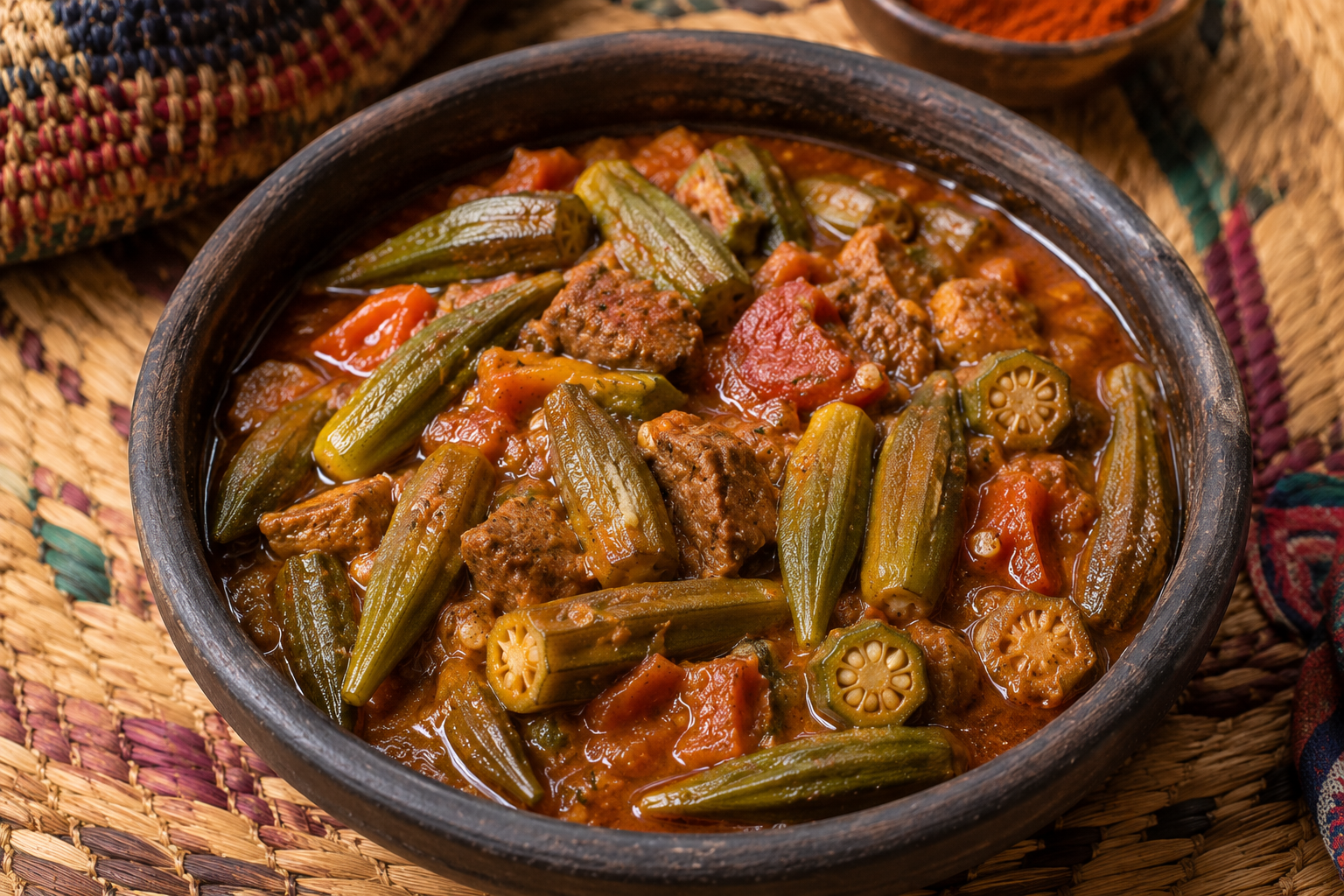
- Bamia in sauce This is one of the most common uses. Bamia is cooked with tomatoes, onions, garlic, chili, and sometimes meat or fish. The sauce becomes slightly thick and very flavorful.
- Bamia stewed with meat In some African cuisines, it is prepared with beef, lamb, goat, or chicken. Slow cooking allows the flavors to meld.
- Bamia with fish In coastal or river regions, it accompanies fresh or dried fish. Its texture pairs well with fish broths.
- Bamia with grains It is often served with rice, millet, corn, or sorghum. It then acts as a sauce or main garnish.
- Dried or roasted bamia Some recipes aim to limit viscosity by cooking it quickly over high heat or roasting it. This results in a firmer, lighter texture.
NUTRITIONAL VALUE
Bamia has many nutritional benefits. It is: • low in calories, • rich in fiber, • a source of vitamins, • a source of minerals, • hydrating, • and useful for diversifying the diet. It notably contains: • viramin C, • viramin K, • B vitamins, • folate, • magnesium, • potassium, • calcium in small amounts, • and soluble fiber. The fibers in bamia are beneficial for digestion and satiety. Its low caloric intake makes it a popular vegetable in balanced diets. When cooked with a lot of oil, fatty meat, or salt, its energy value increases, but the vegetable itself remains light.
DIETARY BENEFITS
In many African traditions, bamia is appreciated not only for its taste but also for its dietary virtues: • it helps to naturally thicken sauces without additional flour, • it provides useful fiber, • it contributes to a more plant-rich meal, • it pairs very well with animal or plant proteins, • it allows for diversification of daily meals. It is therefore an important ingredient in cuisines where the goal is to feed a family in a simple, balanced, and tasty way.
SOCIAL AND FAMILY DIMENSION
Bamia is often linked to home cooking. In many African families, it is prepared by mothers, grandmothers, or household cooks who know the right proportions, cooking times, and flavor combinations. It is an everyday food, but also a dish that can be carefully prepared for guests. It also evokes seasonality and the vegetable garden. In some regions, bamia is grown on a small scale in family courtyards or domestic plots. This strengthens its link with food autonomy and local cuisine.
REGIONAL PREFERENCES
The ways of cooking bamia vary greatly by region: • some prefer a very viscous sauce, • others, on the contrary, seek to make it drier, • some associate it with tomato, • others with leaves, peanuts, or dried fish, • some serve it very spicy, • others milder. This diversity reflects the richness of African cuisine, where the same vegetable can have several culinary destinies depending on the culture.
BAMIA AND CULINARY MODERNITY
Today, bamia is making a comeback in a new generation of African and Afro-descendant cuisines. It is being rediscovered as a healthy, local, and traditional ingredient. Chefs are showcasing it in more contemporary dishes, playing on its texture and pairing it with modern products. This shows that bamia is not a vegetable of the past. It has its place in current cuisines, particularly in approaches to sustainable cooking, valuing local products, and rehabilitating traditional vegetables.
CONCLUSION
Bamia is one of the most emblematic vegetables in African cuisine. It embodies the generosity of sauces, the richness of stews, the transmission of know-how, and the adaptation of local cuisines to their environment. Its particular texture, sometimes loved, sometimes dreaded, is in fact part of its deep identity. In many African regions, bamia is not just a vegetable: it is a pillar of the family meal, a link between land, culture, and table. It accompanies grains, meats, fish, and sauces with remarkable effectiveness. This is why it holds a lasting and precious place in African cuisine.
In the kitchen : Bamia
Recipes from the site to put your knowledge into practice:
Discover these cuisines at a restaurant
Explore our restaurant and caterer directories. Choose your destination and check the establishment’s menu to confirm which dishes are offered and available.
Continue exploring
Enjoy discovering ingredients and African cuisines? Join our newsletter. The illustrated PDF 10 sauces africaines incontournables is in French and is offered after confirming a subscription to the French or bilingual edition.