Okra
Africa
Understanding : Okra
INTRODUCTION
Okra is one of the most iconic vegetables in African cuisines. Known in many French-speaking countries as gombo, it plays a central role in sauces, soups, stews, and grain dishes consumed on the continent. This green, elongated vegetable, sometimes ribbed, sometimes smooth depending on the variety, is appreciated for its particular texture, its discreet but rich taste, and especially its ability to naturally thicken preparations. In African cuisine, okra is not just another ingredient: it is a true culinary, cultural, and identity marker. Understanding the place of okra in African cuisine means understanding an important part of how the continent's cuisines transform plant resources into nourishing, flavorful dishes adapted to the climate. Okra is both an everyday vegetable, a seasonal food, and a product linked to family traditions. It is present in many regions, with different uses depending on the country, but a common value: it provides body, binding, and a unique mouthfeel.
WHAT IS OKRA?
Okra is the edible fruit of the plant Abelmoschus esculentus, a plant of the Malvaceae family. It is harvested young, before the pod becomes too hard and fibrous. The pods are elongated, green, sometimes slightly fuzzy, and contain small white or ivory seeds. When okra is cut or cooked, it releases a gelatinous substance called mucilage, which gives it that slightly slimy texture known and sought after in many cuisines. This viscosity is often the most famous characteristic of okra. Some people discover it with surprise, but in many African cultures, it is precisely appreciated because it allows a sauce to be thickened without added flour or starch. Okra thus becomes a natural binding ingredient, very useful in simmered dishes.
THE PLACE OF OKRA IN AFRICAN CUISINE
Okra holds an immense place in African cuisine because it is simple, economical, versatile, and very well suited to local cooking methods. It is found: • in sauces, • in soups, • in vegetable or meat stews, • with fish, • with grains, • or as a main side dish. It is particularly important in regions where dishes are often served with rice, millet, sorghum, fonio, corn, cassava, or tubers. Okra then provides the consistency that makes the meal more satisfying. In many African homes, an okra sauce can be prepared quickly with simple ingredients: onions, tomatoes, chili, oil, salt, dried fish, or meat. It is an everyday dish, but also a dish deeply rooted in culinary know-how. A vegetable present in many regions Okra is very present in West Africa, Central Africa, the Sahel, East Africa, and some Southern African cuisines. Each region gives it a particular form: • here, it is cut into thin slices; • elsewhere, it is left whole or in larger pieces; • sometimes, it is cooked for a long time to obtain a very thick sauce; • sometimes, on the contrary, its viscosity is limited. In some cuisines, okra is associated with dishes very rich in sauce and flavor. In others, it accompanies rice or grain porridges. Its flexibility of use explains its popularity.
TEXTURE AND TASTE
Okra has a fairly mild, vegetal, slightly herbaceous taste. It does not dominate other ingredients; on the contrary, it supports them. Its great particularity is its mucilaginous texture. This texture can be seen as a defect by some unaccustomed people, but it is often considered a quality in African cuisines. In cooking, this viscosity is an asset. It gives the dish: • thickness, • binder, • a melting sensation, • and a richer mouthfeel. Okra can be prepared in several ways to modulate its texture. Gentle cooking accentuates its gelatinous side. Quick cooking over high heat can make it firmer. The addition of acidic ingredients like tomato or lemon can also slightly reduce viscosity.
CULINARY USES
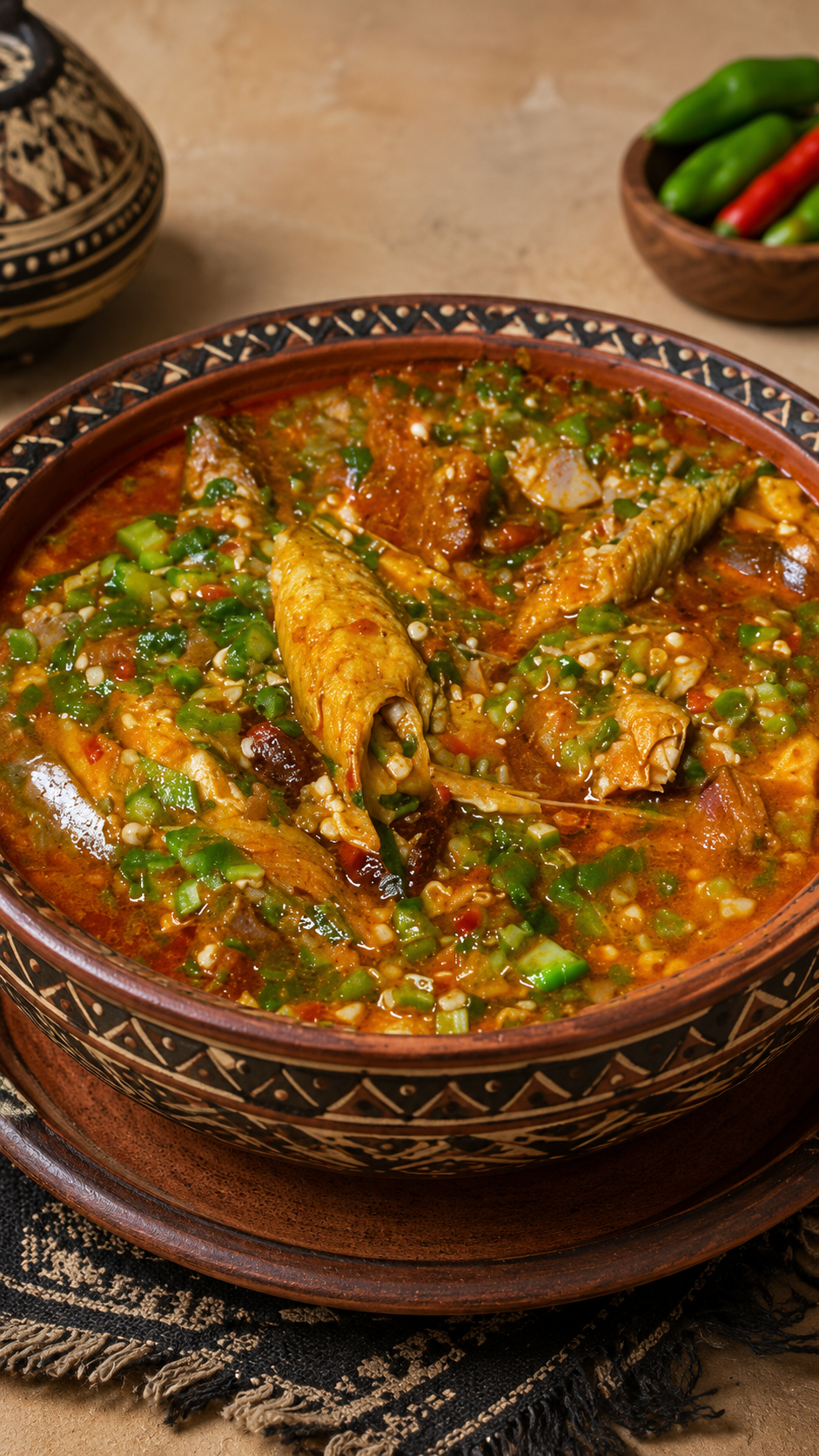
- Okra sauce This is one of the most classic uses. Okra is cut and then simmered with onions, tomato, chili, oil, and sometimes meat or fish. The resulting sauce is thick, flavorful, and slippery, often served with rice, millet, or cassava.
- Okra soup In some regions, okra is used in richer soups with fish, meat, shellfish, or green vegetables. It serves to bind the broth.
- Vegetable stew Okra can be combined with eggplants, tomatoes, leaves, carrots, or beans in vegetarian simmered dishes.
- With fish Okra pairs very well with fresh or smoked fish. The sweetness of the vegetable and the richness of the fish create a beautiful balance.
- With meat In many African recipes, okra accompanies beef, goat, lamb, or poultry.
- Dry or sautéed preparations Some cooks prefer to quickly sauté okra to limit viscosity and obtain a firmer texture.
NUTRITIONAL VALUE
Okra is a very interesting vegetable from a nutritional point of view. It is: • low in calories, • rich in fiber, • a source of vitamin C, • a source of vitamin K, • a source of folate, • and contains useful minerals such as magnesium, potassium, and calcium. Okra's fiber promotes satiety and digestive comfort. Its low caloric density makes it a suitable food for a balanced diet. It is also hydrating, which is useful in hot climates. The presence of mucilage can contribute to a feeling of smoothness in the mouth and contributes to its reputation as a "comforting" vegetable.
PRESENCE IN DOMESTIC TRADITIONS
In many African families, okra is an everyday ingredient. It is sometimes grown in family gardens, bought fresh at the market, or dried for later use. This last point is important: in some regions, dried okra is widely used, especially when the fresh season passes and vegetables need to be preserved for later. Dried okra can be powdered or rehydrated before cooking. It retains some of its thickening qualities and allows the taste of the vegetable to be enjoyed off-season.
OKRA AND THE FOOD ECONOMY
Because it grows relatively quickly, is easy to cultivate, and can be eaten young, okra is a valuable vegetable for small farms and home gardens. It contributes to food security and dietary diversification. In many African communities, it is an accessible, affordable, and useful vegetable. This partly explains its very wide distribution.
OKRA AND CULINARY MODERNITY
Today, okra is increasingly being rediscovered in urban and gastronomic cuisines. It is used in contemporary recipes, fusion dishes, refined side dishes, or preparations inspired by tradition. Some chefs play with its texture, others highlight it in vegetarian or vegan dishes. The renewed interest in local and traditional products gives it significant visibility. Okra is no longer just a popular vegetable: it is also becoming a heritage and identity ingredient.
SYMBOLIC PLACE
Okra perfectly represents the spirit of many African cuisines: simple products, intelligently transformed, to create nourishing dishes, adapted to the climate, and deeply rooted in daily life. It is both humble and essential. In some families, it evokes shared meals, sauce dishes, market memories, and traditions passed down from generation to generation. Its presence in African cuisine is therefore both practical and emotional.
CONCLUSION
Okra, or gombo, is a fundamental vegetable in African cuisine. Its unique texture, versatility, and ability to thicken sauces make it an irreplaceable ingredient in many dishes. Present in all kinds of preparations, from simple home stews to more elaborate recipes, it embodies the richness of African cuisines, based on the intelligent use of local products. It is an everyday vegetable, for sharing and culinary memory. Its place in African cuisine is immense because it combines nutrition, taste, texture, and tradition. Okra is therefore much more than a green vegetable: it is a pillar of African food.
Where to find it
Look for the exact food-grade form required by the recipe at markets and specialist shops. Check the product name, ingredients, condition and storage instructions.
Explore further: Cooking tips · Food hygiene and safety advice.
In my books

Continue exploring the continent’s cuisines with Africa at the Table — 54 countries, 54 iconic dishes, by Alioune FALL. This book is in English.
In the kitchen : Okra
Recipes from the site to put your knowledge into practice:
Discover these cuisines at a restaurant
Explore our restaurant and caterer directories. Choose your destination and check the establishment’s menu to confirm which dishes are offered and available.
Continue exploring
Enjoy discovering ingredients and African cuisines? Join our newsletter. The illustrated PDF 10 sauces africaines incontournables is in French and is offered after confirming a subscription to the French or bilingual edition.