Agoun
Africa
Understanding : Agoun
INTRODUCTION
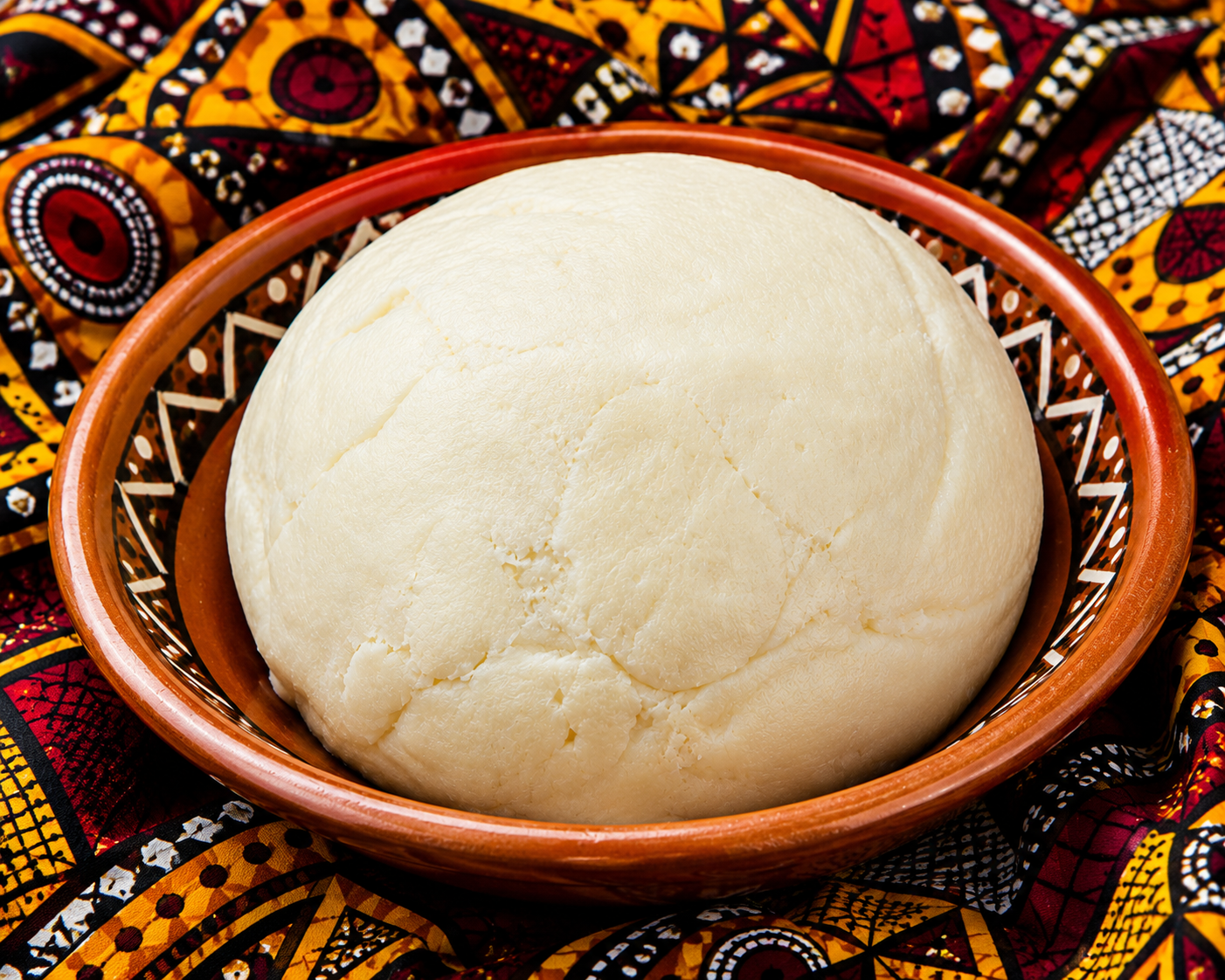
Agoun is a culinary preparation made from pounded yam, highly appreciated in several contexts of African cuisine, particularly in areas where yam holds an important place as a staple food. When we talk about agoun, we evoke a texture, a culinary gesture, and a way of consuming yam that goes far beyond a simple boiled tuber. It is a food of consistency, sharing, satiety, and conviviality. Agoun belongs to that large African family of foods that are pounded, crushed, or worked until a soft, dense, and homogeneous paste is obtained, which is eaten with the fingers or with a spoon, depending on local customs. To understand agoun, one must first understand yam itself. Yam is one of the most important tubers in many regions of West Africa, but also in some areas of Central Africa and other tropical spaces. It is associated with abundance, fertile land, important harvests, and festive meals. Yam is often seen as a noble food, more prestigious than other starches in some societies, because it requires cultivation, care, time, and precise agricultural know-how. Agoun, as pounded yam, inherits this cultural value.
WHAT IS AGOUN?
Agoun refers to a preparation obtained from cooked yam then pounded until it becomes a smooth, elastic, or compact mass, depending on how it is worked. The texture can vary: • very soft and supple, • slightly firm, • homogeneous, • or a little sticky. Here we find a very African culinary logic: transforming a raw product into a nourishing paste, easy to handle and pleasant to eat with a sauce. Agoun is not just a food, it is also a technical result. It requires time, strength, coordination, and often collective work. Yam in African cuisine Yam is a central food in several African cuisines. It can be: • boiled, • fried, • roasted, • mashed, • transformed into pounded paste, • or used in soups and sauces. Agoun is part of this tradition of extensive transformation. Where boiled yam remains simply a softened tuber, agoun becomes a more refined, more textured preparation and often more socially valued. In some families, serving pounded yam can be a sign of special attention towards guests or the reunited family.
TEXTURE, TASTE, AND MOUTHFEEL
One of the great interests of agoun is its texture. Well prepared, it offers a sensation that is both dense and tender. It can be slightly elastic to the touch, which distinguishes it from classic mashed potatoes. Its taste remains that of yam, but it is often softer, more melting, sometimes with a slightly sweet note depending on the variety used. Agoun plays an important role in the balance of the meal. It serves as a neutral or slightly sweet base to accompany stronger, spicier, fattier, or more aromatic sauces. This relative neutrality allows it to pair with a wide variety of African preparations.
THE PLACE OF AGOUN IN AFRICAN MEALS
In African cuisine, pounded starches occupy a major place. We think of foutou, foufou, cassava paste, pounded yam, banku, or other preparations of the same spirit. Agoun is part of this large family of side dishes that provide consistency and allow the sauce to be carried. Agoun is often served with: • meat-based sauces, • vegetable sauces, • peanut sauces, • fish sauces, • or spicy sauces based on tomatoes, onions, and chili. It therefore fulfills a fundamental role: it gives the body of the meal, while the sauce provides the main taste.
SOCIAL AND FESTIVE DIMENSION
Agoun can be an everyday dish, but it can also have a festive dimension. Pounding yam requires work, sometimes done by several people. In some communities, the act of pounding has a social value: it brings people together, it sets the rhythm of the kitchen, it creates an atmosphere of participation. The resulting meal can be associated with celebrations, ceremonies, important visits, or large family gatherings. Serving agoun is sometimes a way of showing that one has had the time, the means, and the intention to prepare something good and substantial. In several African cultures, this symbolic dimension is very important.
AGOUN AND POUNDING: AN EMBLEMATIC CULINARY TECHNIQUE
Pounding is a very old and very common technique in Africa. It consists of crushing and working a food in a mortar until a particular consistency is obtained. This technique is used for: • cereals, • tubers, • spices, • condiments, • and sometimes leaves. Agoun is a good example of this. Cooked yam is transformed by this mechanical action until it becomes a paste. This transformation does not only serve to change the texture; it also modifies the way the food is eaten and shared.
NUTRITIONAL VALUE
Agoun, because it is made from yam, is an important source of complex carbohydrates. It provides: • energy, • a certain satiety, • fiber depending on the variety and preparation, • and some micronutrients naturally present in yam. It is a filling food, useful for main meals. It is well suited for people who need a solid energy intake, particularly in agricultural, physical, or family contexts where the meal must provide sustenance for a long time. Associated with sauces rich in vegetables, fish, or animal proteins, agoun becomes a complete and balanced meal. It can be even more interesting when served with sauces containing green leaves, dried vegetables, or local nutrient-rich products.
REGIONAL VARIATIONS
The place of agoun varies according to the regions. In some areas, pounded yam is a highly appreciated specialty deeply rooted in tradition. In others, it is consumed less often or replaced by other starches depending on the seasons, prices, or local preferences. Variations may concern: • the type of yam used, • the degree of cooking, • the manner of pounding, • the final texture, • and the accompanying sauce. This diversity clearly shows that agoun is not a fixed dish. It lives to the rhythm of territories and culinary habits.
AGOUN IN MODERN CUISINES
Today, agoun can also be revisited in urban or modern contexts. Some seek to prepare it with more contemporary utensils, while maintaining the traditional logic. Others associate it with new sauces or more refined presentations. In African restaurants or urban homes, it can appear as a heritage dish, a local dish, or a dish of nostalgia. This modernization does not detract from its cultural value. On the contrary, it shows that agoun continues to live and evolve with African societies.
A FOOD OF MEMORY AND IDENTITY
For many people, agoun is not just a food. It is a childhood memory, a family meal, a sign of cultural belonging. It often evokes: • home cooking, • Sunday meals, • reunions, • or special occasions. Like many traditional African dishes, it carries a strong emotional charge. It is linked to collective memory as much as to nutrition.
CONCLUSION
Agoun, or pounded yam, holds an important place in African cuisine as a nourishing, traditional, convivial, and symbolic dish. It represents the ability of African cuisines to transform simple tubers into preparations rich in meaning, texture, and taste. Through its consistency, its role as an accompaniment, and its cultural value, agoun is fully part of the large family of African dishes based on dense paste or puree. It nourishes the body, but also memory and identity.
ENJOY YOUR MEAL!
© Photo credit: recettesafricaines.com. All rights reserved.
Where to find it
Look for the exact food-grade form required by the recipe at markets and specialist shops. Check the product name, ingredients, condition and storage instructions.
Explore further: Cooking tips · Food hygiene and safety advice.
In my books

Continue exploring the continent’s cuisines with Africa at the Table — 54 countries, 54 iconic dishes, by Alioune FALL. This book is in English.
In the kitchen : Agoun
Recipes from the site to put your knowledge into practice:
Discover these cuisines at a restaurant
Explore our restaurant and caterer directories. Choose your destination and check the establishment’s menu to confirm which dishes are offered and available.
Continue exploring
Enjoy discovering ingredients and African cuisines? Join our newsletter. The illustrated PDF 10 sauces africaines incontournables is in French and is offered after confirming a subscription to the French or bilingual edition.