Rooibos
South Africa
Understanding : Rooibos
INTRODUCTION
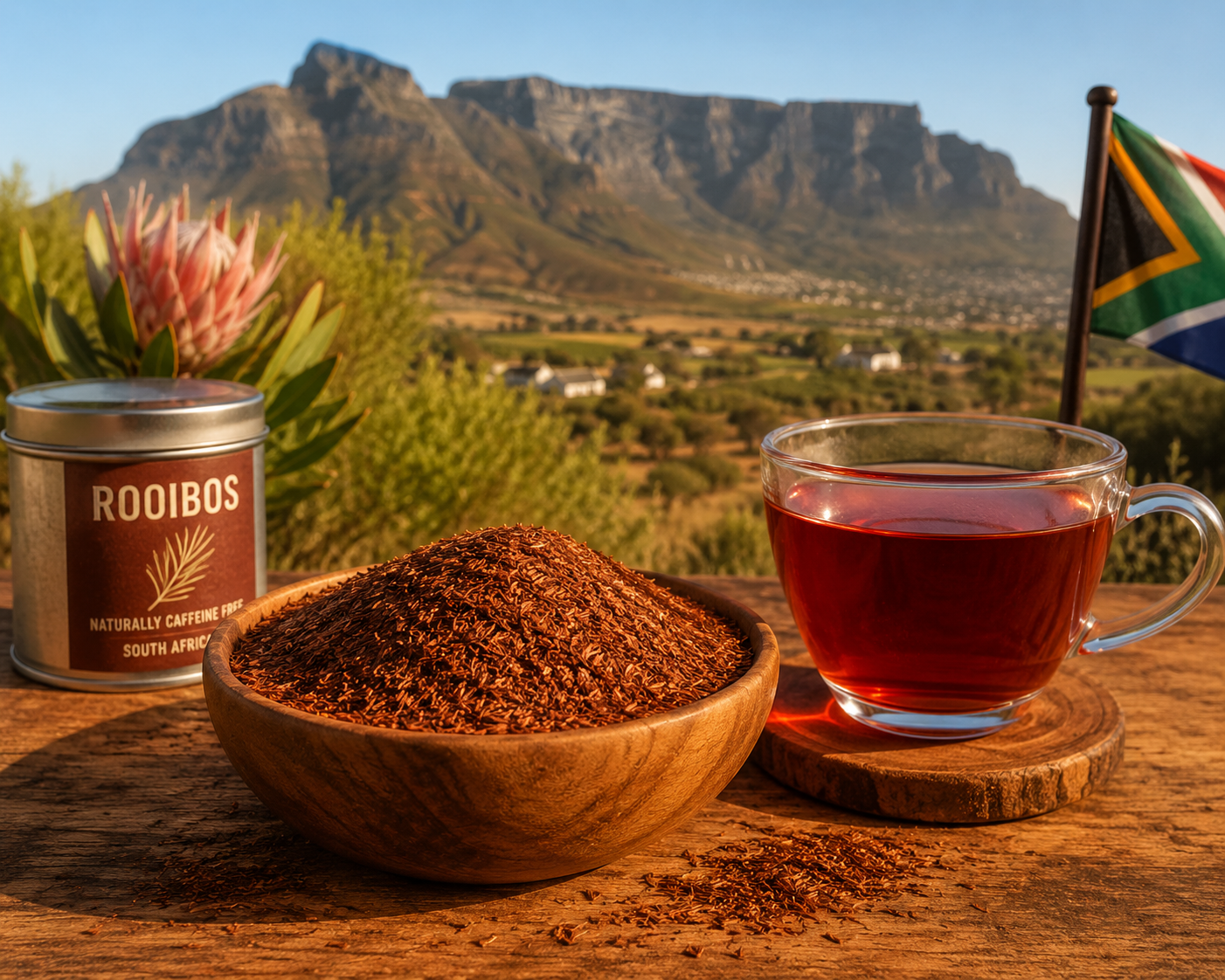
Rooibos is one of the most iconic drinks in South Africa and, more broadly, in the culinary culture of Southern Africa. Often mistakenly called "red tea," rooibos is not a tea in the botanical sense of the word, but an infusion made from the leaves of a South African shrub, Aspalathus linearis. Appreciated for its amber color, its soft and round taste, its slightly woody and sometimes vanilla notes, rooibos holds a unique place in African cuisine. It can be drunk hot or cold, plain or flavored, and it accompanies everyday moments as well as festive meals, convivial breaks, and certain family traditions. In African cuisine, rooibos is much more than a drink. It embodies South African identity, the deep relationship between local biodiversity and food culture, as well as the African art of transforming an endemic plant into a daily and prestigious consumer product. Its place is particularly strong in homes, cafes, hotels, gourmet restaurants, and even in some recipes where it is used as a liquid base for sauces, desserts, or marinades.
WHAT IS ROOIBOS?
Rooibos is a South African infusion prepared from the leaves and thin stems of a shrub that grows mainly in the Cederberg region of the Western Cape. The word "rooibos" literally means "red bush" in Afrikaans, referring to the reddish color the leaves take after oxidation and drying. We generally distinguish between: • fermented red rooibos • unfermented green rooibos, closer to the plant's natural product Rooibos is appreciated for several reasons: • it contains no caffeine • it has a mild and slightly bitter flavor • it can be consumed by children and in the evening • it pairs very well with milk, honey, lemon, or spices This drink has become a symbol of a local African product transformed into an international brand.
ORIGINS AND HISTORICAL CONTEXT OF ROOIBOS
Rooibos has a history deeply linked to the knowledge of local South African populations. Indigenous communities had long used the plant to prepare infusions with soothing properties. Later, the drink was adopted, cultivated, and commercialized on a larger scale. The expansion of rooibos particularly developed in the 20th century when it became a popular product in South Africa and then abroad. Its reputation was built on its mildness, its lack of caffeine, and its natural association with well-being. Rooibos is also part of a broader history of African cuisine: that of a progressive valorization of local resources. Like fonio in West Africa or bissap in other regions, rooibos represents a drink rooted in the land, culture, and transmission.
THE PLACE OF ROOIBOS IN AFRICAN CUISINE
Rooibos holds an important place in African cuisine, especially in Southern Africa, for several reasons.
- An identity drink Rooibos is one of South Africa's most emblematic drinks. It is often presented as a national and culturally representative product.
- A healthy and convivial alternative Caffeine-free, mild, and versatile, it is suitable for all ages and many occasions.
- A cooking ingredient Rooibos is not only drunk: it is also used in cooking, particularly in desserts, jellies, syrups, marinades, or sauces.
- A local product It reflects the importance of local flora in African gastronomy and the attachment to products deeply linked to African soil.
THE TASTE AND AROMATIC PROFILE OF ROOIBOS
Rooibos has a very particular taste profile: • mild • naturally slightly sweet • woody • round • sometimes vanilla or honeyed • almost no bitterness Red rooibos, which is oxidized, is warmer and deeper. Green rooibos, which is unoxidized, is more vegetal and fresher. These qualities make it a drink that is easy to pair with many foods.
HOW TO CONSUME ROOIBOS?
Rooibos can be consumed in multiple ways: • hot infusion • iced drink • rooibos with milk • rooibos with honey • lemon rooibos • spiced rooibos • rooibos with ginger • rooibos in a non-alcoholic cocktail • rooibos used in cooking In South African homes, it is often served in the afternoon, in the evening, or after meals. It can also be served at breakfast.
ROOIBOS IN AFRICAN CULINARY TRADITIONS
Rooibos is particularly linked to daily life in South Africa, but it has also found its place in modern gastronomy. It is found: • in family homes • in restaurants • in tasting menus • in hotels • in pastries and desserts • in summer cold drinks This versatility makes it a culinary product in its own right. It can accompany a light dish, a sweet dessert, or a simple relaxing break.
ROOIBOS PAIRINGS
Rooibos pairs very well with: • biscuits • cakes • tarts • scones • buttered bread • fresh fruits • pastries • honey • milk • mild spices In an African context, it gladly accompanies snacks, afternoon teas, or family breakfasts.
DRINKS AND VARIATIONS AROUND ROOIBOS
Rooibos can be made into many drinks: • plain rooibos • rooibos with milk • vanilla rooibos • cinnamon rooibos • ginger rooibos • orange rooibos • iced lemon rooibos • mint rooibos These variations show how adaptable the drink is to contemporary tastes.
NUTRITIONAL BENEFITS OF ROOIBOS
Rooibos is often appreciated for its qualities as a light and natural drink. Main benefits • caffeine-free • low in calories • source of hydration • contains antioxidants • can be consumed at any time of day • suitable for people avoiding coffee or caffeinated tea Rooibos contains natural antioxidant compounds that are of interest to many people concerned about their diet. It does not replace a balanced diet, but it is a pleasant and light drink.
APPROXIMATE NUTRITIONAL VALUES
For a cup of plain unsweetened rooibos, the values are very low: • Calories: approximately 0 to 5 kcal • Carbohydrates: 0 g • Proteins: 0 g • Fats: 0 g • Fiber: 0 g • Salt: 0 g • Vitamins: variable traces depending on the infusion • Minerals: small amounts of natural minerals Nutritional details • Calories: almost zero in plain version • Carbohydrates: absent or negligible • Fats: absent • Proteins: absent • Vitamins and minerals: present in small quantities, but not a major contribution If milk, sugar, or honey are added, the nutritional intake obviously increases.
ROOIBOS AND HEALTH
Rooibos is often sought after for its mild and reassuring profile. It is appreciated because it: • does not stimulate like coffee • can be drunk in the evening • is well tolerated by many people • fits into a light diet It is particularly popular in contexts of relaxation, well-being, and family consumption.
ROOIBOS IN MODERN AFRICAN CUISINE
Modern African cuisine increasingly uses rooibos beyond simple infusion: • in sauces • in syrups • in desserts • in creams • in non-alcoholic cocktails • in marinades for meat or fish Rooibos can bring a subtle, slightly woody and sweet note to a culinary preparation. It has therefore become a creative ingredient in contemporary gastronomy.
WHY IS ROOIBOS IMPORTANT IN AFRICAN CUISINE?
Rooibos is important because it embodies several values: • South African identity • the valorization of a local plant • simplicity and elegance • culinary adaptability • the connection between tradition and modernity It is a drink that tells the story of Southern Africa through a unique product, deeply linked to its terroir.
TIPS FOR PREPARING ROOIBOS WELL
- Steep long enough Generally, 5 to 8 minutes gives a good balance.
- Avoid excess sugar Rooibos is naturally sweet.
- Try iced rooibos Very refreshing in warm weather.
- Add lemon or honey to taste This enriches its aromatic profile.
- Serve it with light pastries It pairs very well with afternoon snacks.
CONCLUSION
Rooibos is one of the great emblematic drinks of African cuisine, particularly in South Africa. Mild, caffeine-free, versatile, and deeply linked to its terroir, it holds a unique place between an everyday drink, a traditional product, and a modern cooking ingredient. Its popularity continues to grow because it combines health, pleasure, and cultural identity. In African gastronomy, rooibos is much more than an infusion: it is a symbol of local know-how and natural refinement.
ENJOY YOUR MEAL!
🍩 A contemporary pastry use
In 2026, chef Huwitt Strydom presented a rooibos koesister for World Koesister Day. This documents a culinary use of rooibos beyond drinking it as an infusion. It is a contemporary interpretation of the Cape Malay pastry, not evidence that rooibos is required in a traditional koesister. The distinction from the plaited koeksister remains useful.
Prepare this speciality
Choose a detailed recipe, adjust the portions and prepare your ingredients before starting. Our cooking tips and food safety advice complement the steps described in the recipes.
Explore further: Cooking tips · Food hygiene and safety advice.
In my books

Continue exploring the continent’s cuisines with Africa at the Table — 54 countries, 54 iconic dishes, by Alioune FALL. This book is in English.
In the kitchen : Rooibos
Recipes from the site to put your knowledge into practice:
Discover these cuisines at a restaurant
Explore our restaurant and caterer directories. Choose your destination and check the establishment’s menu to confirm which dishes are offered and available.
Continue exploring
Enjoy discovering ingredients and African cuisines? Join our newsletter. The illustrated PDF 10 sauces africaines incontournables is in French and is offered after confirming a subscription to the French or bilingual edition.