Satini
Seychelles
Understanding : Satini
🌿 INTRODUCTION
Satini holds a very special place in Seychellois gastronomy. More than just a side dish, it is a fresh, spicy, and expressive preparation that frequently accompanies fish, meat, seafood, or vegetable dishes. In the Seychellois culinary imagination, satini is not just a sauce: it is a marker of identity, a way of connecting the table to gardens, markets, harvests, seasons, and family habits. Its presence is discreet but essential, as it brings contrast, relief, and vivacity to dishes that are often rich, stewed, or fragrant.
Beyond its local place, satini is part of a broader set of African and Afro-Oceanic traditions where fresh condiments play a fundamental role. In many cuisines of the African continent, a tangy, spicy, or herbaceous preparation balances a main dish. Satini participates in this logic: it refreshes, stimulates the appetite, enhances flavors, and gives character to the entire meal. It is a perfect example of how a sauce can become a central element of culinary identity.
Where to find it
Look for the exact food-grade form required by the recipe at markets and specialist shops. Check the product name, ingredients, condition and storage instructions.
Explore further: Cooking tips · Food hygiene and safety advice.
History and uses
🇸🇨 ORIGIN AND SEYCHELLOIS CONTEXT
The Seychelles form an archipelago where culinary traditions have been built in an island environment, with African, Malagasy, European, Indian, and Asian influences. Satini naturally finds its place there, as it meets a very concrete need: to accompany seafood and stewed dishes with a fresh and pungent note. The word satini alone evokes the Creole culture of the Indian Ocean. It refers to a family of condiments that can vary according to the islands, families, and available products. In the Seychelles, satinis are often found based on fruits, grated vegetables, lime, chili, herbs, and aromatics. This flexibility is important: it shows that Seychellois cuisine is alive, adaptable, and deeply linked to local resources.
In a country where the sea provides a large part of the food, satini plays a balancing role. It counteracts the fat of fried fish, the richness of a curry, the sweetness of a stew, or the density of a rice dish. It brings a vegetal and acidic dimension that lightens the meal.
🌶️ COMPOSITION AND FLAVOR PROFILES
There is not one single version of satini, but several forms, often depending on the main ingredient used. Satini can be prepared with:
- tomatoes
- onions
- chili
- lime
- cucumber
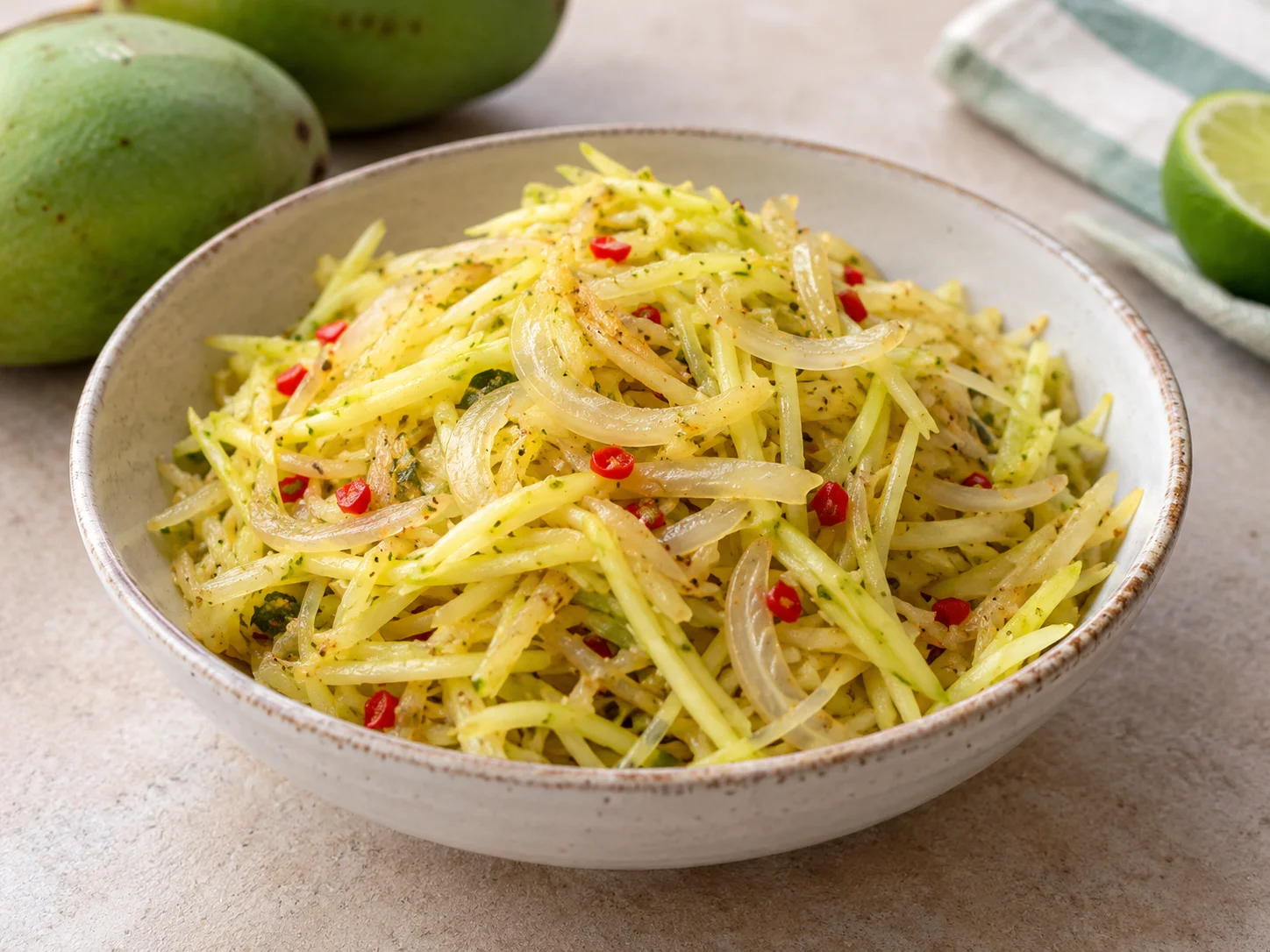
- green papaya
- grated coconut
- fresh herbs
- sometimes tamarind or other tart fruits The principle remains the same: to create a lively, crunchy, or juicy condiment, often prepared raw or with very light cooking. The texture can be fine, grated, or chopped. The taste is generally marked by acidity, spiciness, freshness, and sometimes a slight vegetal sweetness. What makes satini strong is its balance. Too acidic, it would dominate the dish. Too sweet, it would lose its function. Too spicy, it would mask other flavors. Satini is therefore distinguished by its gustatory intelligence: it does not overpower, it accompanies and reveals.
🐟 WITH WHICH DISHES IS SATINI SERVED?
Satini is very often served with fish dishes, including:
- grilled fish
- fried fish
- fish in sauce
- seafood
- octopus
- curries
- grilled meats It can also accompany rice, bread, cassava, or vegetables. In Seychellois meals, it brings a note that awakens the palate. It can be considered a “bridge” between the main dish and the flavors of the table. On a plate composed of rice, fish, and a stew, satini introduces freshness. It plays a role very similar to that of certain salsas, achards (pickles), chutneys, or condiment salads from other regions of the world. But in the Seychelles, it has its own identity, linked to the creoleness of the archipelago.
🌍 SATINI IN AFRICAN CUISINE
To understand the place of satini in African cuisine, one must think of the continent's cuisine as a set of regional traditions linked by common logics. Satini fits into several of these logics. 🧅 1. The culture of the condiment In many African cuisines, a meal is not complete without an accompaniment that enhances, spices up, or refreshes. Whether one thinks of sauces, relishes, tomato salads, herb condiments, or spicy preparations, the principle is the same: to balance the main dish. Satini belongs to this large family of accompaniments that structure taste. 🌊 2. Coastal and island cuisines Satini has an obvious kinship with the cuisines of the African coasts and the Indian Ocean. In areas where fish is abundant, fresh condiments are often favored to accompany seafood. This logic is found in Madagascar, Mauritius, Comoros, on the Swahili coast, or in certain regions of Mozambique and Tanzania. 🌿 3. The valorization of freshness African cuisine is not only made up of long-simmered dishes. It also knows how to value raw, grated, chopped, and marinated ingredients. Satini demonstrates this ability to make freshness a central element of the meal. It reminds us that African cuisine is also a cuisine of contrasts. 🔥 4. Spiciness as a culinary language Chili occupies an important place in a large part of the African continent. It is not only there to be “strong” but to structure taste. In satini, chili can be more or less present, but it often contributes to the condiment's signature. It gives relief, energy, and a sensation of vivacity.
In my books

Continue exploring the continent’s cuisines with Africa at the Table — 54 countries, 54 iconic dishes, by Alioune FALL. This book is in English.
Explore further
🥥 VARIATIONS AND ADAPTATIONS
Satini can be very different depending on the household. Some families favor a very simple, almost minimalist satini, with a few tomatoes, onions, lime, and chili. Others add grated coconut for a richer texture and a sweeter flavor. Still others prefer versions based on green fruits, such as papaya, to achieve a balance between acidity and crunch. This diversity shows that satini is not a fixed object. It adapts to available products, the season, the type of dish served, and personal tastes. It can be prepared quickly, just before the meal, or left to rest slightly for the aromas to blend.
🍽️ SOCIAL AND FAMILY DIMENSION
Satini also has a social value. Like many traditional condiments, it is linked to everyday cooking, family transmission, and the memory of gestures. One often learns to prepare it by watching elders, by tasting, adjusting, and correcting. This empirical transmission is characteristic of many African traditions. Satini says something about the way people eat together. It creates a link between dishes, encourages the exchange of tastes, and allows everyone to adjust their plate according to their preferences. It is never uniformly imposed; it is chosen, dosed, and shared.
🎨 CULINARY SYMBOLISM
Satini may seem modest, but it embodies a very strong idea: cuisine is not limited to abundance or complexity. Sometimes, a small fresh preparation is enough to transform an entire meal. From this perspective, satini symbolizes:
- freshness
- controlled simplicity
- balance
- Creole memory
- openness to African and oceanic influences It is a reminder that culinary richness is not only about expensive ingredients but also about the accuracy of combinations.
🏝️ CONCLUSION
Satini holds an essential place in Seychellois cuisine, and more broadly in the African cuisine of the islands and coasts. It is a seemingly discreet preparation, but decisive in the meal experience. It brings freshness, acidity, spiciness, and relief, while connecting the table to broader African and Creole culinary traditions.
Understanding satini means understanding a way of cooking where the condiment is not a simple addition but a structuring element. It is also discovering how African cuisine knows how to combine sea, garden, spices, and family memory in simple but refined preparations. Satini is thus a small monument of Seychellois cuisine: humble, indispensable, and profoundly alive.
In the kitchen : Satini
Recipes from the site to put your knowledge into practice:
Discover these cuisines at a restaurant
Explore our restaurant and caterer directories. Choose your destination and check the establishment’s menu to confirm which dishes are offered and available.
Continue exploring
Enjoy discovering ingredients and African cuisines? Join our newsletter. The illustrated PDF 10 sauces africaines incontournables is in French and is offered after confirming a subscription to the French or bilingual edition.