Cassava leaves
Africa
Understanding : Cassava leaves
🇦🇫 INTRODUCTION
Cassava leaves hold a significant place in many African cuisines, especially in West Africa, Central Africa, and some parts of East Africa. They are valued for their deep, earthy flavor, their ability to enrich sauces, and their nutritional value when properly prepared. In several African countries, cassava leaves are more than just a vegetable: they represent a culinary tradition, an accessible food resource, and a central element of local gastronomic identity.
Cassava itself is a fundamental plant in African diets. While its root is widely consumed as a tuber, flour, or paste, its leaves are also a prominent food. They are often simmered for a long time with palm oil, fish, meat, peanuts, or spices, depending on the region. However, their preparation requires skill and patience, as they must be properly processed to be edible and flavorful.
Prepare this speciality
Choose a detailed recipe, adjust the portions and prepare your ingredients before starting. Our cooking tips and food safety advice complement the steps described in the recipes.
Explore further: Cooking tips · Food hygiene and safety advice.
History and uses
🌿 ORIGIN AND SPREAD IN AFRICA
Cassava is not native to Africa; it originates from South America. It was introduced to the African continent from the 16th century onwards and gradually established itself as a major food crop. Its adaptation to tropical climates and its drought resistance made it an essential resource for many populations. Over time, cassava leaves also became a staple food in several African countries. Today, cassava leaves are consumed in various forms in Sierra Leone, Liberia, Congo, the Democratic Republic of Congo, Angola, Cameroon, Guinea, Ivory Coast, Tanzania, Zambia, and other regions. Each area has its techniques, seasonings, and ingredient combinations. This diversity shows that cassava leaves have integrated into various culinary cultures while maintaining a strong identity.
🥬 TRADITIONAL PREPARATION OF CASSAVA LEAVES
Cassava leaves are not consumed raw. They must be carefully prepared to remove their bitterness and ensure proper cooking. Traditionally, they are:
- thoroughly washed
- pounded or finely ground
- sometimes blanched or pre-cooked
- then simmered for a long time This long cooking is essential. It softens the fibers, reduces undesirable compounds, and develops a pleasant texture. In some regions, they are hand-pounded in a mortar until a green paste is obtained. Elsewhere, they are finely chopped before being incorporated into a sauce. This preparation step is important because it is part of the culinary heritage. It involves time, effort, and often a collective dimension. Preparing cassava leaves can be a family or community activity, where several people participate in processing the leaves.
🍲 EMBLEMATIC DISHES MADE WITH CASSAVA LEAVES
Cassava leaves are at the heart of several well-known African dishes. Among them are:
- saka saka
- pondu
- kontomire in some similar regional variations
- cassava leaf sauces with peanuts
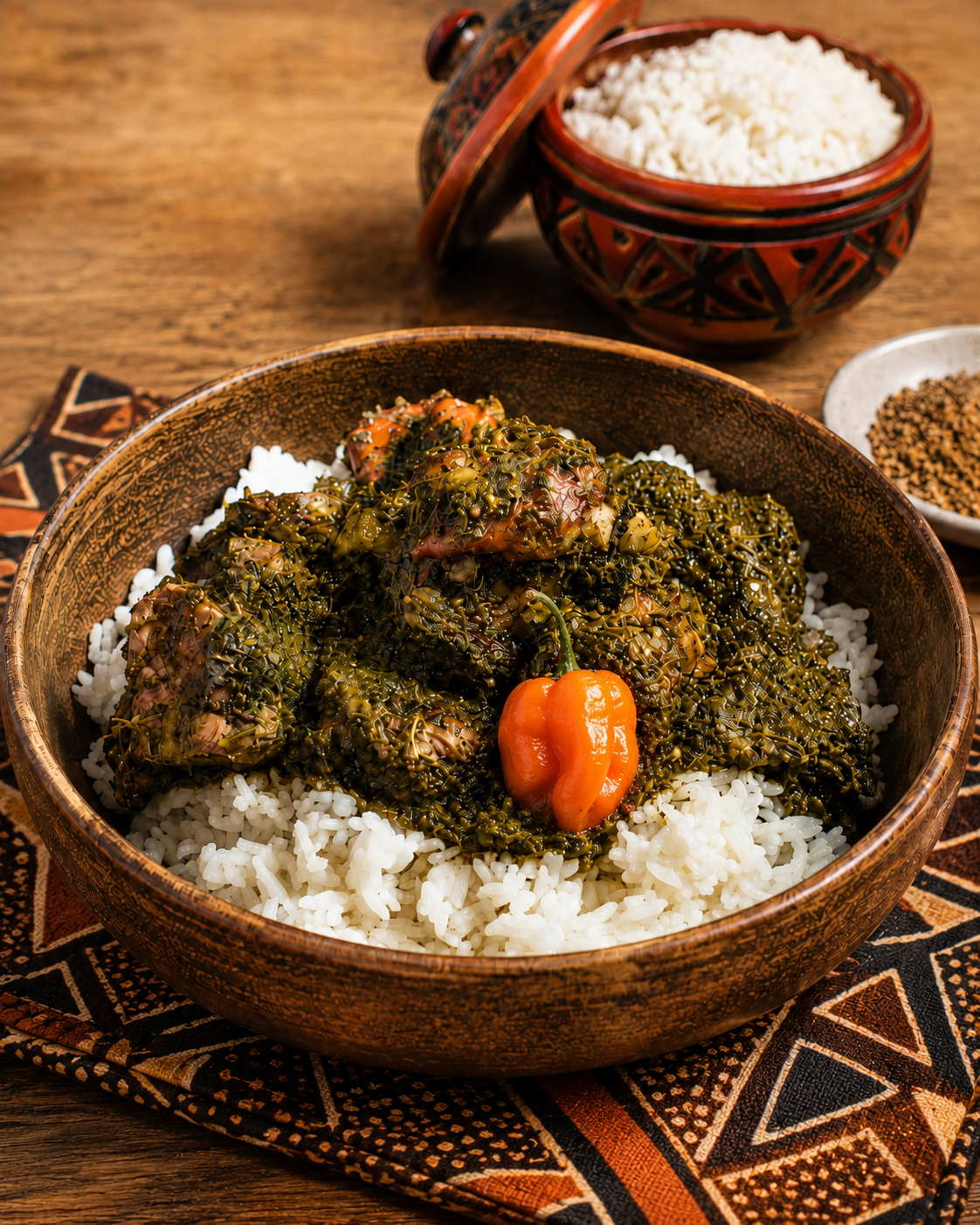
- fish or meat stews with cassava leaves In Central Africa, cassava leaves are often cooked with palm oil and served with smoked fish, dried meat, or fresh meat. In West Africa, they can be prepared in rich sauces, sometimes with peanuts or complementary vegetables. The result is almost always a dense, flavorful, and nourishing sauce. In many households, these dishes are served with rice, fufu, cassava, yam, plantain, or other starches. Cassava leaves then play the role of the main sauce, providing color, taste, and consistency to the meal.
🌍 THE PLACE OF CASSAVA LEAVES IN AFRICAN CUISINE
Cassava leaves hold a central place in African cuisine for several reasons. 🧡 1. A local and accessible resource In many rural areas, cassava grows easily and requires relatively little maintenance. Its leaves are therefore available close to homes. This makes it an economical, practical, and valuable food for families. 🌱 2. A cuisine of transformation African cuisine often places great importance on the transformation of raw products. Cassava leaves perfectly illustrate this logic. They are unappetizing when raw but become delicious after patient preparation. This transformation is at the heart of many African culinary traditions. 🔥 3. A place in daily meals Cassava leaves are not only reserved for special occasions. They are part of the daily diet in many households. They constitute a complete dish or a sauce base in simple but nourishing family meals. 🐟 4. An association with local proteins Cassava leaves are often associated with flavorful ingredients such as smoked fish, snails, meat, peanuts, or palm oil. This reflects a common logic in African cuisine: balancing plant products with elements that enhance the depth of the dish.
In my books

Continue exploring the continent’s cuisines with Africa at the Table — 54 countries, 54 iconic dishes, by Alioune FALL. This book is in English.
Explore further
🌶️ TASTE, TEXTURE, AND CHARACTER
The taste of cassava leaves is vegetal, deep, sometimes slightly bitter, but this bitterness often disappears after prolonged cooking. Their texture becomes tender when well-simmered. They absorb the aromas of spices, oil, and accompanying ingredients very well. Depending on the recipe, one can obtain:
- a thick and creamy sauce
- a drier preparation
- a stew rich in palm oil
- a lighter and greener version Their taste is often compared to that of other long-cooked leaves, but cassava leaves have their own identity, marked by an earthy depth and a strong ability to carry flavors.
🧑🍳 TRANSMISSION AND KNOW-HOW
The preparation of cassava leaves is not always learned from books. It is passed down in families, through observation, repetition, and correction. One learns to recognize the right texture, the right cooking time, the right level of seasoning. This oral and practical transmission is typical of many African culinary traditions. In some communities, knowing how to prepare cassava leaves is a sign of culinary mastery. The gestures may seem simple, but they require attention. If undercooked, the leaves remain fibrous and bitter. If overcooked, they lose their freshness. Balance is therefore essential.
🌿 NUTRITIONAL VALUE
Cassava leaves are appreciated not only for their taste but also for their nutritional richness. They contain:
- fiber
- vitamins
- minerals
- vegetable proteins in significant quantities compared to other leaves They thus contribute to dietary diversity. In contexts where food security is important, they represent a valuable resource. When properly prepared and accompanied by other foods, they contribute to a complete and balanced meal.
🏺 CULTURAL AND SOCIAL DIMENSION
Cassava leaves are not just an ingredient. They are a symbol of resilience, adaptation, and culinary ingenuity. In many African societies, cooking cassava leaves means valuing a plant useful in all its parts. Nothing is lost, everything is transformed. They also tell a story of sharing. Preparing a large dish of cassava leaves can bring together family, neighbors, or guests around a common meal. This type of dish promotes conviviality and mutual aid.
🌏 CONCLUSION
Cassava leaves hold a major place in African cuisine. They embody a food tradition deeply linked to the land, patience, and culinary creativity. Used in sauces, stews, and family dishes, they cross regional borders while maintaining strong local identities.
Whether called saka saka, pondu, or otherwise depending on the region, cassava leaves remain a symbol of the richness of African cuisines. They show how a modest plant can become, thanks to human know-how, an essential, nourishing, and culturally significant food.
In the kitchen : Cassava leaves
Recipes from the site to put your knowledge into practice:
Discover these cuisines at a restaurant
Explore our restaurant and caterer directories. Choose your destination and check the establishment’s menu to confirm which dishes are offered and available.
Continue exploring
Enjoy discovering ingredients and African cuisines? Join our newsletter. The illustrated PDF 10 sauces africaines incontournables is in French and is offered after confirming a subscription to the French or bilingual edition.