Ful medames
Sudan, South Sudan
Understanding : Ful medames
🌍 INTRODUCTION
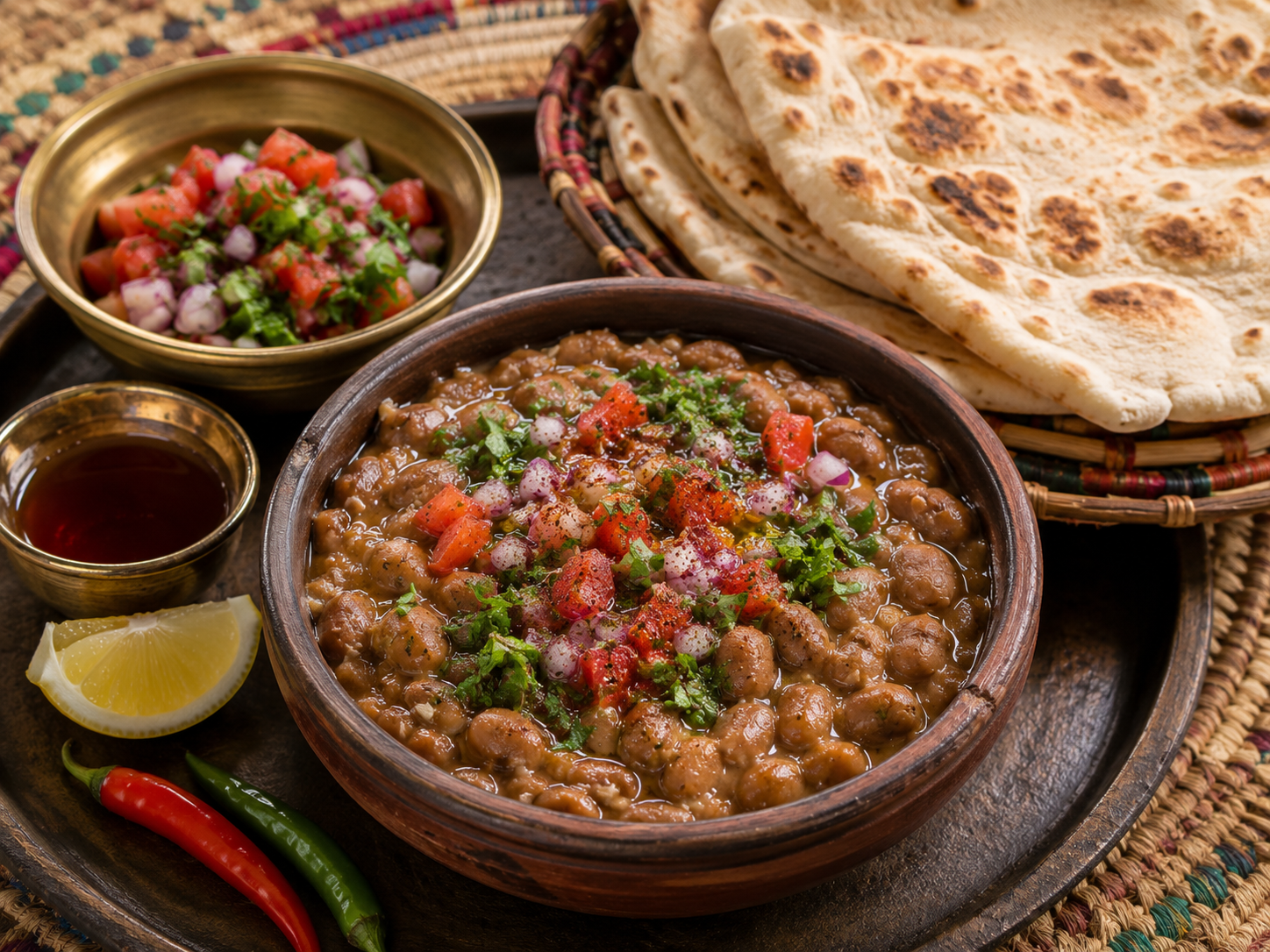
Ful medames is one of the oldest, simplest, and most iconic dishes in North Africa and the Arab world. Prepared from slow-cooked fava beans (broad beans) seasoned with oil, lemon, garlic, onions, cumin, and sometimes tomatoes or eggs, it holds a prominent place in the daily diet of millions of people. In Egypt, where it is particularly famous, it is often considered a national dish, but its influence extends far beyond Egyptian borders. It can be found in various forms in Sudan, Ethiopia, Eritrea, Somalia, the Levant, and other cultural areas linked to Africa and the Mediterranean.
Ful medames is much more than just a simple bean dish. It embodies a cuisine of patience, slow cooking, and nourishing simplicity. In African cuisine, it holds an important place because it meets a fundamental need: to nourish economically, deliciously, and sustainably. Its ancient history, its ability to transcend eras, and its adaptation to different contexts make it a deeply cultural food.
Prepare this speciality
Choose a detailed recipe, adjust the portions and prepare your ingredients before starting. Our cooking tips and food safety advice complement the steps described in the recipes.
Explore further: Cooking tips · Food hygiene and safety advice.
History and uses
🏺 HISTORICAL ORIGINS AND CULTURAL ROOTS
Ful medames has very ancient roots, probably linked to the first civilizations of the Mediterranean basin and the Nile Valley. Fava beans have been consumed for centuries in the region because they were easy to cultivate, nutritious, and available in quantity. Ful medames became a popular preparation due to its simple cooking and high energy value.
The word ful refers to the fava bean, while medames refers to slow cooking, often in a closed container or buried in hot ashes according to older practices. This cooking method gives the dish a melting texture and a deep flavor. The use of prolonged cooking demonstrates ancient culinary know-how, designed to extract the best from a humble ingredient.
In Egypt, ful medames is traditionally eaten for breakfast or as a light main meal. In other regions of Africa, it can be served at other times of the day, depending on local customs.
🫘 FAVA BEANS: A FUNDAMENTAL FOOD
Fava beans are at the center of ful medames. They are appreciated for their richness in plant proteins, fiber, and essential nutrients. In many African cuisines, legumes play a crucial role because they provide protein at a lower cost. Ful medames fully fits into this logic. The fava beans are first soaked then cooked very slowly. This cooking transforms them into a tender and soft base. Once cooked, they are seasoned with simple but powerful ingredients:
- olive oil or other vegetable oil
- lemon juice
- garlic
- cumin
- salt
- pepper
- onions
- tomatoes
- parsley
- chili according to taste
- hard-boiled eggs in some versions The dish can be lightly mashed or left whole depending on the desired texture. This flexibility explains its great popularity. It can be rustic, refined, spicy, or very mild.
🍋 TASTE, TEXTURE AND CULINARY PLEASURE
Ful medames is distinguished by a deep and comforting flavor. The fava beans, after long cooking, become melting. The oil brings creaminess, the lemon freshness, the cumin an aromatic warmth, and the garlic a savory intensity. The whole creates a much-appreciated balance. The taste of ful medames is not spectacular in the modern sense of the term; it is rather solid, stable, and generous. It is a dish that satisfies and comforts. Its simplicity is precisely what makes it strong. It shows how a small number of well-chosen ingredients can produce great culinary satisfaction.
🍽️ WAYS TO SERVE IT
Ful medames can be served in multiple ways depending on the country and families. In Egypt, it is often accompanied by:
- flatbread
- falafel
- eggs
- tahini
- salad
- pickles
- cheese In other regions, it can be eaten with local bread, rice, or other accompaniments. It can also be offered in family meals, street stalls, or popular breakfasts. This diversity of service shows that ful medames is not a fixed dish. It is flexible, adaptable, and integrated into daily eating habits. It can feed an entire family or be sold as an individual portion on the street.
In my books

Continue exploring the continent’s cuisines with Africa at the Table — 54 countries, 54 iconic dishes, by Alioune FALL. This book is in English.
Explore further
🌍 PLACE OF FUL MEDAMES IN AFRICAN CUISINE
Ful medames holds an important place in African cuisine for several reasons. 🫘 1. A nourishing and accessible legume In many African contexts, legumes are essential for dietary balance. The fava beans in ful medames represent an affordable and sustainable source of plant protein. 🔥2. The value of slow cooking Slow cooking is a common characteristic of many African cuisines. Ful medames illustrates this tradition where time is an integral part of the flavor. 🌾 3. A daily and shared dish Ful medames is a popular, simple, and convivial food. It is consumed by all social classes in some countries, which gives it a strong cultural scope. 🌍 4. Trans-African and Mediterranean circulation Although strongly associated with Egypt, ful medames circulates in several African areas. It shows how the cuisines of the continent interact with those of the Near East and the Mediterranean. 🧄 5. A sober and intelligent seasoning logic African cuisine often knows how to make the most of a few essential ingredients. Ful medames is a perfect example: few elements, but a remarkable balance.
🏺 SOCIAL AND URBAN HISTORY
Ful medames is also a dish of the city, market, and street. In Egypt, it has long been sold by street vendors, which contributed to its massive spread. It has become a food for workers, students, families, and passers-by. Its affordable price and its ability to satisfy have made it a symbol of popular cuisine. This urban character does not erase its domestic dimension. On the contrary, it shows how a dish can circulate between homes, streets, and cafes, while maintaining its identity. Ful medames is therefore both traditional and vibrant.
🌿 NUTRITIONAL VALUE AND DIETARY IMPORTANCE
Ful medames is particularly appreciated for its nutritional value. It provides:
- plant proteins
- fiber
- iron
- magnesium
- sustainable energy It is therefore a very useful dish in diets where one seeks to combine satiety, balance, and accessibility. In many African households, this type of dish contributes to food security and meal diversity.
🌺 CONCLUSION
Ful medames is much more than a fava bean dish. It is a deep culinary heritage that connects North Africa, the Nile Valley, and several traditions of the Arab world. In African cuisine, it holds a special place because it embodies nourishing simplicity, controlled slowness, conviviality, and dietary intelligence.
Its ancient history, versatility, and nutritional richness explain its longevity. Today, it continues to be prepared in homes, sold on the street, and celebrated as an identity food. Ful medames shows that African cuisine knows how to transform a humble ingredient into a symbol of culture and continuity.
In the kitchen : Ful medames
Recipes from the site to put your knowledge into practice:
Discover these cuisines at a restaurant
Explore our restaurant and caterer directories. Choose your destination and check the establishment’s menu to confirm which dishes are offered and available.
Continue exploring
Enjoy discovering ingredients and African cuisines? Join our newsletter. The illustrated PDF 10 sauces africaines incontournables is in French and is offered after confirming a subscription to the French or bilingual edition.