Sadza
Zimbabwe
Understanding : Sadza
🌾 INTRODUCTION
Sadza is one of the most emblematic dishes of Zimbabwe, but also a food deeply rooted in the cuisine of a large part of Southern Africa. Prepared from cornmeal cooked in water until a thick and firm paste is obtained, it resembles other African preparations such as ugali, pap, nsima, or phutu. Yet, sadza has its own cultural and social identity. It is not just a staple food: it is a daily landmark, a symbol of the family table, and a marker of national identity.
In African cuisine, sadza holds an essential place because it fulfills several functions at once. It nourishes, satisfies, accompanies sauces, and brings people together around the same dish. In many Zimbabwean households, it is consumed almost daily. Its apparent simplicity hides a profound role in the domestic economy, the transmission of culinary knowledge, and social cohesion.
Prepare this speciality
Choose a detailed recipe, adjust the portions and prepare your ingredients before starting. Our cooking tips and food safety advice complement the steps described in the recipes.
Explore further: Cooking tips · Food hygiene and safety advice.
History and uses
🌽 Origins and cultural roots Sadza has its roots in the agricultural history of the southern African region. The introduction and widespread adoption of maize in this part of the continent profoundly transformed eating habits, even though ancient local cereals like sorghum and millet remained important. Over time, maize became the most common base for sadza, particularly due to its ease of cultivation, availability, and ability to feed large families. The word sadza refers to both the dish and the principle of preparation. It evokes a cooked, compact, and malleable paste, which is shaped by hand to accompany vegetables, meat, or sauces. In many families, knowing how to prepare good sadza is an essential skill, passed down from generation to generation. Sadza is also rich in memory. It refers to childhood, family meals, field work, evening reunions, and rural as well as urban life. It represents a form of continuity between past and present.
🍚 Traditional sadza preparation The preparation of sadza relies on a simple but precise technique. Water is first brought to a boil, then cornmeal is gradually added while stirring vigorously. This first phase results in a thick porridge. Then, more flour is added until the dough becomes firm, smooth, and well-cooked. The quality of sadza depends heavily on the gesture. One must know how to stir with force, avoid lumps, and achieve the right consistency. Good sadza should be neither too liquid nor too hard. It should be able to be formed into a portion with the hand, break easily, and absorb the sauce without falling apart too quickly. In some regions, different flours can be used or corn can be mixed with other cereals. However, corn remains the most common base today.
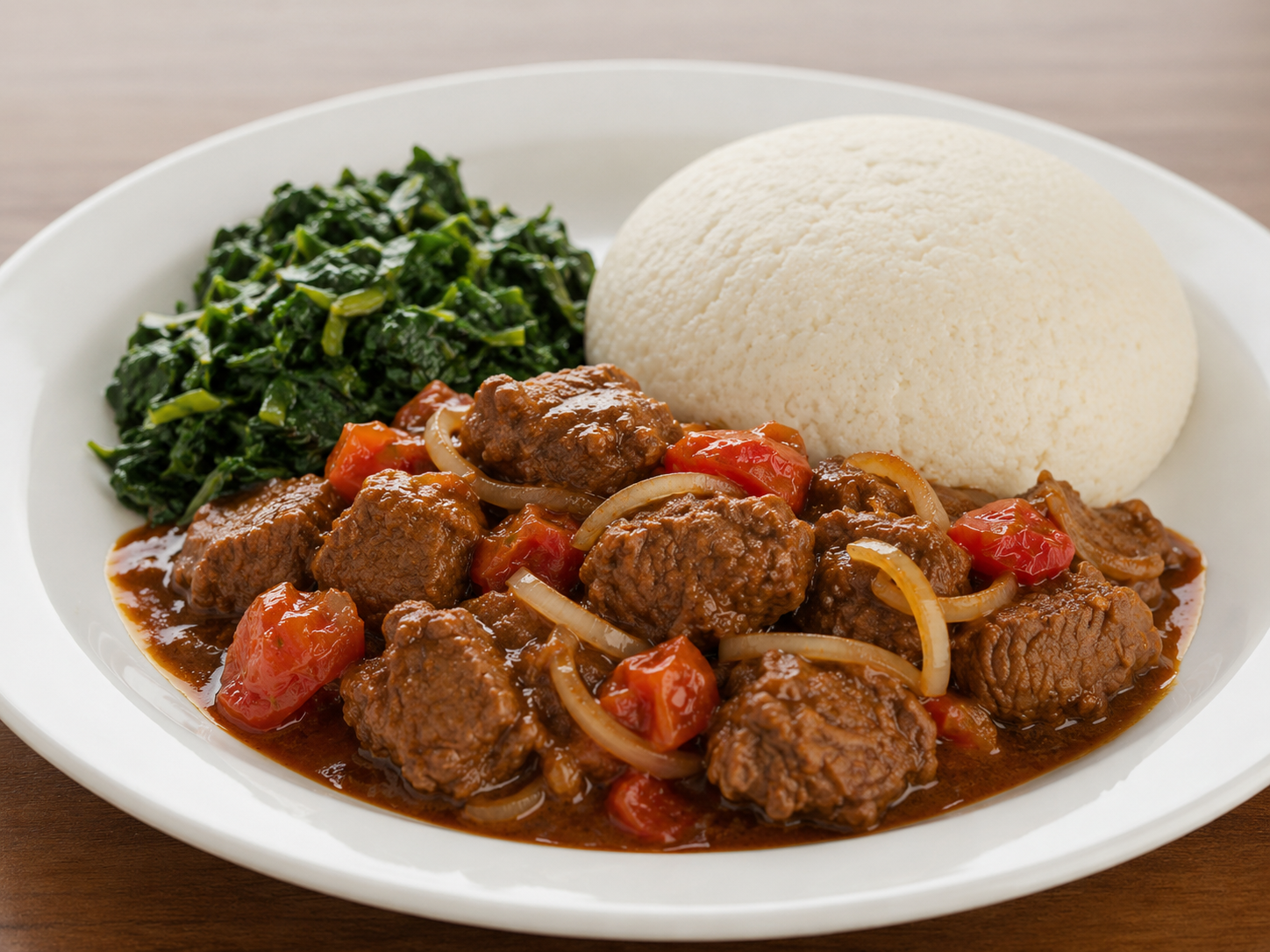
🍲 What do you eat sadza with? Sadza is rarely eaten alone. It is almost always accompanied by a relish, meaning a sauce, stew, or savory side dish. The combinations can be very varied:
- green leafy sauce
- beef stew
- chicken in sauce
- fish
- beans
- peanuts
- simmered vegetables
- tomato or onion sauces This association between sadza and accompaniment shows the culinary logic of many African cuisines: a nourishing base with a sauce that provides taste, moisture, and nutritional richness. Sadza serves as a support, a link, and a material for the meal. The act of eating is also important. A portion of sadza is taken with the hand, lightly shaped, then dipped into the sauce. This method of consumption is an integral part of the culinary experience.
In my books

Continue exploring the continent’s cuisines with Africa at the Table — 54 countries, 54 iconic dishes, by Alioune FALL. This book is in English.
Explore further
🌍 SADZA'S PLACE IN AFRICAN CUISINE
Sadza holds a major place in African cuisine for several reasons. 🌾 1. A daily staple food It feeds millions of people in Southern Africa and contributes to food security. 🍚 2. A simple but fundamental preparation With few ingredients, it allows for a complete and satisfying meal. 🤲 3. A dish for sharing Sadza is often served in a common dish, which strengthens family and community ties. 🧑🍳 4. Transmitted know-how Its preparation requires mastery of gesture and texture, passed down in households. 🌍 5. A strong regional culinary identity It is one of the emblematic dishes of Zimbabwe and Southern Africa, just like other cereal pastes on the continent.
🏡 SOCIAL AND FAMILY DIMENSION
Sadza is deeply linked to family life. It is often prepared for lunch or dinner and can be served to the whole family. In households, it constitutes a stable daily landmark. Its presence at the table is reassuring and familiar. In villages as well as in cities, sadza accompanies the rhythms of life: work, school, markets, celebrations, ceremonies. It is also a dish for visitors and hospitality when accompanied by a good stew. Its importance goes beyond the simple food aspect: it contributes to the organization of the household. Sadza is also associated with values of sobriety, sharing, and respect for resources. It shows how simple cuisine can be both nourishing and culturally rich.
🌿 NUTRITIONAL VALUE
Sadza, prepared from cornmeal, primarily provides carbohydrates, hence energy. When accompanied by vegetables, meat, fish, or legumes, it becomes a balanced meal. Its combination with rich sauces provides proteins, vitamins, minerals, and fiber. In rural areas, sadza often represents a solution adapted to the local availability of products. It can be prepared in large quantities and easily shared, making it practical for large families.
🌟 CONTEMPORARY CHALLENGES
Like many traditional dishes, sadza must today coexist with industrial foods, fast consumption patterns, and urban changes. Some young people consume it less often, especially in large cities where eating habits are evolving. However, sadza remains very present. It continues to be a strong symbol of Zimbabwean cuisine and an identity marker. Its simplicity, relatively affordable cost, and social role ensure its persistence.
🌺 CONCLUSION
Sadza is much more than a corn paste. It is a fundamental food of African cuisine, a symbol of Zimbabwe, and a marker of family life in Southern Africa. Its simple preparation, its nourishing role, and its ability to accompany a wide variety of sauces make it an essential dish.
In African culture, sadza reminds us that food is both practical, social, and symbolic. It shows how a modest food can become a pillar of culinary identity and collective memory.
In the kitchen : Sadza
Recipes from the site to put your knowledge into practice:
Discover these cuisines at a restaurant
Explore our restaurant and caterer directories. Choose your destination and check the establishment’s menu to confirm which dishes are offered and available.
Continue exploring
Enjoy discovering ingredients and African cuisines? Join our newsletter. The illustrated PDF 10 sauces africaines incontournables is in French and is offered after confirming a subscription to the French or bilingual edition.