Bushmeat
Africa
Understanding : Bushmeat
🌍 INTRODUCTION
Bushmeat, often referred to as wild game in more neutral language, holds a complex place in several regions of Africa. It cannot be summarized as a simple food category. It is at once a historical reality, a subsistence practice, a cultural issue, a local economic matter, and today a public health and environmental conservation concern. When discussing bushmeat in African cuisine, it is therefore necessary to avoid caricatures. One must consider differences between countries, regional traditions, national laws, the species involved, rural realities, and recent transformations due to urbanization, markets, and ecological concerns.
In several African societies, game consumption is part of a long history. Long before modern livestock farming circuits, hunting was part of food strategies, alongside fishing, gathering, and agriculture. It provided protein, fats, skins, bones, and participated in social systems of sharing. Even today, in some forested or isolated areas, bushmeat remains linked to the food security of households with few alternatives. But in parallel, its commercialization towards urban centers has created new imbalances, with higher health and ecological risks. 🍲🌿⚖️
Where to find it
Look for the exact food-grade form required by the recipe at markets and specialist shops. Check the product name, ingredients, condition and storage instructions.
Explore further: Cooking tips · Food hygiene and safety advice.
History and uses
🕰️ HISTORICAL ROOTS AND CULTURAL DIMENSIONS
In many African cultures, traditional hunting had rules. Certain species were avoided according to beliefs, others reserved for special occasions, and the distribution of meat sometimes followed a precise hierarchy: hunters, elders, families, guests. Game could be associated with ritual moments, community feasts, or prestige meals. In this context, bushmeat was not just “what we eat,” but also “what it means”: bravery, know-how, connection to the forest, transmission of knowledge, respect for certain taboos.
These cultural dimensions still exist in several territories, but they are evolving. Urbanization, the monetization of exchanges, and demand pressure are changing practices. Where hunting was once primarily oriented towards self-consumption, it can become a regular commercial activity. This shift from a subsistence logic to a market logic is central to understanding the current situation. It changes the scale of harvesting, the techniques used, distribution channels, and impacts on biodiversity. 🧭🏞️💬
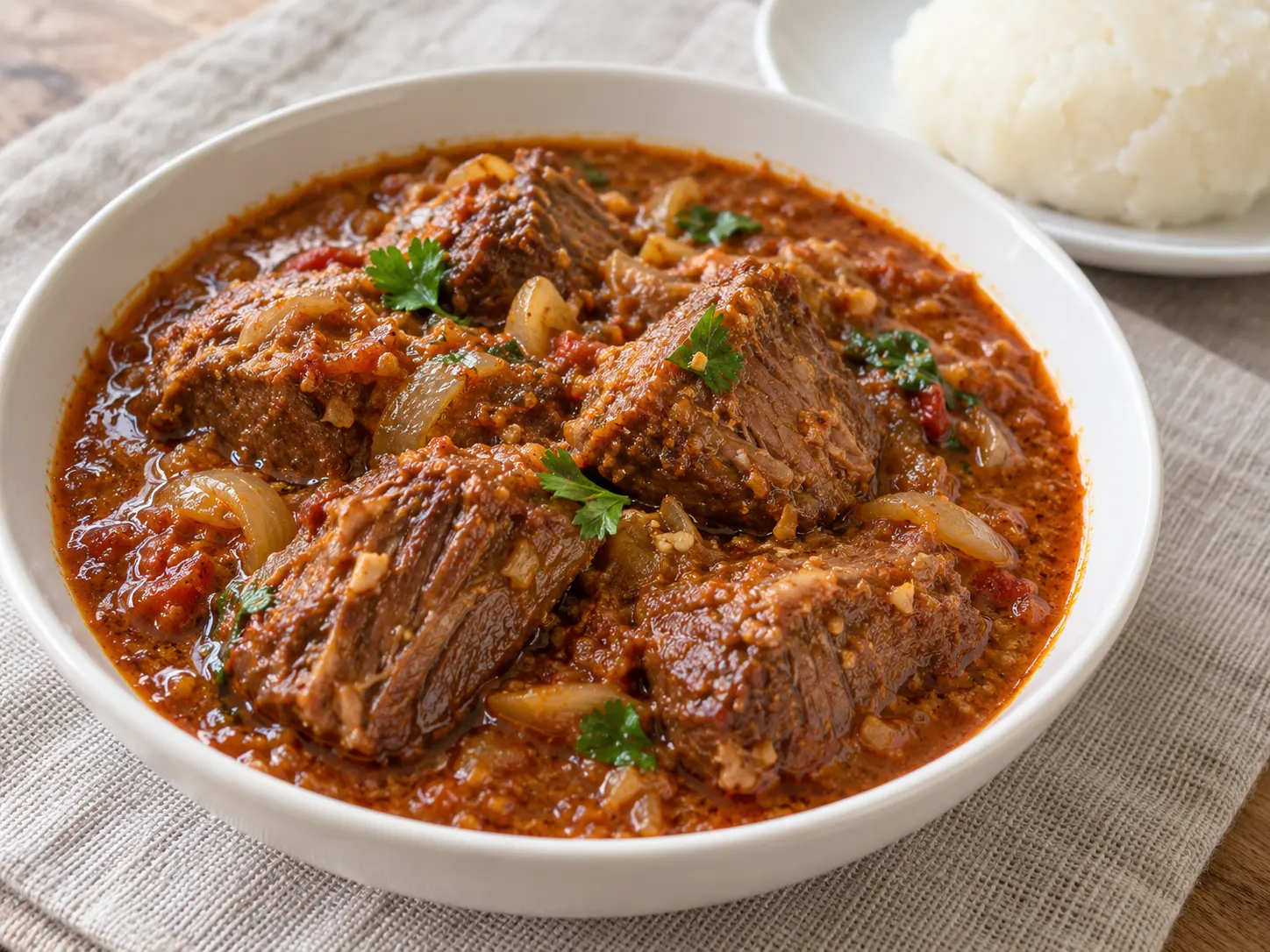
🍛 CULINARY PLACE: tastes, techniques, and table uses From a culinary perspective, bushmeat is appreciated for its specific flavors, often considered more pronounced than those of farmed meats. Depending on the species and regions, the texture can be firmer, the taste more “woody” or more “smoky,” especially when the meat is previously dried or smoked for preservation. In local cuisines, it is integrated into various preparations: long sauces, spicy stews, soups, grills, pot cooking with aromatic leaves, chili, garlic, ginger, onions, and sometimes peanut paste.
Cooking is often prolonged to tenderize the meat and develop the aromas. Smoking plays an important role in several areas: it allows the meat to be preserved longer, facilitates transport, and enhances the flavor profile. As an accompaniment, one finds the classic staples of many African cuisines: cassava, plantain, yam, corn, rice, millet, or sorghum depending on the regions.
It is important to emphasize that “bushmeat” is not a single dish, but a category of products used in very diverse cuisines. Recipes vary greatly between Central Africa, West Africa, East Africa, or Southern Africa, and even from one ethnolinguistic group to another. This diversity reminds us that there is not one uniform African cuisine, but plural African cuisines. 🍠🌶️🍚
💼 ECONOMIC ISSUES AND SOCIAL REALITIES
In some rural areas, hunting and selling game can represent a complementary, or even primary, source of income. When access to livestock farming is limited, infrastructure is weak, and formal markets are distant, bushmeat circuits establish themselves as a local economy. They involve hunters, transporters, smokers, market vendors, informal restaurateurs.
For precarious households, this chain can seem indispensable. This is why public responses cannot be solely repressive; they must also offer viable alternatives: local livestock farming, fish farming, access to refrigeration, support for domestic protein sectors, rural roads, microcredit, agricultural support. Without concrete options, prohibitions alone risk failing or shifting the problem to more clandestine circuits.
The social question is therefore central. Bushmeat cannot be analyzed solely in moral or symbolic terms. One must look at living conditions, food costs, protein availability, and real economic opportunities for the populations concerned. 👩🏾🌾📉🛒
In my books

Continue exploring the continent’s cuisines with Africa at the Table — 54 countries, 54 iconic dishes, by Alioune FALL. This book is in English.
Explore further
🧪 PUBLIC HEALTH: health risks and precautions Meat from wild animals can expose people to health risks when handled, transported, or consumed without adequate controls. There are many critical steps: bush slaughter, contact with blood and fluids, absence of a cold chain, insufficient smoking, cross-contamination in markets. Certain diseases can circulate between animals and humans, especially when hygiene is poor.
In this area, public health messages generally emphasize:
- reducing risky contacts during hunting and butchering
- improving the hygiene of surfaces and utensils
- thorough cooking of meat
- veterinary control when possible
- raising awareness among vendors and consumers
Simplistic discourses that stigmatize communities must be avoided. The most useful approach combines information, prevention, health infrastructure, and accessible food alternatives. Health security is not decreed; it is built with local actors. 🧼🔥🏥
🌱 BIODIVERSITY AND SUSTAINABILITY: the unavoidable ecological question One of the major debates surrounding bushmeat concerns wildlife conservation. When hunting pressure exceeds the capacity of animal populations to renew themselves, certain species decline rapidly. This phenomenon is exacerbated by urban demand, modern weapons, the opening of forest tracks, and the organization of more efficient commercial networks.
Not all harvests are equal. Impacts vary according to species, seasons, areas, hunting methods, and the level of regulation. Hence the importance of differentiated policies: strict protection of endangered species, surveillance of protected areas, community management in certain zones, combating illegal trafficking, and developing substitute activities.
Therefore, the place of bushmeat in contemporary African cuisine cannot be considered without the question of sustainability. Preserving forest ecosystems also means preserving future livelihoods, cultural food diversity, and regional ecological stability. 🐾🌳♻️
⚖️ LEGAL FRAMEWORKS AND CONTEMPORARY TRANSFORMATIONS
In many African countries, the hunting and commercialization of wild animals are governed by laws that distinguish protected species, authorized periods, hunting zones, and infractions. In practice, the application of these rules can be difficult due to lack of resources, territorial control, or local adherence. Customary realities and national regulations sometimes coexist in a tense manner.
Furthermore, urban tastes are evolving. Some consumers are gradually turning away from bushmeat for reasons of price, availability, health, or environmental ethics. Others remain attached to it for identity, taste, or cultural reasons. This coexistence of trends reflects a period of food transition in several African societies: between heritage and modernity, between necessity and choice, between tradition and regulation.
🤝 WHAT IS ITS PLACE TODAY IN AFRICAN CUISINE?
Bushmeat retains a real but contrasting place in African cuisine. It remains significant in certain rural areas and in certain cultural contexts. At the same time, its role is increasingly discussed in light of health and environmental issues. Its current place can be summarized as a place in tension:
- tension between culinary heritage and wildlife conservation
- tension between immediate food needs and long-term sustainability
- tension between local survival economies and national regulations
- tension between ancient practices and new risks linked to expanded markets Recognizing this complexity is essential to avoid quick judgments. Neither romantic idealization nor abstract condemnation: a nuanced reading, rooted in the territories, is needed.
🏁 Conclusion: towards a responsible, cultural, and sustainable approach Describing bushmeat in African cuisine requires a balanced approach. Yes, it belongs to deep culinary histories and real social practices. Yes, it has contributed and still contributes, in some contexts, to the food and income of vulnerable households. But yes, too, it raises major public health, legality, and biodiversity issues that can no longer be ignored.
The future probably lies in combined solutions: valuing local culinary heritage, strict protection of endangered species, strengthening protein alternatives, economic support for rural communities, health education, and more effective environmental governance. African cuisine, rich in its inventiveness, has the resources to evolve without denying its roots. It can preserve its memory while building safer and more sustainable practices for future generations. 🌍🍲🌱
In the kitchen : Bushmeat
Recipes from the site to put your knowledge into practice:
Discover these cuisines at a restaurant
Explore our restaurant and caterer directories. Choose your destination and check the establishment’s menu to confirm which dishes are offered and available.
Continue exploring
Enjoy discovering ingredients and African cuisines? Join our newsletter. The illustrated PDF 10 sauces africaines incontournables is in French and is offered after confirming a subscription to the French or bilingual edition.