Baghrir
Maghreb
Understanding : Baghrir
🌍 INTRODUCTION
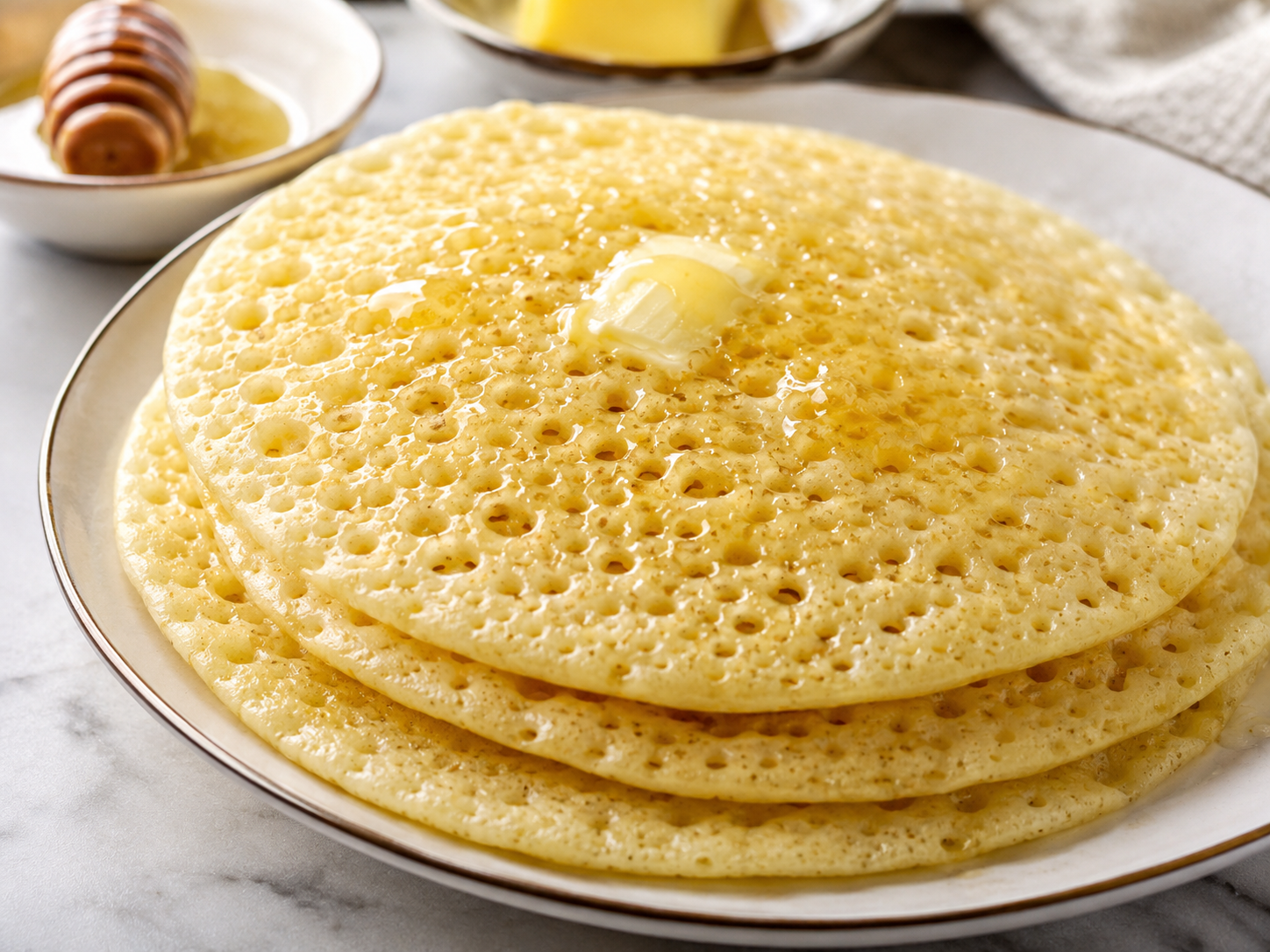
Baghrir, often nicknamed the thousand-hole pancake, is one of the most recognizable preparations in North African cuisines, particularly in Morocco and Algeria, with variations in Tunisia and echoes in other Saharan and Mediterranean regions. Its dimpled, light, and spongy surface makes it an instantly identifiable dish. But beyond its appearance, baghrir is a true cultural marker: it embodies conviviality, family transmission, everyday cooking, and also festive cooking and the month of Ramadan. It is simple in its ingredients, sophisticated in its texture, and generous in how it is served. 🫓🍯☀️
Talking about baghrir in African cuisine reminds us that the continent possesses exceptionally rich cereal traditions. Baghrir belongs to this large family of preparations based on semolina, flour, fermentation, and griddle cooking, where mastering the dough is an art in itself. It also testifies to a very ancient culinary intelligence: transforming modest ingredients into a delicate, nourishing, and socially valued preparation.
Prepare this speciality
Choose a detailed recipe, adjust the portions and prepare your ingredients before starting. Our cooking tips and food safety advice complement the steps described in the recipes.
Explore further: Cooking tips · Food hygiene and safety advice.
History and uses
🌾 ORIGINS AND ANCHORING IN MAGHREB CULTURES
Baghrir is part of an Amazigh, Arab, Maghrebi, and Mediterranean culinary universe, shaped by historical exchanges, trade routes, population movements, and climate adaptations. Cereals have held a central place for centuries: durum wheat, barley, sometimes millet depending on the area. Within this context, semolina and fermented doughs have given rise to many specialties, of which baghrir is one of the most popular expressions.
In Moroccan and Algerian homes, it is associated with specific moments: family breakfast, afternoon snack, light evening meal, breaking the fast during Ramadan, festive tables, welcoming guests. It can be prepared in large quantities during family gatherings, then served warm, stacked, drizzled with melted butter and honey. This image is deeply rooted in collective memory: the pan heating up, the dough bubbling, the holes gradually appearing on the surface, and the sweet smell attracting everyone to the table. 🏠👨👩👧👦🍵
🧪 A PRECISE CULINARY TECHNIQUE: the science of dough and alveoli Baghrir seems simple, but its success depends on a delicate technical balance. The basic ingredients are generally fine semolina (sometimes mixed with a little flour), lukewarm water, yeast (and depending on the recipe, a little baking powder), a pinch of salt, and sometimes a touch of sugar. The dough is more fluid than a thick pancake batter, but more structured than a completely liquid dough.
The secret lies in several parameters:
- the quality and granularity of the semolina
- the water temperature
- the resting time of the dough
- the yeast activity
- the heat of the pan
- cooking on one side only
Cooking on one side only is fundamental. Unlike other pancakes, baghrir is generally not flipped. A ladle of dough is poured, then the surface is observed: dozens then hundreds of small holes form as steam escapes. These alveoli are not an aesthetic detail; they define the very identity of baghrir. Above all, they allow for perfect absorption of toppings, especially the butter-honey mixture. 🔥🕳️🥄
🍯 TASTE PROFILE AND WAYS OF ENJOYING
The taste of baghrir is mild, slightly yeasty, with a distinct cereal note. Its texture is soft and fluffy, sometimes almost airy when very well made. Thanks to its dimpled surface, it acts like a flavor sponge: it retains melted butter, honey, flavored syrups, jams, sometimes culinary argan oil in certain traditions.
Accompaniments vary according to regions and family habits:
- melted butter + honey (classic combination)
- pure honey
- amlou (in some Moroccan regions)
- apricot, fig, or orange jams
- fresh cheese or spread in modern versions
- mint tea, milk, coffee, or infusions
During Ramadan, baghrir often holds a privileged place on the ftour table alongside harira, dates, chebakias, eggs, and other traditional preparations. It provides an energetic sweetness and a comforting texture after the day's fast. 🌙🫖🍯
🗺️ DIVERSITY OF VARIATIONS AND CIRCULATION OF PRACTICES
Like any living recipe, baghrir exists in several versions. Some prefer it very thin and full of micro-alveoli, others thicker and softer. Some families use only semolina, others add flour to modify the texture. Fermentation time can vary, as can the degree of sweetness.
In my books

Continue exploring the continent’s cuisines with Africa at the Table — 54 countries, 54 iconic dishes, by Alioune FALL. This book is in English.
Explore further
Culinary kinship can also be found with other fermented African or Afro-Mediterranean pancakes, even if techniques and ingredients differ. This highlights an important reality: African cuisines communicate with each other. Ideas of fermentation, griddle cooking, and cereal valorization cross regions, while yielding very distinct local results.
In the North African diasporas in Europe, North America, and elsewhere, baghrir has retained its emotional significance. It is prepared at home to maintain a connection with origins, but also sold in oriental bakeries, tea rooms, and community businesses. It thus becomes a culinary ambassador for the Maghreb and, more broadly, for North Africa. ✈️🌍🫓
🤝 SOCIAL PLACE: HOSPITALITY, TRANSMISSION, AND FAMILY MEMORY
Baghrir has strong relational value. It is often associated with hospitality. Serving warm baghrir to guests, with fragrant tea, is a way of showing attention, generosity, and respect. In many families, its preparation is also a moment of intergenerational transmission: a mother, grandmother, or aunt shows the precise gestures to a younger person, corrects the consistency of the dough, and explains how to recognize the right cooking temperature.
This transmission is precious because it goes beyond the recipe. It transmits a way of being together, an attention to detail, a culture of patience. Baghrir teaches that cooking can be an act of care and memory. People living far from their home country often say that its smell and texture immediately awaken childhood memories: morning cooking, family holidays, Ramadan at home, voices of loved ones around the table. ❤️🏡👵
📈 CONTEMPORARY BAGHRIR: BETWEEN TRADITION AND INNOVATION
Today, baghrir evolves with its time. In Maghreb cities and in the diaspora, we see the emergence of:
- mini versions for buffets or brunch
- more creative fillings (dried fruits, light creams, citrus fruits)
- nutritional adaptations (less sugar, alternative semolinas)
- refined presentations in modern restaurants
Social media has also played a role in its visual dissemination: the holey texture is photogenic, which has made baghrir very popular in culinary content. This visibility promotes its recognition beyond the communities that historically consumed it.
But this modernization does not erase the traditional version. On the contrary, it coexists with it. Many cooks advocate a return to basic gestures and quality ingredients. This creative tension between heritage and innovation is typical of contemporary African cuisines: they move forward without breaking with their foundation. 📱🍽️✨
🌍 BAGHRIR IN AFRICAN CUISINE IN THE BROADER SENSE
The place of baghrir in African cuisine is important for several reasons:
- it represents the richness of North African heritage
- it illustrates the African art of cereal fermentation
- it shows the strength of orally transmitted domestic cuisines
- it embodies a gastronomy of hospitality
- it contributes to the global influence of African cuisine
It also reminds us that African cuisine is not limited to savory dishes or the large stews often highlighted. Traditional breads, flatbreads, pancakes, porridges, and pastries are fully part of this heritage. Baghrir occupies a unique place in this ensemble: that of a food that is both everyday and festive, modest and refined, local and universal.
🏁 CONCLUSION: a heritage pancake, vibrant and unifying Baghrir is much more than a pancake. It is a form of culinary language that speaks of cereals, precise gestures, patience, sharing, and memory. In North African cuisines, it is part of daily life as much as it is of exceptional moments. In broader African cuisine, it recalls the historical depth of the continent's know-how and its ability to cross borders.
Its place is therefore fully legitimate and lasting: it nourishes, it gathers, it transmits. Whether enjoyed for family breakfast, served at ftour during Ramadan, or prepared in a distant diaspora, baghrir remains a warm symbol of African culinary identity. A recipe that seems simple, but carries within it a whole world of culture, history, and emotion. 🫓🌍🍯
In the kitchen : Baghrir
Recipes from the site to put your knowledge into practice:
Discover these cuisines at a restaurant
Explore our restaurant and caterer directories. Choose your destination and check the establishment’s menu to confirm which dishes are offered and available.
Continue exploring
Enjoy discovering ingredients and African cuisines? Join our newsletter. The illustrated PDF 10 sauces africaines incontournables is in French and is offered after confirming a subscription to the French or bilingual edition.