Bourek
Maghreb
Understanding : Bourek
🌍 INTRODUCTION
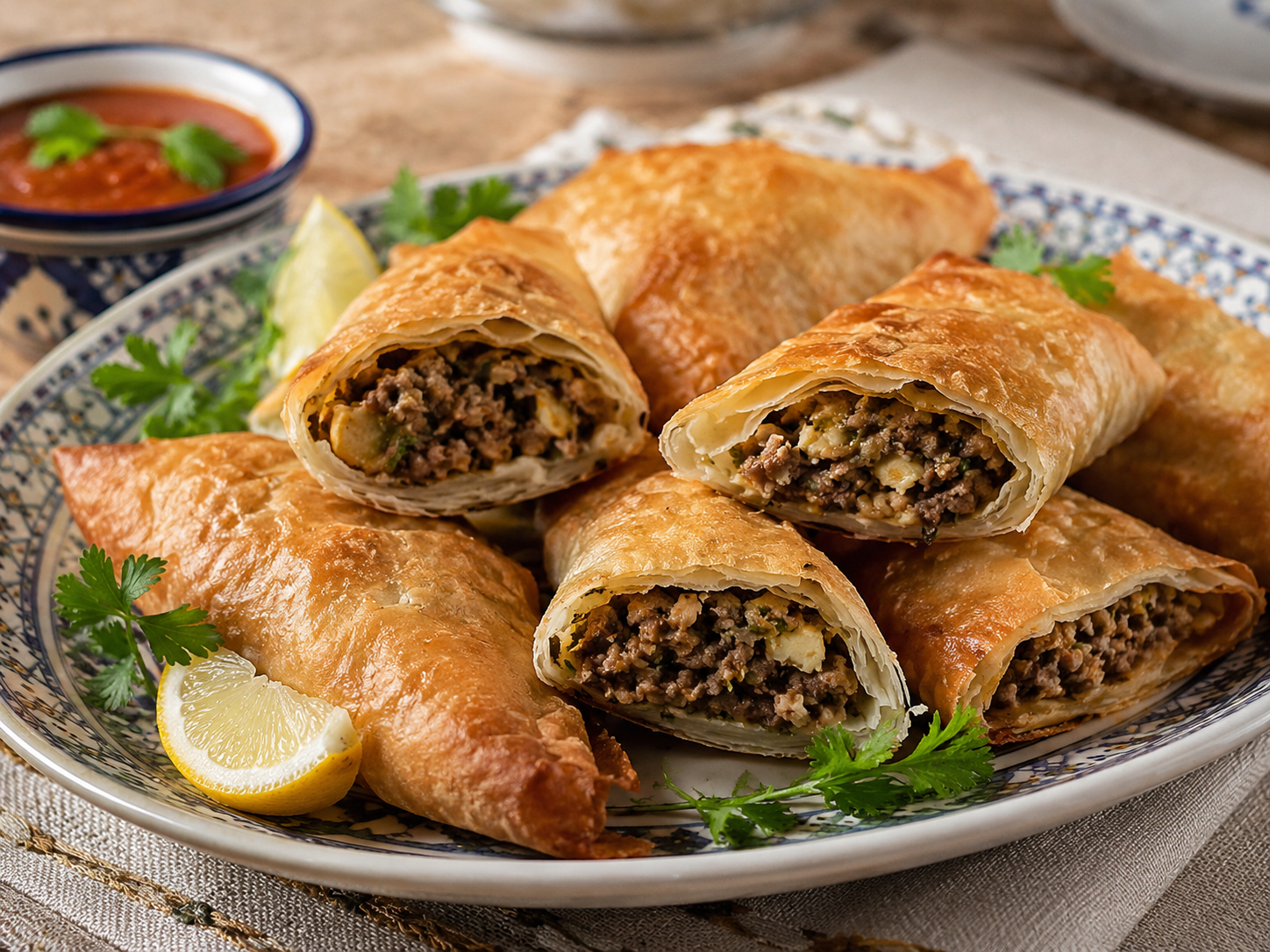
Bourek, sometimes spelled bourak, brik, or borek depending on the country, language, and family traditions, is one of the most popular preparations in North Africa. It belongs to the large family of stuffed crispy pastries: a thin wrapper (brick pastry, dioul (a type of thin pastry sheet), or similar dough), filled with a savory preparation, then fried or baked. Behind this simple definition, bourek is actually a culinary universe in itself. It can be modest or refined, daily or festive, family-style or commercial, classic or creative. It is eaten as a starter, a side dish, a snack, for breaking the fast, and sometimes even as a light meal depending on its size and filling.
Prepare this speciality
Choose a detailed recipe, adjust the portions and prepare your ingredients before starting. Our cooking tips and food safety advice complement the steps described in the recipes.
Explore further: Cooking tips · Food hygiene and safety advice.
History and uses
In African cuisine, and particularly in Maghreb cuisines, bourek holds an emblematic place because it represents several dimensions at once: conviviality, the transmission of gestures, the mastery of textures, and the art of transforming simple ingredients into tasty bites. It is also an excellent example of culinary circulation between Africa, the Mediterranean, and the Middle East, with strong local adaptations that give it a deeply Maghrebi identity. 🥟🔥🍋
🕰️ HISTORY AND CULINARY CIRCULATIONS: a heritage in motion Bourek is part of an ancient history of savory stuffed pastries present in several regions of the Mediterranean and Ottoman world. Over time, each cultural space has developed its own forms. In North Africa, this preparation found a particularly fertile ground for expression: availability of thin sheets, a taste for spicy fillings, the importance of festive frying, and the central place of starters in shared meals.
Over the centuries, influences have mingled: Amazigh, Arab, Andalusian, Ottoman, local urban, and rural. The result is not a copy from elsewhere, but a set of original Maghrebi variants. In Algeria, Morocco, Tunisia, Libya, we find similar but distinct versions, with names, folding techniques, seasonings, and cooking methods that reflect regional identities.
This history shows that African cuisines are dynamic and connected. Bourek is proof of this: a culinary format travels, but is reconfigured according to local products, tastes, and habits. 🌍🧭🍽️
🥟 ANATOMY OF BOUREK: dough, filling, folding, cooking Bourek relies on four essential technical elements:
- The wrapper Often a thin sheet of brick/dioul type, flexible before cooking, crispy after cooking. Its quality is crucial: too dry, it breaks; too wet, it tears.
- The filling Extremely variable: minced meat, chicken, tuna, potatoes, cheese, egg, onions, parsley, coriander, spices, sometimes olives or capers depending on habits.
- The shaping Triangle, cigar, half-moon, square, roll… The folding influences the hold and the final texture. Good folding prevents oil or moisture leaks.
- The cooking Traditionally fried for intense crispiness, but also baked in lighter versions. Temperature control is crucial: too hot, the wrapper burns before the inside heats up; too low, the bourek absorbs oil.
The success of bourek therefore depends on a subtle balance between external crispiness and internal softness. When well made, it offers a remarkable contrast of textures: a golden and brittle shell, a fragrant and melting heart. ✨🍳🧅
🍲 REGIONAL VARIANTS AND FILLING CREATIVITY
One of bourek's great riches is its culinary plasticity. Each family has “its” version, often transmitted orally. Some frequent trends appear:
- minced meat-onions-parsley-spices version
- shredded chicken-coriander-cheese version
- tuna-potatoes-egg-capers version
- cheese-fresh herbs version
- vegetarian version with spicy vegetables
- runny egg version (closer to certain Tunisian brik traditions) Spices play an important role: pepper, paprika, cumin, sometimes ras el hanout (a North African spice blend) depending on domestic cuisines. Lemon and fresh herbs bring freshness and balance to the richness of frying. During Ramadan, boureks become almost essential in many Maghrebi households. They are served on the ftour (meal to break the fast) table with chorba (a type of soup) or harira (a traditional Moroccan soup), dates, bread, salads, and pastries. Their crispy and gourmet side makes them a highly anticipated starter after fasting. 🌙🥣🥟
In my books

Continue exploring the continent’s cuisines with Africa at the Table — 54 countries, 54 iconic dishes, by Alioune FALL. This book is in English.
Explore further
🤝 SOCIAL ROLE: HOSPITALITY, SHARING, AND TRANSMISSION
Bourek is deeply linked to conviviality. It is rarely prepared for a single person; it is rather part of a logic of platters, series, and collective service. They are made for the whole family, for guests, for neighbors, for festive evenings. It circulates easily, is eaten with the fingers, and is shared without complex protocol. Its preparation is also a social moment. In many homes, several people participate: one prepares the filling, another folds, another cooks. This chain work creates an atmosphere of collaboration and transmission. The youngest learn the gestures by observing: moistening the wrapper, dosing the filling, closing without tearing, monitoring the cooking. These are precise skills, acquired through repetition, which strengthen intergenerational bonds. 👩🍳👵👧
In North African diasporas, bourek holds a very strong memorial function. Preparing it in Paris, Montreal, Brussels, or Marseille is recreating a piece of home. It is rediscovering the smells, rhythms, and tastes of childhood. Thus, bourek goes beyond cuisine: it becomes a support for cultural identity.
💼 ECONOMIC PLACE: from home cooking to restaurants Bourek is also important economically. Its production feeds several sectors:
- manufacturing and sale of brick pastry sheets
- trade of spices and herbs
- butcher shops and fishmongers for fillings
- street food and caterers
- bakeries and snack bars In many African cities, boureks are sold in markets, commercial districts, small stalls, especially during periods of high demand like Ramadan. They represent a high-turnover product: controllable cost, adaptable preparation, possible unit sale. This makes it an interesting source of income for small family or artisanal businesses. Modern catering has also embraced it: miniature boureks for buffets, baked versions, fusion fillings, contemporary presentations. This commercial adaptation shows the vitality of the product, capable of circulating between popular tradition and urban gastronomy. 🛍️📈🍴
🌱 BOUREK AND CONTEMPORARY AFRICAN CUISINE: between heritage and health Like many fried specialties, bourek today raises nutritional questions. Consumers sometimes seek lighter versions: oven baking, better controlled oil, vegetable fillings, reduced salt. This evolution does not eliminate the traditional recipe; it offers alternatives according to contexts and needs. The challenge is to modernize without distorting. Keeping the spirit of bourek means preserving:
- the crispy/melting contrast
- the fragrance of herbs and spices
- the dimension of sharing
- the anchoring in collective moments In contemporary African cuisine, this tension between heritage and innovation is constant. Bourek perfectly illustrates this adaptability: it remains faithful to its roots while integrating new expectations (practicality, balance, diversification of fillings, modern presentation). 🥗♻️🏙️
🌍 ITS PLACE IN AFRICAN CUISINE IN THE BROADER SENSE
Bourek holds a major place in African cuisine, especially North African, for several reasons:
- it represents the art of fine stuffed pastries, highly developed in the Maghreb
- it is at the crossroads of daily and festive
- it values precise domestic techniques
- it embodies culinary hospitality
- it is strongly present in diasporas, and thus in the international influence of African cuisine It also reminds us that African cuisines are not limited to saucy dishes or basic starches. They also include a vast repertoire of starters, bites, fried foods, breads, and shared table preparations. Bourek is a pillar of this repertoire, with a rare ability to be both popular, elegant, simple, and sophisticated.
🏁 CONCLUSION: bourek, a bite of living culture Bourek is much more than a stuffed pastry. It is a complete culinary form, a language of textures, a ritual of collective preparation, a marker of hospitality, and a link between generations. In North African cuisines, it is essential. In African cuisine in the broader sense, it embodies the richness of regional heritages and their power of adaptation.
Whether served hot at home, offered as street food, presented in a contemporary restaurant, or prepared in the diaspora for a Ramadan meal, it retains the same essential function: to bring people together around a familiar and generous taste. It is this ability to connect memory, pleasure, and sharing that makes bourek a lasting reference in African gastronomy. 🥟❤️🌍
In the kitchen : Bourek
Recipes from the site to put your knowledge into practice:
Discover these cuisines at a restaurant
Explore our restaurant and caterer directories. Choose your destination and check the establishment’s menu to confirm which dishes are offered and available.
Continue exploring
Enjoy discovering ingredients and African cuisines? Join our newsletter. The illustrated PDF 10 sauces africaines incontournables is in French and is offered after confirming a subscription to the French or bilingual edition.