Chakhchoukha
Algeria
Understanding : Chakhchoukha
🌍 INTRODUCTION
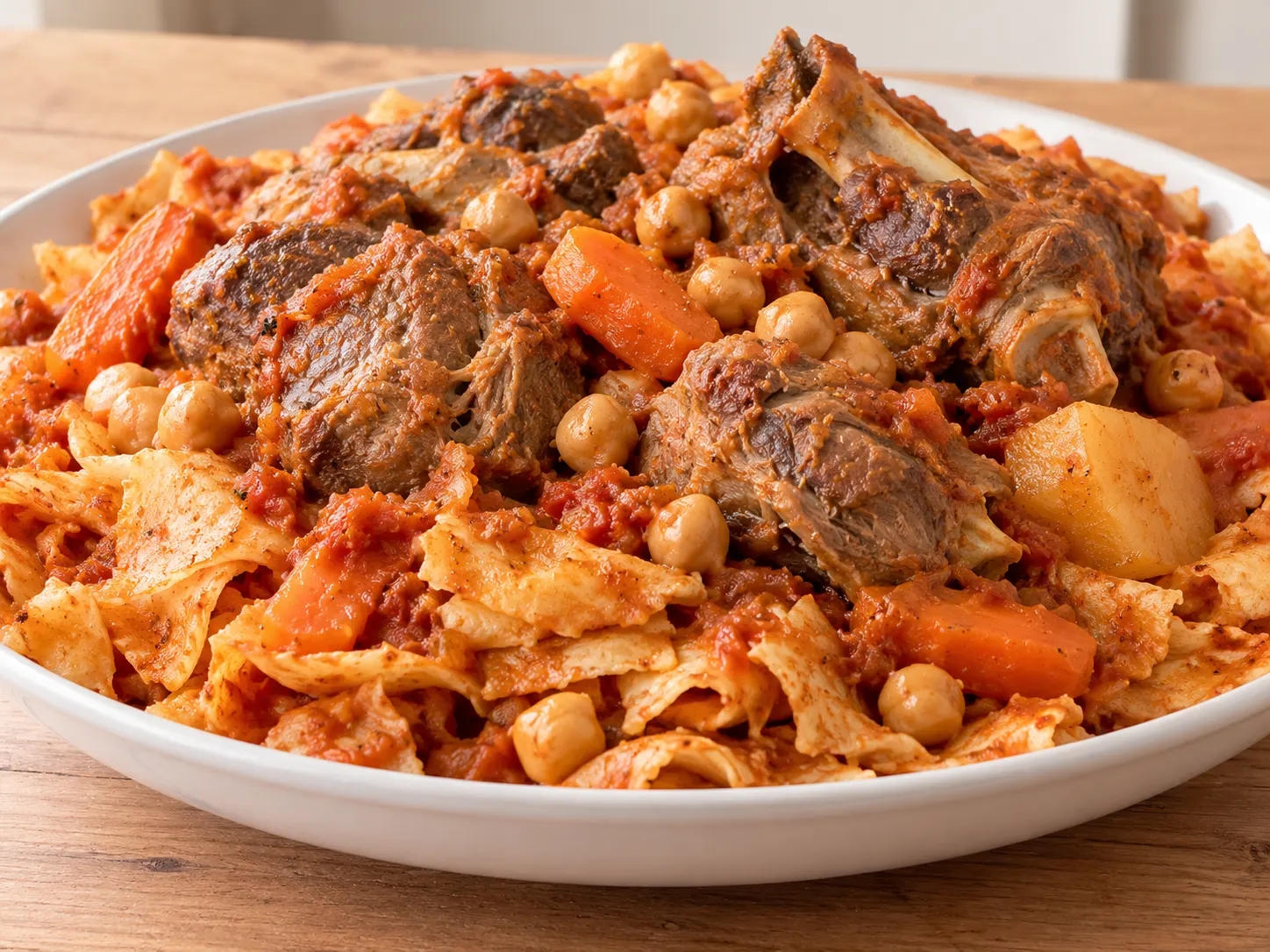
Chakhchoukha is one of the great traditional North African dishes, particularly rooted in Algeria, with significant regional variations and echoes in other parts of the Maghreb. It is a generous, family, festive dish, based on a simple and brilliant culinary idea: transforming a bread or a thin crumbled galette (a type of flatbread) into a soft base, then soaking it in a rich sauce with spices, vegetables, and meats. The result is a dish of texture, fragrance, and sharing, deeply rooted in ancient practices, but still alive in contemporary kitchens.
To speak of chakhchoukha in African cuisine is to highlight the richness of the continent's cereal know-how. Behind this dish lies the mastery of wheat, semolina, artisanal pasta, shaping, drying, slow cooking, and final assembly. There is also the art of feeding large tables with balance and human warmth. Chakhchoukha is not just a recipe: it is a table culture, a language of hospitality, and a symbol of continuity between generations. 🍲🌾🤝
Prepare this speciality
Choose a detailed recipe, adjust the portions and prepare your ingredients before starting. Our cooking tips and food safety advice complement the steps described in the recipes.
Explore further: Cooking tips · Food hygiene and safety advice.
History and uses
🕰️ ORIGINS AND HISTORICAL ROOTS IN THE MAGHREB
Chakhchoukha belongs to a family of North African dishes that value cereals transformed into sheets, crumbs, or pieces of bread, then combined with a sauce. Historically, these practices are part of agro-pastoral societies where the domestic economy relied heavily on cereals, legumes, livestock, and spices. Bread is not just an accompaniment here: it is the raw material of the dish itself.
In Algeria, chakhchoukha is often associated with specific regions, particularly the East and Central-East, with famous traditions around Biskra, Constantine, Batna, Khenchela, and other neighboring territories. Each area claims its way of preparing the galette, cutting the dough, seasoning the sauce, and choosing the meat. This diversity is not a contradiction: it is proof of a living heritage dish, adapted to local terroirs, climates, and tastes.
Over time, chakhchoukha has become a marker of major occasions: religious holidays, weddings, births, family gatherings, honorary invitations. It is also prepared daily in some homes, especially when culinary transmission remains active. In all cases, it retains an image of a noble, generous, and unifying dish. 🏠🎉🍽️
🌾 THE TECHNICAL CORE: BETWEEN CRUMBLED GALETTE AND SIMMERED SAUCE
The uniqueness of chakhchoukha lies in the meeting of two complementary preparations:
- The cereal base Depending on the region, a thin cooked galette (a type of flatbread) is used and then crumbled, or pieces of dough are worked in a specific way. This base must be neither too dry nor too compact. It must be able to absorb the sauce without dissolving entirely.
- The sauce Often red, fragrant, and simmered, it can contain meat (lamb, mutton, sometimes chicken), chickpeas, tomatoes, onions, spices (paprika, ras el hanout, chili depending on the families), sometimes vegetables depending on the variants. The sauce must be generous enough in liquid to impregnate the cereal base. The final assembly is a key moment. The crumbled galette is gradually moistened to obtain a soft, homogeneous, but still structured texture. Too much sauce drowns the dish; insufficient sauce makes it dry. All the mastery is there: finding the right balance between absorption and hold. 🔥🥣🧅
🍛A TASTE ARCHITECTURE: texture, spices, and depth Chakhchoukha is a dish of aromatic depth. The taste does not come from a single dominant ingredient, but from the fusion of cereals, cooking fat, spices, meat, and legumes. The base absorbs the juices, spices, and broth, which creates a sensation of richness in the mouth without excessive heaviness when the dosage is well controlled. The texture is central: soft, melting, with sometimes slightly firmer areas depending on the size of the crumbs or pieces. This variation gives relief to the dish. Chickpeas bring an additional roundness, meat a fleshy dimension, spices an aromatic warmth that can range from mild to spicy. Chakhchoukha is often served in a large communal dish, with the meat arranged on top. This presentation reinforces the idea of sharing. Everyone serves themselves or eats around the dish according to family customs, which transforms the meal into a collective moment rather than individual consumption. 🍖🌶️👨👩👧👦
🗺️ REGIONAL VARIANTS: a plurality of chakhchoukhas There is no single “official” chakhchoukha. Many variants are found, particularly in Algeria:
- versions based on very thin galette (a type of flatbread) crumbled by hand
- versions with more visible pieces of dough
- spicier sauces in some regions
- milder and more fragrant sauces in others
- presence or absence of certain vegetables
- choice of meat according to availability, season, or budget Some preparations are more rustic, others more festive. Some favor spicy power, others subtle balance. This plurality is essential to understand African cuisine: the same dish name can cover very strong local culinary identities. In diasporas, these variants are recomposed again. Ingredients available abroad, time constraints, modern equipment sometimes modify the gestures. Yet, the spirit of the dish remains intact: a worked cereal base, a generous sauce, a convivial service. 🌍✈️🍲
In my books

Continue exploring the continent’s cuisines with Africa at the Table — 54 countries, 54 iconic dishes, by Alioune FALL. This book is in English.
Explore further
🤝 SOCIAL FUNCTION: hospitality, ceremony, and transmission Chakhchoukha is intimately linked to hospitality. Preparing it for guests means offering time, attention, and know-how. It is a dish that requires several steps; it therefore carries a value of social consideration. In many families, its preparation involves several people: one takes care of the dough, another of the sauce, another of the assembly and service. This collective dimension promotes intergenerational transmission. Gestures are transmitted orally and visually: how to knead, how to cook the galette (a type of flatbread), how to crumble it correctly, when to add spices, how to dose the sauce. This knowledge, often carried by women in the domestic sphere, constitutes a major culinary heritage. During religious holidays and family events, chakhchoukha takes on a symbolic dimension: it represents abundance, the blessing of the shared meal, and anchoring in tradition. It connects generations around a common taste. ❤️🫓🫶
💼 ECONOMIC PLACE AND HERITAGE VALORIZATION
Beyond the home, chakhchoukha participates in the local culinary economy: traditional restaurants, caterers, private parties, gastronomic tourism. In some cities, it is an identity dish highlighted in culinary discovery circuits. It values local products (cereals, chickpeas, spices, meats) and supports artisanal know-how. Its patrimonialization is also a cultural issue. Highlighting chakhchoukha means recognizing the historical depth of African cuisines and their technical sophistication. Too often, the gastronomies of the continent are reduced to a few clichés. However, a dish like chakhchoukha shows an advanced mastery of textures, slow cooking, assembly, and food conviviality. This recognition can also encourage younger generations to preserve and modernize their culinary traditions without impoverishing them. 📚🏺🍴
🌱 CONTEMPORARY CHAKHCHOUKHA: between fidelity and adaptation Today, chakhchoukha is evolving. Some families offer lighter versions in fat, others incorporate more vegetables, still others simplify steps to adapt to urban rhythms. In restaurants, more modern presentations are appearing, sometimes in individual portions, while retaining the basic flavors. The challenge is to keep the soul of the dish: soft texture, fragrant sauce, generosity of service. Successful modernization does not consist of erasing tradition, but of making it practicable in current conditions. This is exactly what many African cuisines are doing today: they innovate without breaking with their foundations. 🏙️🥄✨
🌍 ITS PLACE IN AFRICAN CUISINE
In African cuisine as a whole, chakhchoukha occupies an important place for several reasons:
- it illustrates the excellence of North African cereal traditions
- it shows the ability to build complex dishes from accessible ingredients
- it embodies the logic of the shared meal, central to many African cultures
- it connects daily cooking and festive cooking
- it contributes to the influence of Maghrebi gastronomy in the diaspora It also recalls an essential truth: African cuisine is plural, technical, historical, and deeply rooted in its territories. Chakhchoukha is one of those dishes that prove that simplicity of ingredients never means cultural simplicity.
🏁 CONCLUSION: chakhchoukha, culinary memory and shared future Chakhchoukha is much more than a traditional dish. It is an edible memory, an architecture of gestures, a family pedagogy, and a celebration of hospitality. It tells the story of North Africa in its most generous aspect: the art of transforming cereals into a feast, of making a meal a place of social connection, and of transmitting a living heritage.
Its place in African cuisine is solid and legitimate. It belongs to the past through its history, to the present through its daily and festive practice, and to the future through its adaptability. As long as there are families to crumble the galette (a type of flatbread), simmer the sauce, and gather loved ones around a large dish, chakhchoukha will continue to bring to life one of the most beautiful expressions of African gastronomy. 🍲🌍🤍
In the kitchen : Chakhchoukha
Recipes from the site to put your knowledge into practice:
Discover these cuisines at a restaurant
Explore our restaurant and caterer directories. Choose your destination and check the establishment’s menu to confirm which dishes are offered and available.
Continue exploring
Enjoy discovering ingredients and African cuisines? Join our newsletter. The illustrated PDF 10 sauces africaines incontournables is in French and is offered after confirming a subscription to the French or bilingual edition.