Molho
Angola
Understanding : Molho
🌍 INTRODUCTION
The word molho simply means sauce in Portuguese. Said like that, it seems very broad, almost too general. Yet, in Lusophone African culinary contexts, particularly in Angola, Mozambique, Cape Verde, Guinea-Bissau, and São Tomé and Príncipe, molho refers to much more than just an accompanying liquid. It is often the element that builds the identity of the dish, that connects the ingredients, that gives aromatic depth, that balances spiciness, acidity, fat, and salt. In practice, one can eat grilled fish, boiled tubers, plain rice, or an almost neutral funge (a starchy staple food made from cassava or corn flour); it is the molho that transforms the whole into a complete experience.
Where to find it
Look for the exact food-grade form required by the recipe at markets and specialist shops. Check the product name, ingredients, condition and storage instructions.
Explore further: Cooking tips · Food hygiene and safety advice.
History and uses
In many African cuisines, sauce is a structuring principle. Starches serve as an energy base, proteins provide density, and the sauce connects all of this into a coherent composition. The Lusophone African world perfectly illustrates this logic. Molho is not an accessory: it carries the historical memory of Atlantic circulations, local techniques, tropical products, Iberian influences, Creole adaptations, and daily constraints. It is a culinary language in its own right.
🕰️ MOLHO AND HISTORY: between local heritage and Atlantic circulations The history of Lusophone African molhos is linked to several cultural layers. On one hand, there are ancient African traditions of pounded preparations, thickened broths, condiments based on chili, seeds, leaves, onions, and fermented products. On the other hand, the Portuguese language and certain Iberian techniques introduced or disseminated ways of naming, cooking, and structuring sauces: use of acidic marinades, importance of garlic, place of oil, logic of simmering, etc.
Over time, these influences blended with products from different continents: tomato, chili, cassava, peanut, lime, palm oil depending on the area, vinegars, dry spices. The result is not a “copied” cuisine, but a set of original Afro-Lusophone cuisines where molho becomes a space for local creativity.
In ports, coastal cities, and commercial contact zones, sauces often evolved faster, integrating new products and hybrid techniques. In rural areas, some older forms persisted with local ingredients. This coexistence between tradition and adaptation explains the current diversity of molhos.
🍅 THE MAIN MOLHO PROFILES IN AFRICAN CUISINES
Even if there are hundreds of variants, a few dominant profiles can be distinguished:
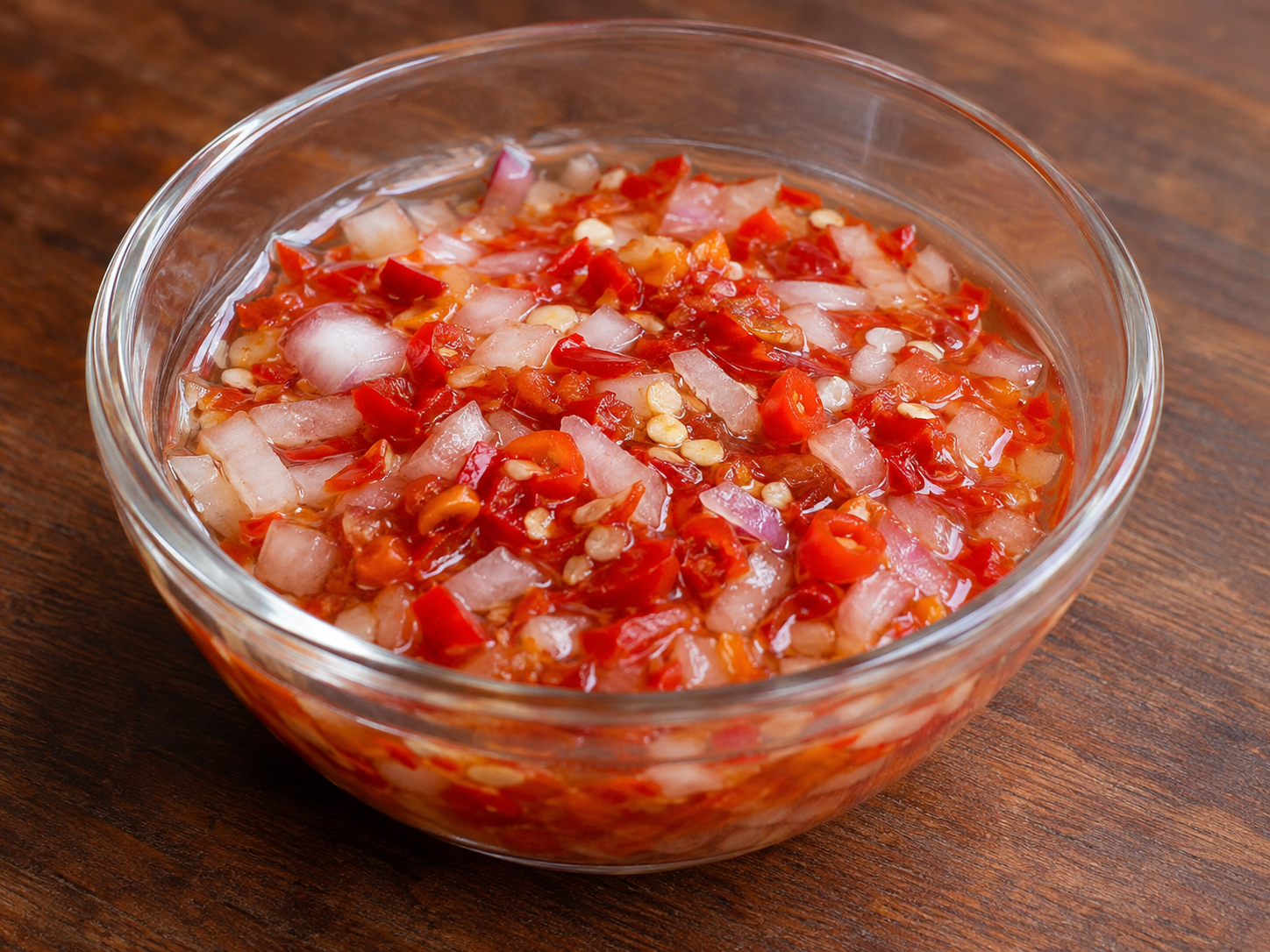
- Seasoned raw molho Often based on onion, tomato, chili, lemon or vinegar, oil, and herbs. It pairs very well with grilled fish and tubers. It brings freshness, vibrancy, and contrast.
- Cooked molho More profound, rounder, sometimes thicker. Onion, garlic, tomato, spices, and possibly broth are simmered. Ideal for topping meats, fish, vegetables, or funge.
- Spicy molho Chili sauce, sometimes very concentrated. It can be fresh or cooked, and serves both to enhance and to preserve certain preparations.
- Molho based on aromatic fat In some traditions, the sauce is carried by a structuring fat (vegetable oil, palm oil, sometimes butter depending on the context). This base captures aromas and prolongs the sensation in the mouth.
- Hybrid marinade-sauce molho One part is used to season before cooking, the other to top when serving. Very common with grilled fish.
What is striking is the balancing function: a good sauce compensates for what the rest of the plate lacks. If the base is sweet and starchy (cassava, funge), the molho brings acidity and chili. If the protein is grilled and dry, it brings moisture and aromatic fat. If the dish is rich, it can, on the contrary, bring freshness and tension.
🔥 CULINARY TECHNIQUE: why molho makes the difference A successful molho depends less on the quantity of ingredients than on the method. A few principles often recur:
- Onion treatment: raw for crunch and vibrancy, or slowly sweated for sweetness.
- Garlic: added early to infuse, or late to retain character.
- Chili: dosed in stages to control intensity.
- Acidity: lemon, vinegar, or tomato to structure the sauce.
- Fat: it carries aromas and softens the heat of the chili.
- Resting: many molhos are better after a few minutes, or even a few hours, when the flavors blend. Texture also matters. Some sauces must remain fluid to soak; others must coat; still others are almost condiment-like. In popular cuisines, this mastery is very empirical: one adjusts by tasting, by looking at the shine, by observing how the sauce adheres to the spoon or the fish.
In my books

Continue exploring the continent’s cuisines with Africa at the Table — 54 countries, 54 iconic dishes, by Alioune FALL. This book is in English.
Explore further
🐟 PLACE OF MOLHO IN EMBLEMATIC DISHES
In many Lusophone African dishes, molho is the element that defines the dish:
- With grilled fish: it brings acidity, chili, and moisture.
- With funge de bombó: it provides the main flavor, as funge is intentionally neutral.
- With boiled tubers: it avoids monotony and creates contrast.
- With stews: it binds meat, vegetables, and starch.
- With street food: it allows each portion to be customized according to chili tolerance and customer taste.
In other words, one can change the fish or garnish, but if the molho is mastered, the taste identity remains strong. That is why many cooks say that a house, a family, or a region is recognized by its sauce.
👩🏾🍳 SOCIAL AND ECONOMIC DIMENSION OF MOLHO
Molho is also a tool for household economy. With few ingredients, it allows a simple base to be enhanced and to feed several people without excessive costs. In urban markets and street food kitchens, sauce allows for standardizing a taste quality despite the variability of products. Women often play a central role in this sauce economy: purchasing ingredients, processing, dosing, selling, transmitting recipes. The know-how of molho is culinary capital. It can build the reputation of a stall, retain customers, and create stable income. In this sense, sauce is also a social resource. Molho also participates in intergenerational transmission. Many learn “by eye”: expected color, smell at the right moment, reaction of the tomato, amount of lemon according to the season, intensity of chili according to the guests. This oral knowledge is a living heritage.
🌶️ MOLHO AND AFRICAN CUISINE IN A BROADER SENSE
If we broaden to the entire continent, we see that the logic of molho joins a wider African reality: the importance of sauces and condiments as the architecture of the meal. Whether it is sauces based on peanuts, leaves, okra, tomato, seeds, or chili, the structure is comparable: a starchy base + a structuring sauce + an optional protein depending on means.
The Lusophone specificity lies mainly in certain markers: Portuguese vocabulary, particular acidic profiles, use of certain marinades, dialogues between African and Iberian techniques. But fundamentally, molho shares with other African cuisines the same intelligence: transforming daily life through taste, creating complexity with sometimes modest means, and maintaining the meal as a space for social connection.
🧭 CONTEMPORARY CHALLENGES: HEALTH, MODERNITY, HERITAGE PRESERVATION
Today, molhos are evolving with urban lifestyles. Lighter versions in oil, stricter salt controls, less spicy variants for wider audiences, or conversely, very strong sauces valued as a gastronomic signature, are appearing. Modern restaurants are also re-working textures and plating.
From a nutritional perspective, the challenge is to preserve aromatic power while controlling salt and fats. This is possible thanks to fresh herbs, natural acidities, spices, and cooking techniques that develop taste without overload.
From a heritage perspective, molhos deserve better recognition. They are often less visible than “solid” dishes, even though they constitute their heart. Documenting these sauces, their regional variants, and their social uses is essential to preserve a fundamental part of African culinary memory.
🏁 CONCLUSION: molho, a key to understanding Lusophone African cuisine Talking about molho is not talking about a simple accompaniment. It is talking about a grammar of taste. In Lusophone African cuisines, sauce organizes the plate, expresses local identity, transmits knowledge, supports the popular economy, and connects generations. It is at once technical, cultural, and emotional.
Its place in African cuisine is therefore major. Molho shows that gastronomic richness does not depend on the scarcity of ingredients, but on the correctness of balances: acidity, chili, fat, salt, texture, temperature, timing. It is this living and accessible culinary intelligence that makes molho a central element of African food heritage.
In the kitchen : Molho
Recipes from the site to put your knowledge into practice:
Discover these cuisines at a restaurant
Explore our restaurant and caterer directories. Choose your destination and check the establishment’s menu to confirm which dishes are offered and available.
Continue exploring
Enjoy discovering ingredients and African cuisines? Join our newsletter. The illustrated PDF 10 sauces africaines incontournables is in French and is offered after confirming a subscription to the French or bilingual edition.