Akoumé
Togo, Benin
Understanding : Akoumé
🍲 INTRODUCTION
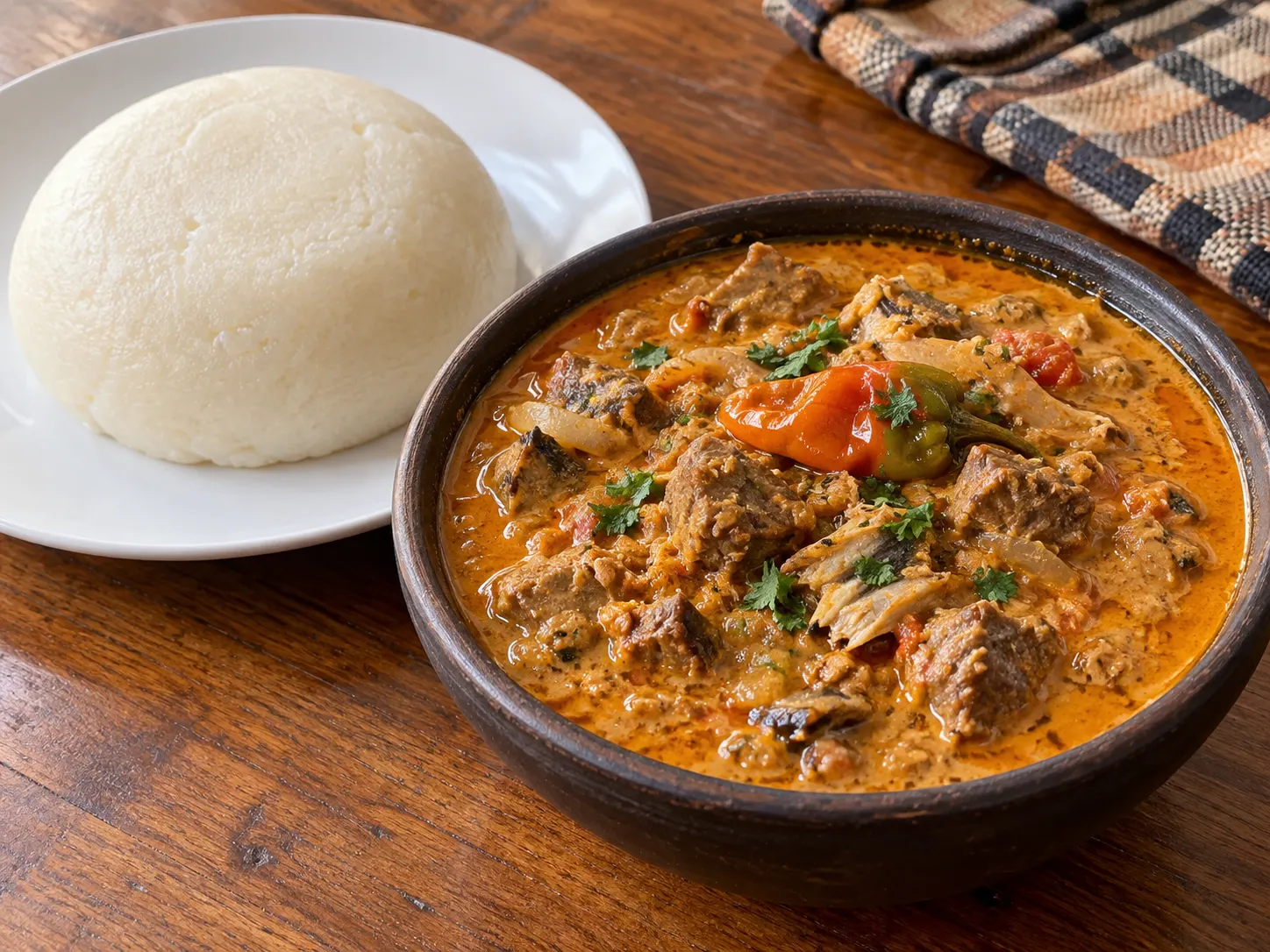
Akoumé is one of the great culinary markers of West Africa, particularly Togo and Benin, where it holds a daily place in family diets. More than just a side dish, it is a nourishing, cultural, and emotional base. In many households, it is at the center of the meal, surrounded by sauces, condiments, fish, meats, or leafy vegetables that vary according to the seasons, household means, and local traditions. Its strength lies precisely in its ability to absorb and reveal flavors, while remaining simple in its composition. Prepared from corn flour, sometimes mixed with other flours depending on habits, it is a cooked paste, firm and supple at the same time, which is eaten by hand. This gesture, passed down from generation to generation, is part of a deeply African culinary language, where food is not just a matter of taste, but also of social connection, memory, and identity.
Prepare this speciality
Choose a detailed recipe, adjust the portions and prepare your ingredients before starting. Our cooking tips and food safety advice complement the steps described in the recipes.
Explore further: Cooking tips · Food hygiene and safety advice.
History and uses
🏺🌍 ORIGINS, LIVING HISTORY AND CULTURAL ROOTS
The history of akoumé is linked to the evolution of West African food systems. Like many cereal-based preparations, it is part of a long tradition of cooked pastes that have fed entire populations throughout the centuries. Corn, now fundamental in the recipe, was integrated into local practices through historical exchanges, then adapted to existing culinary techniques. This capacity for appropriation is a signature of many African cuisines: an ingredient circulates, then it becomes local through use, through gestures, through the meaning given to it in daily life.
In Togolese and Beninese families, akoumé is often associated with childhood, shared meals, large pots, and discussions around the table or the common dish. It accompanies ordinary days as well as certain festive moments, depending on the region. Its importance extends far beyond nutrition. Preparing a good akoumé is a recognized, valued skill, sometimes even a source of domestic prestige. A person who masters the perfect texture, consistent cooking, and the right stirring rhythm is perceived as someone who knows the foundations of family cooking.
This heritage dimension is essential. Akoumé is rarely transmitted through strict written recipes. One learns by watching, by helping, by repeating gestures, by listening to the advice of elders. The indications are sensory: one must observe the consistency, feel the resistance of the dough, hear the sound of the spatula in the pot, recognize the precise moment when the mass becomes homogeneous. This pedagogy of the body and senses is an important feature of many African culinary traditions.
🧑🏾🍳 INGREDIENTS, TECHNIQUES AND THE INTELLIGENCE OF THE GESTURE
At first glance, akoumé seems to rely on few ingredients: corn flour and water, sometimes a pinch of salt. Yet, behind this apparent simplicity, there is real technicality. It all starts with the quality of the flour, its fineness, its moisture content, sometimes its more or less fermented character depending on local preferences. Then comes the dosage, which is not always expressed in fixed measurements, but adjusted according to experience.
The traditional method often consists of dissolving part of the flour in cold water to limit lumps, then incorporating it into heated water. The rest of the flour is added gradually, while stirring vigorously with a strong wooden spatula. The stirring is continuous, energetic, sometimes physically demanding. One must maintain cooking, break up clumps, smooth the dough, and find the balance point between firmness and suppleness. Too much water, the akoumé becomes loose. Too much flour, it becomes dry, heavy, and difficult to swallow.
Expertise lies in this real-time adaptation. The texture is corrected during cooking, the heat is adjusted, the exact moment the dough is ready is decided. Some people seek a very smooth and dense dough, others appreciate a slightly softer version. Depending on the context, regional variations may also be found where the flour base differs slightly, but the spirit of the dish remains the same: a nourishing, neutral-tasting paste, intended to receive the richness of the sauces.
This neutral character is not a weakness, quite the contrary. It is a culinary architecture. Akoumé is designed to carry the flavors of what accompanies it. It becomes a taste canvas on which chili, acidity, smoky aromas, the umami of dried fish, the richness of palm oil, or the freshness of leaves unfold.
🌶️🐟 PAIRINGS WITH SAUCES AND NUTRITIONAL BALANCE
Akoumé comes into its own when paired with a well-constructed sauce. In West African practices, sauces are complete universes, often made from tomatoes, onions, chili peppers, okra, local green leaves, peanuts, fermented seeds, fresh or smoked fish, or meat, depending on availability. Each household has its preferences, each region its signatures, each cook their touch.
A spicy sauce based on tomato and smoked fish offers an intense combination, where the cereal sweetness of akoumé balances the heat of the spices. An okra sauce provides an enveloping texture that adheres perfectly to the hand-formed bite. Leafy sauces, rich in minerals and deep vegetal taste, give the meal a more earthy and nutritious dimension. Peanut versions, richer and creamier, create generous plates, particularly appreciated in contexts of physical labor or hearty family meals.
In my books

Continue exploring the continent’s cuisines with Africa at the Table — 54 countries, 54 iconic dishes, by Alioune FALL. This book is in English.
Explore further
From a nutritional perspective, this model is based on complementarity. Akoumé primarily provides complex carbohydrates, thus energy. Sauces provide protein, fats, vitamins, fiber, and micronutrients. Together, they form a complete, adaptable, and satisfying meal. This is one of the reasons for its longevity in eating habits: it meets real needs for satiety, controlled cost, and flexibility according to available resources.
In many households, akoumé is also an economical dish in the noble sense of the term: it allows feeding several people with a simple base, while varying the pleasures thanks to the diversity of sauces. This domestic intelligence, often carried by women in daily culinary organization, is an integral part of akoumé's place in society.
🤝🏾🍛 SOCIAL DIMENSION, SHARING GESTURES AND HOSPITALITY
Eating akoumé means entering into a logic of conviviality. Service can be in individual portions, but it often retains a memory of the shared dish, the family circle, the discussion around the meal. The act of eating with the hand, forming a small ball of dough before dipping it in the sauce, creates a tactile relationship with food. This gesture is precise, codified, learned early, and participates in a specific table culture.
In many African traditions, the table is a place of education, transmission, and social regulation. One learns respect, patience, solidarity, and everyone's place. Akoumé, because it is frequent and central, becomes one of the vectors of this daily pedagogy. It connects nutrition to living together. Offering akoumé to a guest is offering more than a meal: it signifies welcome, temporary integration into the family space, recognition of a bond.
This social function also explains its importance in diasporas. In Europe, North America, or elsewhere, preparing akoumé allows for recreating cultural continuity despite the distance. Ingredients may sometimes be adapted, techniques slightly adjusted, but the intention remains the same: to maintain a bridge between generations, between territories, between languages and memories.
🚀 PLACE IN CONTEMPORARY AFRICAN CUISINE AND INTERNATIONAL VISIBILITY
Today, akoumé continues to hold a major place, while evolving with urban and global transformations. In large African cities, it coexists with faster habits and industrialized products, but it remains a benchmark of food and identity stability. Many families alternate between modern and traditional dishes, and akoumé often remains at the core of preferences.
At the same time, the increasing visibility of African cuisines on the international scene contributes to revaluing this type of preparation. Specialized restaurants highlight traditional pastes and their sauces as refined expressions of complex culinary terroirs. Akoumé appears not as a fixed dish, but as a living base that accepts contemporary interpretations without losing its soul.
It also plays a role in discussions about food sovereignty. Because it relies on widely accessible local raw materials and techniques that are not highly dependent on expensive equipment, it is part of a logic of resilience. In a context of economic and climatic fluctuations, robust traditional preparations like akoumé represent important assets for local food systems.
Finally, its place in African cuisine is also symbolic: it reminds us that culinary sophistication does not always involve multiplying ingredients, but rather the precision of gestures, the mastery of textures, the knowledge of associations, and the sense of community. Akoumé is a remarkable example of this discreet sophistication. It teaches that a dish can be humble in form and immense in its cultural scope.
❤️🔥 WHY AKOUMÉ REMAINS A PILLAR OF AFRICAN CULINARY IDENTITY
If akoumé crosses generations, it is because it responds to several dimensions at once. It nourishes the body, of course, but it also nourishes memory, the relationship to the land, the feeling of belonging, and family continuity. It carries a history of ingredient circulation, local inventiveness, the endurance of traditions, and permanent adaptation.
In the mosaic of African cuisines, it occupies a place comparable to that of the great staple foods that structure daily life: those foods that do not just 'accompany', but organize the meal, punctuate domestic time, and give a common language to the community. Akoumé belongs to this category of fundamental dishes, those that survive trends because they are useful, loved, and deeply rooted.
To consider it seriously is to recognize the richness of African culinary knowledge. It is to admit that behind a corn paste lies a universe of techniques, symbols, nutritional balances, geographies of taste, and human connections. It is also to understand that African cuisine is not a uniform block, but a set of powerful local traditions, of which akoumé is one of the most eloquent expressions in West Africa.
🌍 CONCLUSION
Ultimately, akoumé is not just a dish. It is a complete cultural practice. It tells the story of a territory, the creativity of families, the strength of sharing, and the dignity of everyday cuisines. Its place in African cuisine is therefore central, not only because it is widely consumed, but because it embodies a way of experiencing the meal as a space for transmission, hospitality, and continuity between past, present, and future.
In the kitchen : Akoumé
Recipes from the site to put your knowledge into practice:
Discover these cuisines at a restaurant
Explore our restaurant and caterer directories. Choose your destination and check the establishment’s menu to confirm which dishes are offered and available.
Continue exploring
Enjoy discovering ingredients and African cuisines? Join our newsletter. The illustrated PDF 10 sauces africaines incontournables is in French and is offered after confirming a subscription to the French or bilingual edition.