Aseeda
Sudan, South Sudan
Understanding : Aseeda
🥣 INTRODUCTION
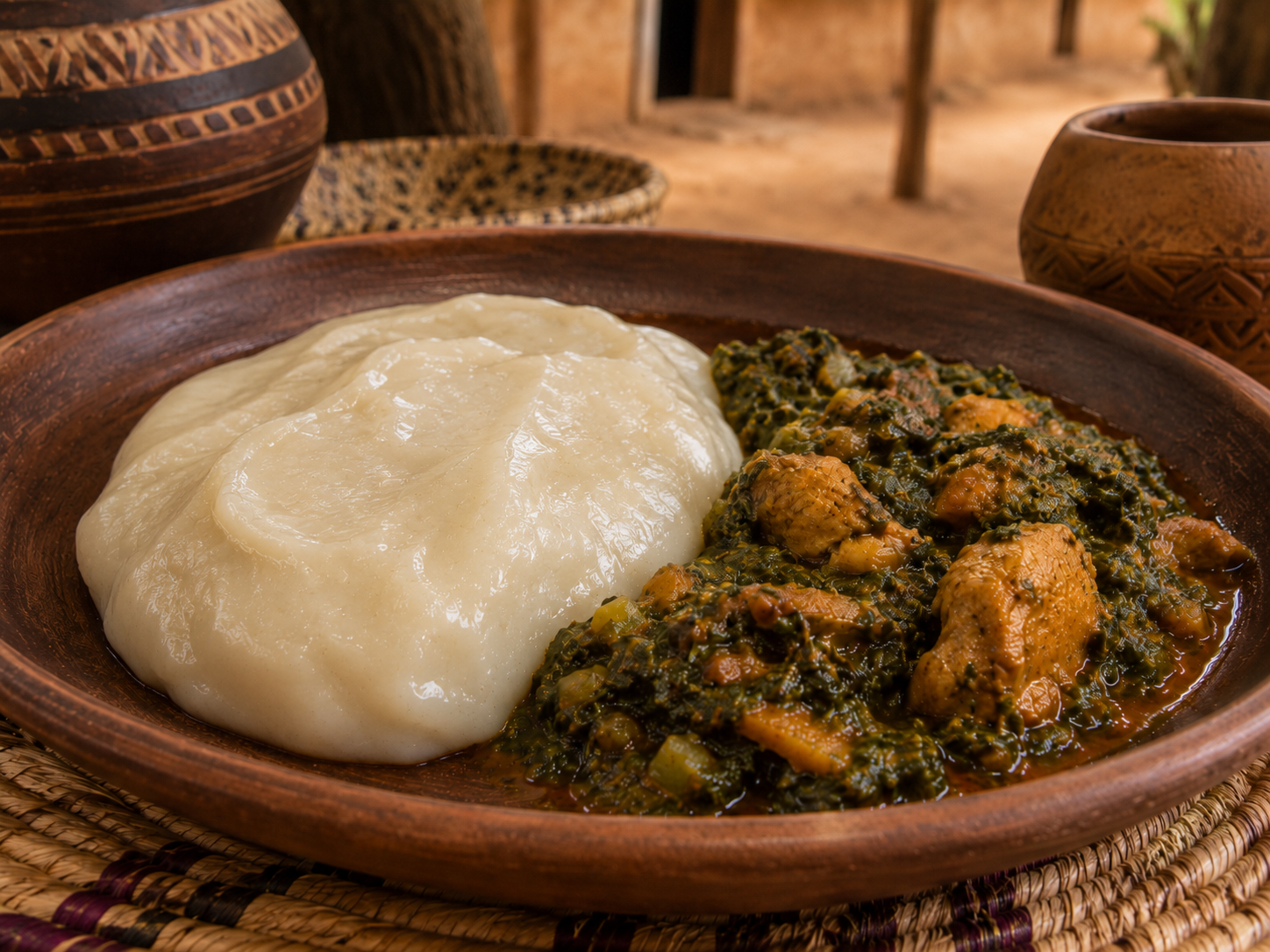
Aseeda, or asseda, or asida, is a major traditional paste from Sudan and South Sudan, and it holds a fundamental place in the daily diet of many communities in these two countries. When we talk about asseda, we are talking about a staple food, in the strong sense of the term: it is not a supplement, nor a secondary garnish, but the central axis of the meal. Its function is comparable to that of the great cereal pastes of the African continent, but with its own identity linked to Nilotic and Sudanese cultures, local cereals, and table habits passed down through generations. It is generally prepared from sorghum or millet flour, sometimes corn depending on the region, seasons, economic availability, or family traditions. The paste is cooked in water until it obtains a homogeneous, compact, and flexible consistency at the same time, firm enough to be picked up in a bite, but tender enough to blend with sauces.
Prepare this speciality
Choose a detailed recipe, adjust the portions and prepare your ingredients before starting. Our cooking tips and food safety advice complement the steps described in the recipes.
Explore further: Cooking tips · Food hygiene and safety advice.
History and uses
🔥🥣 A SEEMINGLY SIMPLE PREPARATION, ACTUALLY TECHNICAL
Aseeda perfectly illustrates a principle very present in African cuisines: few ingredients, but a great demand for skill. On paper, the recipe seems elementary: water, flour, sometimes a little salt. In practice, success depends on a series of precise decisions during cooking. The type of flour strongly influences the final texture. A fine sorghum flour does not behave like a more rustic flour; millet absorbs water differently; corn gives a different grain in the mouth. The cook must constantly adjust the amount of water, the rate of incorporation, and the vigor of stirring.
Cooking is generally done by gradually incorporating the flour into hot water, then stirring vigorously to avoid the formation of lumps. This step is physical and requires endurance. It is necessary to stir, crush the masses, smooth the paste, control the heat, and recognize the exact moment when the asseda “sets” correctly. If undercooked, it retains a floury taste and an unpleasant sticky texture. If too dry, it becomes heavy and loses its flexibility. When well prepared, it has a smooth surface, a coherent structure, and moderate elasticity that facilitates tasting.
This know-how is often oral and practical. One learns not only with measurements, but with the eye, the hand, and by listening to elders. In many Sudanese and South Sudanese families, it is by observing mothers, aunts, grandmothers, and then repeating the gestures that one masters asseda. This transmission through practice is part of its cultural importance: it transforms a recipe into living heritage.
🌾🌍 THE DEEP CONNECTION WITH LOCAL CEREALS AND SUDANESE ENVIRONMENTS
Aseeda is intimately linked to the cereal crops of Sudan and South Sudan, particularly sorghum and millet. These cereals are not chosen at random. They correspond to specific climatic, agricultural, and historical realities. In sometimes arid or unstable environments, sorghum and millet have long been reliable resources, adapted to local conditions. Their place on the plate therefore reflects ancient agrarian intelligence: producing with what the land allows, then transforming these harvests into nourishing and sustainable dishes.
Aseeda is thus much more than a culinary preparation; it is also a testament to the relationship between local societies and their environment. It tells how populations structured their diet around robust crops, how they developed effective milling and cooking techniques, and how they built balanced meals from sometimes limited resources. From this perspective, it contributes to local food sovereignty: a staple food based on locally cultivable products and transmissible domestic know-how.
🍲🌶️ THE ROLE OF SAUCES: COMPLEMENT, CONTRAST, AND NUTRITIONAL RICHNESS
Asseda, with its relatively neutral taste, is designed to interact with sauces and stews. This is where the meal takes on its full dimension. Accompaniments vary according to regions, households, economic contexts, and cultural habits. There are sauces based on meat, legumes, vegetables, sometimes dried or fermented products, with aromatic profiles ranging from mild to very spicy. Chili, onion, garlic, certain herbs, and various fats add depth to the overall dish.
In this culinary architecture, asseda plays the role of a matrix: it absorbs, balances, and extends flavors. It tempers very spicy sauces and allows for a better perception of aromatic nuances. Each bite combines the cereal density of the paste and the complexity of the stew. Nutritionally, this duo is relevant: asseda mainly provides carbohydrate energy, while the sauce provides proteins, lipids, vitamins, and minerals. This model is both practical, economical, and filling, which explains its permanence in eating habits.
In my books

Continue exploring the continent’s cuisines with Africa at the Table — 54 countries, 54 iconic dishes, by Alioune FALL. This book is in English.
Explore further
It should also be emphasized that this complementarity allows for great flexibility. Depending on the means of the moment, the sauce can be simpler or richer, but asseda remains the stable base of the meal. This flexibility is essential in contexts where resources can fluctuate. It contributes to the food resilience of households.
🤝🏾🏠 A SOCIAL, IDENTITY-FORMING, AND INTERGENERATIONAL FOOD
In Sudanese and South Sudanese cultures, aseeda is strongly associated with family life. It accompanies ordinary meals, but also gatherings where much more than food is shared. Its preparation mobilizes time, attention, sometimes several people, and its consumption is often part of convivial practices. Even when service is individualized, the dish retains a collective memory: that of the home, shared meals, exchanges around the table.
Aseeda also plays a role in identity continuity. In internal displacements, regional migrations, or diasporas, it becomes a strong cultural landmark. Reproducing this dish far from its place of origin allows for maintaining a connection with family habits, languages, and gestures learned in childhood. It is a concrete way to maintain cultural transmission between generations, especially for younger people born outside the territory of origin.
This identity dimension is essential to understanding its place in African cuisine. Aseeda is not just “what we eat,” it is also “what connects us.” It materializes a collective memory, a form of belonging, and a certain idea of hospitality.
🧭🌍 ITS PLACE IN AFRICAN CUISINE IN A BROADER SENSE
In the culinary geography of the continent, asseda occupies the place of a great regional pillar, rooted in the Sudanese and South Sudanese area, but understandable in a broader African logic. Many African cuisines are organized around a common principle: a dense starchy base, associated with a structured sauce. This pattern varies differently according to peoples, cereals, tubers, techniques, and local tastes. Asseda represents one of these major variations, with its own identity and historical roots.
It is therefore important on two levels. First at the local level, where it remains a daily food, economically and culturally central. Then at the continental level, where it contributes to understanding African culinary logics: valorization of local products, mastery of textures, nutritional complementarity, and the social role of the shared meal. Its presence reminds us that African cuisines are not an addition of isolated dishes, but coherent systems, built on centuries of experience.
In the contemporary context, marked by urbanization, changing lifestyles, and the influence of globalized consumption, asseda continues to exist with vigor. It can coexist with modern habits without losing its meaning. This maintenance is not a simple reflex of tradition; it is also proof of its dietary effectiveness, its symbolic value, and its adaptability.
❤️🌾 Why aseeda remains essential Asseda remains essential because it brings together rare qualities in a single dish: accessibility, satiety, flexibility, cultural depth, and power of transmission. It is accessible thanks to basic ingredients often available locally. It is filling thanks to its energy density. It is flexible because it goes with a wide variety of sauces. It is culturally powerful because it carries gestures, memories, and identities. It is transmissible because it is learned in family practice, without depending on complex tools.
To talk about asseda is therefore to recognize the sophistication of everyday African cuisines. This sophistication does not necessarily rely on the multiplication of products, but on technical precision, the accuracy of balances, and the strength of the social context. Asseda shows that a dish can be humble in its components and immense in its historical and cultural scope.
🌍 CONCLUSION
Ultimately, its place in African cuisine is clear: it is a regional pillar of Sudan and South Sudan, and an exemplary expression of the great African culinary traditions based on cereal, sauce, sharing, and transmission. It embodies a way of nourishing bodies while maintaining connections, knowledge, and memories. It is precisely this dual function, nourishing and cultural, that explains its longevity and importance even today.
In the kitchen : Aseeda
Recipes from the site to put your knowledge into practice:
Discover these cuisines at a restaurant
Explore our restaurant and caterer directories. Choose your destination and check the establishment’s menu to confirm which dishes are offered and available.
Continue exploring
Enjoy discovering ingredients and African cuisines? Join our newsletter. The illustrated PDF 10 sauces africaines incontournables is in French and is offered after confirming a subscription to the French or bilingual edition.