Bogobe
Botswana
Understanding : Bogobe
🌍 INTRODUCTION
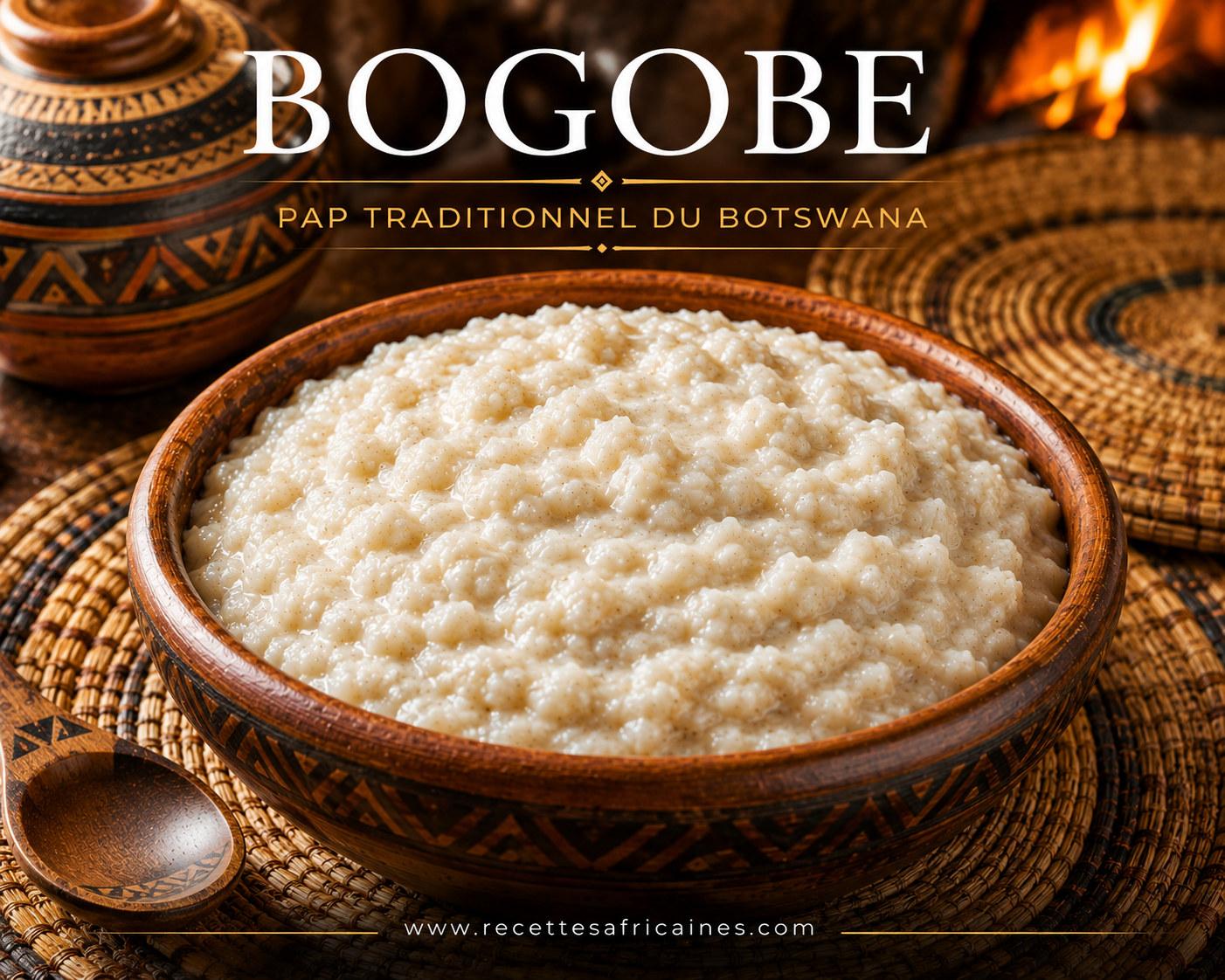
Bogobe is one of the most representative dishes of Southern Africa, particularly in Botswana, where it holds a central place in daily diet, family memory, and national culinary identity. The term refers to a porridge or cereal paste, most often prepared from sorghum, millet, or maize, depending on the region, season, local customs, and household means. In some contexts, the texture can be more fluid, similar to a nourishing porridge, while in others, it becomes denser, like a firm paste served with accompaniments. This flexibility of form is part of bogobe's richness: it is not a single fixed dish, but a family of preparations that share the same dietary logic.
Prepare this speciality
Choose a detailed recipe, adjust the portions and prepare your ingredients before starting. Our cooking tips and food safety advice complement the steps described in the recipes.
Explore further: Cooking tips · Food hygiene and safety advice.
History and uses
🌾🌍 A CEREAL BASE DEEPLY ROOTED IN THE TERRITORIES
To understand bogobe, one must start from the link between cuisine and environment. In much of Southern Africa, cereals like sorghum and millet have long been essential, as they are adapted to sometimes difficult climatic conditions and agricultural systems based on resilience. Maize, introduced later historically, has also gained significant importance in many regions. Bogobe is the culinary expression of this agrarian history: transforming local grains into a simple, energetic, digestible, and shareable preparation.
Sorghum, in particular, is very significant in Botswanan food culture. Its presence in bogobe reflects not only agricultural availability but also cultural continuity. For generations, the mastery of cereals, milling, and cooking has structured domestic organization. Preparing bogobe is not just “making food”; it is extending knowledge related to the land, harvests, and the rhythm of the seasons. It reflects a form of local food sovereignty, based on products that can be grown and processed in circuits close to communities.
🍲🔥 A DISCREET BUT DEMANDING EXPERTISE
Like many fundamental African dishes, bogobe may seem simple at first glance: cereal flour, water, heat, stirring. However, success depends on precise technique. The person cooking must manage the temperature, gradually incorporate the flour, stir continuously to avoid lumps, and adjust the consistency according to the intended use. A version intended for breakfast will not necessarily have the same texture as a version served with meat or vegetables at lunch or in the evening.
The control of texture is essential. Too liquid, bogobe loses its satiety power and its hold. Too thick, it can become heavy and less pleasant in the mouth. Correct cooking must eliminate the floury taste, develop a smooth or slightly granular texture depending on the grind, and produce a comforting warmth that is an integral part of the dish's experience. The gestures are often transmitted orally, through observation and repetition: watching an elder's hand, learning the stirring rhythm, visually recognizing the “right point” of cooking.
This practical transmission gives bogobe a strong heritage dimension. It is not reduced to a written formula. It is learned in the kitchen, in daily life, in intergenerational relationships. This is one of the striking features of basic African cuisines: they rely on an intelligence of gesture, often invisible in books, but fundamental in the reality of households.
🥛🍯 Multiple uses from morning to night Bogobe is also distinguished by its versatility. It can be consumed as a morning porridge, sometimes sweetened or enriched according to habits, or served in a more consistent version during main meals. In some households, it accompanies savory preparations: vegetables, sauces, fermented milk, meat, or other locally available foods. Elsewhere, it can be taken more simply, as a main food in contexts of limited resources.
This flexibility explains its longevity. The same culinary base can meet varied needs: quick meal, children's food, work food, family dish, nutritional support during periods of economic constraint. Bogobe is both ordinary and essential. It does not need expensive ingredients to play its role. It is part of a logic of food efficiency, in the noble sense: to nourish correctly, regularly, and in a way adapted to the local context.
🥬🍖 Nutritional complementarity and food intelligence Nutritionally, bogobe primarily provides energy through carbohydrates from cereals. Depending on the cereal chosen, it can also provide fiber and certain micronutrients. But its interest is especially visible in how it fits into the overall meal. As in many African traditions, the starchy base is complemented by accompaniments that provide protein, lipids, vitamins, and minerals.
In my books

Continue exploring the continent’s cuisines with Africa at the Table — 54 countries, 54 iconic dishes, by Alioune FALL. This book is in English.
Explore further
When bogobe is served with leafy vegetables, legumes, fermented milk, fish, or meat, it becomes the heart of a balanced ensemble. This meal architecture is the result of long empirical experience: combining a filling and affordable base with more nutrient-concentrated elements. Even when means are modest, this logic allows for optimizing family nutrition.
It is also important to highlight the agronomic relevance of traditionally used cereals, particularly sorghum and millet, in an African context marked by increasing climatic challenges. Valuing bogobe also means valuing adapted crops, diversifying diets, and reducing dependence on certain imported products. Thus, bogobe's place extends beyond domestic cooking: it touches on issues of sustainability, public health, and the resilience of food systems.
🤝🏾🏠 A dish of social connection and cultural continuity The strength of bogobe is not only measured by its nutritional qualities. It is also a food of social connection. It is present in daily life, in family meals, sometimes in broader community contexts. Its preparation and consumption are part of a culture of sharing, where food is a vector of relationship, attention, and hospitality.
In many families, bogobe is associated with specific memories: childhood mornings, meals prepared by grandparents, periods of agricultural work, moments of solidarity. This emotional charge is central. It explains why the dish remains important even when new food products appear in urban markets. Bogobe continues to be prepared not only because it nourishes well, but because it “feels homemade,” because it reassures, because it connects generations.
In the Southern African diaspora, bogobe also plays a role in memory. Reproducing it abroad, with available ingredients, helps preserve a concrete connection to the original culinary identity. It is a way to transmit a culture to children born far from home, to maintain gestures, tastes, and family stories.
🧭🌍 Its place in African cuisine in the continental sense On a continental scale, bogobe is part of a large family of African cereal preparations that structure the diet of millions of people. Each region has its names, textures, and preferred cereals, but the common logic is clear: a dense and nourishing base, combined with accompaniments that diversify contributions and flavors. Bogobe is the Botswanan and more broadly Southern African variation of this continental culinary intelligence.
Its place is therefore twofold. On the one hand, it is a local pillar, deeply rooted in the history and daily life of Botswana. On the other hand, it contributes to a broader understanding of African cuisines: cuisines of adaptation, efficient sobriety, technical know-how, and community connection. Too often, these staple dishes are underestimated because they seem “simple.” In reality, they are at the heart of food, economic, and cultural balances.
In the current period, marked by rapid urbanization, nutritional transitions, and the rise of ultra-processed foods, bogobe retains remarkable relevance. It can coexist with modern habits while offering a local, minimally processed, and culturally significant alternative. This endurance shows that it is not a relic of the past, but a living food, capable of evolving without losing its identity.
❤️🔥 Why bogobe remains a lasting pillar Bogobe remains durably central because it combines several strengths: availability of ingredients, relatively controlled cost, strong satiety, culinary adaptability, intergenerational transmission, and symbolic value. It represents a daily cuisine that does not separate nutrition, culture, and sociability. Each bowl or portion tells something broader: a relationship to the land, a family history, a collective memory, and a way of caring for one's own.
Talking about bogobe is also recognizing the sophistication of African food traditions. This sophistication does not necessarily rely on visual complexity, but on the precision of gestures, suitability for local environments, and the ability to build balanced meals with realistic resources. Bogobe is a strong example of this culinary intelligence: a seemingly humble preparation, but structurally important at all levels.
🌍 CONCLUSION
Ultimately, bogobe's place in African cuisine is major. In Botswana and Southern Africa, it is a daily food and cultural landmark. On a continental scale, it illustrates the power of traditional cereal bases in organizing meals, community resilience, and knowledge transmission. It is a dish that nourishes the body, connects generations, and maintains a living dialogue between heritage and modernity.
In the kitchen : Bogobe
Recipes from the site to put your knowledge into practice:
Discover these cuisines at a restaurant
Explore our restaurant and caterer directories. Choose your destination and check the establishment’s menu to confirm which dishes are offered and available.
Continue exploring
Enjoy discovering ingredients and African cuisines? Join our newsletter. The illustrated PDF 10 sauces africaines incontournables is in French and is offered after confirming a subscription to the French or bilingual edition.