Chipsi mayai
Tanzania
Understanding : Chipsi mayai
🌍 INTRODUCTION
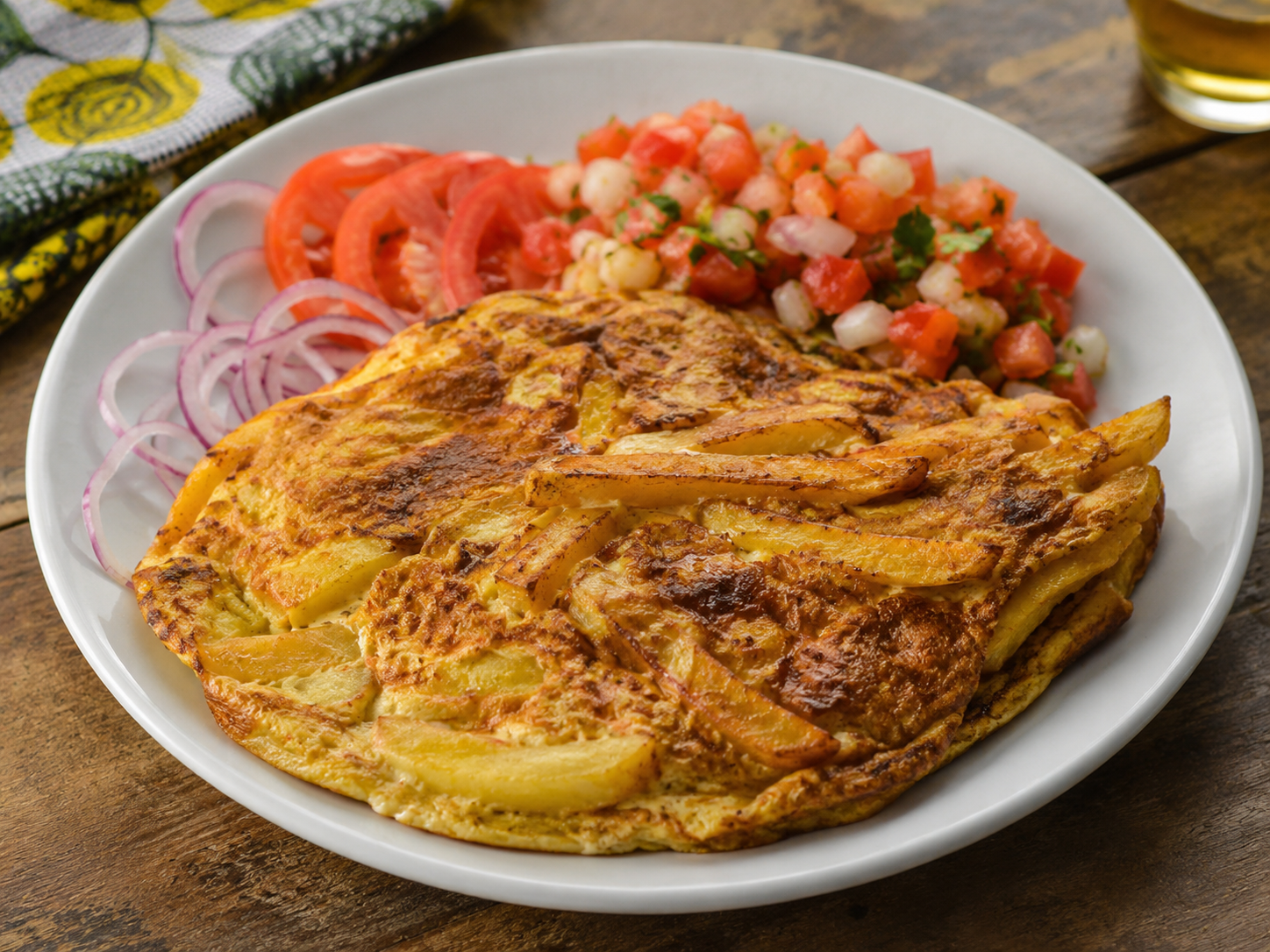
Chipsi mayai is one of East Africa's most iconic street foods, especially in Tanzania, where it holds a very strong place in daily urban life. Its name comes from Swahili: chipsi means fries and mayai means eggs. The principle is simple but incredibly effective: fries are incorporated into an omelet, then the whole is cooked into a thick patty, golden on the outside, soft on the inside, and served hot, often with kachumbari (a salad of tomatoes, onions, chili, and cilantro, depending on variations), chili sauces, or ketchup. Behind this apparent simplicity, chipsi mayai represents much more than a snack. It is a symbol of popular cuisine, urban creativity, food accessibility, and the blending of contemporary African culinary practices.
Prepare this speciality
Choose a detailed recipe, adjust the portions and prepare your ingredients before starting. Our cooking tips and food safety advice complement the steps described in the recipes.
Explore further: Cooking tips · Food hygiene and safety advice.
History and uses
🍳🌍 A STREET DISH THAT BECAME A CULTURAL MARKER
The identity of chipsi mayai is intimately linked to public spaces: streets, small stalls, eateries, markets, student neighborhoods, transit areas, and workplaces. It can be found at different times of the day, but it is particularly associated with quick meals, informal dinners, or late-night snacks. Its popularity stems from several factors: it is filling, relatively economical, quick to prepare, and easy to customize. This combination makes it a dish adapted to the rhythms of East African cities, where people often seek hot, substantial, and easily accessible food without formality.
Over time, chipsi mayai has surpassed the status of a simple street food. It has become an emotional and identity landmark, especially in Tanzania, but also in neighboring countries where it circulates in different forms. For many, it evokes specific memories: breaks with friends, nights out, student meals, late returns from work, moments shared in modest but lively places. This emotional dimension is essential to understanding its place in African cuisine. Like many popular dishes, its value is not limited to the ingredients; it also lies in the social context of consumption.
🍟🔥 CULINARY TECHNIQUE: SIMPLICITY, PRECISION, AND RHYTHM
Preparing a good chipsi mayai requires more skill than one might imagine. The cook must first fry the potatoes until they achieve a texture that remains flexible without becoming soft. Then, the beaten eggs are seasoned, sometimes enriched with onions, chili, herbs, or light spices, depending on the habits of the stall or household. The fries are then poured into the eggs and cooked into a thick omelet in a hot pan.
The main difficulty lies in the cooking balance. The outside must be golden enough to offer a slight crust, while the inside remains tender and homogeneous. If the heat is too high, the omelet burns before setting properly. If it is too low, the whole becomes greasy and poorly structured. Flipping is also a key moment: it must be clean to maintain the shape and consistency of the patty.
In the best stalls, this gesture becomes a true signature. The rhythm, heat management, oil quantity, seasoning, and final texture distinguish an ordinary chipsi mayai from a memorable one. This popular technicality is often underestimated, yet it reflects an everyday culinary intelligence: producing quickly, well, and consistently for a varied clientele.
🥗🌶️ ACCOMPANIMENTS AND FLAVOR BALANCE
Chipsi mayai is almost never served alone in its most appreciated version. Kachumbari brings freshness, acidity, and crunch, counterbalancing the richness of the egg and the density of the potatoes. Chili adds vibrancy, sauces provide depth, and some versions include additional toppings such as meat, sautéed vegetables, or cheese, depending on local influences and the innovations of urban cooks.
This taste structure is important: rich and soft on one side, fresh and spicy on the other. It is this contrast that makes the dish so satisfying. Here we find a common logic in many African cuisines: creating balances from simple but complementary elements, rather than relying on a single aromatic register.
From a nutritional point of view, chipsi mayai is primarily an energetic dish, with a combination of carbohydrates (fries) and proteins/fats (eggs). It can be perceived as heavy if consumed often without vegetable accompaniment. But in its real context of consumption, especially with fresh salad and condiments, it functions as a complete emergency or convivial meal. Its primary function remains rapid satiety and gustatory comfort, which explains its embeddedness in urban life.
In my books

Continue exploring the continent’s cuisines with Africa at the Table — 54 countries, 54 iconic dishes, by Alioune FALL. This book is in English.
Explore further
🤝🏾🏙️ POPULAR CUISINE, LOCAL ECONOMY, AND SOCIABILITY
The place of chipsi mayai in African cuisine is also explained by its economic role. It fuels a network of micro-enterprises: street vendors, small restaurants, neighborhood kiosks, independent cooks. The dish requires accessible ingredients, limited equipment, and reproducible know-how, making it a viable activity for many actors in the informal or semi-formal economy.
This economic dimension is inseparable from its social dimension. The places where chipsi mayai is eaten are often meeting spaces: people chat, wait, and observe the city. The dish becomes a pretext for conversation, a break, and the coexistence of different publics. Students, drivers, employees, artisans, visitors: all can gather around this simple preparation. In this sense, chipsi mayai participates in a form of urban culinary democracy, where taste and satiety are accessible on a large scale.
In households, the dish is also present, especially for quick or convivial meals. Homemade versions can be more personalized, sometimes less greasy, sometimes enriched with additional ingredients. This shows that chipsi mayai navigates between two worlds without contradiction: the street and the home, the popular economy and family cuisine.
🧭🌍 ITS PLACE IN CONTEMPORARY AFRICAN CUISINE
On a continental scale, chipsi mayai represents an important facet of African culinary modernity: urban, inventive, mixed, and pragmatic street food. It is not an ancient rural dish in the classic sense, but an urban creation that has become a tradition in a few decades. This trajectory is essential for understanding current African cuisine, which is not limited to ancient heritage: it also produces new classics adapted to social transformations, mobilities, and city rhythms.
The dish dialogues with global influences (fries, omelet) while remaining deeply local in its practice, its Swahili name, its serving method, and its accompaniments. This is exactly what gives it its identity strength. It shows that a dish can be “modern” without being uprooted, and “influenced” without losing its African roots. In Tanzania, it is already a popular national marker; in the region, it circulates as a symbol of accessible conviviality.
Its growing notoriety outside Africa, particularly via social networks, diasporas, and East African restaurants, also contributes to revaluing African street cuisines, long underrepresented in international gastronomic narratives. Chipsi mayai often serves as a gateway: easy to understand in its form, but rich in cultural context when explored in depth.
❤️🔥 WHY CHIPSI MAYAI HAS BECOME A LASTING CLASSIC
If chipsi mayai endures, it is because it meets concrete needs while offering a strong identity. It is quick, nutritious, affordable, adaptable, and tasty. It can be cooked with few resources, sold in various formats, customized according to taste, and integrated into very different contexts. This flexibility gives it rare cultural robustness.
But its durability also stems from its emotional dimension. For many Tanzanians and East Africans, it is a taste of daily life, a taste of the neighborhood, a taste of shared moments. Dishes that cross generations are often those that manage to be both practical and emotional. Chipsi mayai clearly belongs to this category.
In African cuisine, it therefore occupies a specific and important place: that of a popular urban classic, born from the encounter between simple ingredients and street intelligence, which has become over time a symbol of conviviality and culinary ingenuity. It reminds us that gastronomic greatness is not only measured by technical complexity or social prestige, but also by a dish's ability to nourish, bring people together, and represent a way of life.
🌍 CONCLUSION
Ultimately, chipsi mayai is much more than a fries omelet. It is a living expression of contemporary urban Africa, its daily creativity, and its sense of sharing. Its place in African cuisine is now solid: a bridge dish between tradition and modernity, between street and home, between the simplicity of ingredients and the richness of social uses.
In the kitchen : Chipsi mayai
Recipes from the site to put your knowledge into practice:
Discover these cuisines at a restaurant
Explore our restaurant and caterer directories. Choose your destination and check the establishment’s menu to confirm which dishes are offered and available.
Continue exploring
Enjoy discovering ingredients and African cuisines? Join our newsletter. The illustrated PDF 10 sauces africaines incontournables is in French and is offered after confirming a subscription to the French or bilingual edition.