Daraba
Chad
Understanding : Daraba
🇹🇩 INTRODUCTION
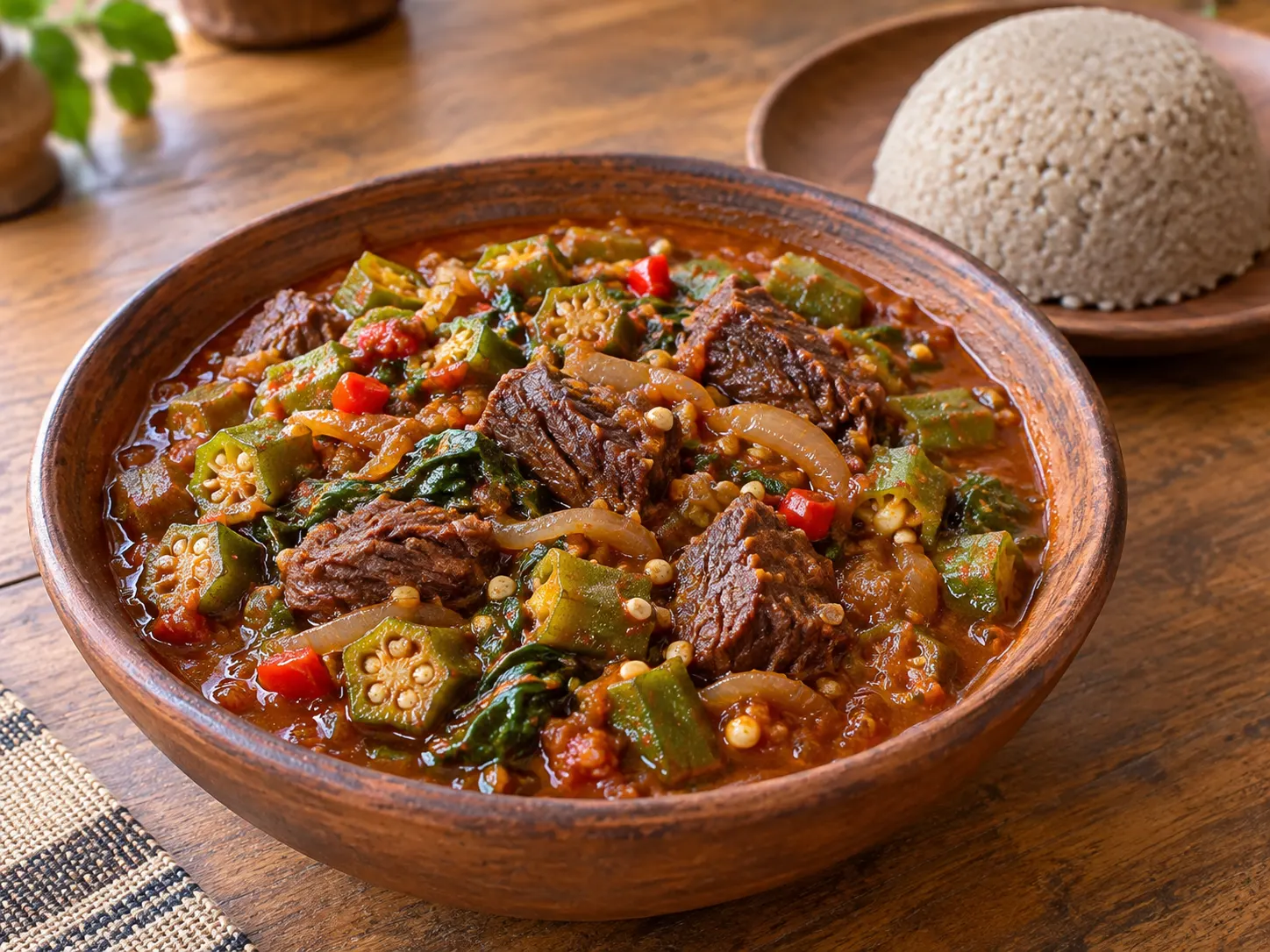
Daraba is a dish deeply rooted in Chadian cuisine, with variations found in several neighboring Sahelian areas. In Chad, it generally refers to a sauce made from green leaves and/or okra, often enriched with ingredients that provide body, flavor, and high nutritional value. It is an everyday preparation, but its apparent simplicity should not be misleading: daraba is a dish of know-how, family transmission, and fine adaptation to climate, seasons, available resources, and regional habits. Its place in African cuisine is important because it embodies a central logic of Sahelian culinary traditions: building complete meals around a dense vegetable sauce, served with a cereal base such as boule (a thick porridge made from millet, sorghum, or corn flour), millet, sorghum, corn, or sometimes rice.
Prepare this speciality
Choose a detailed recipe, adjust the portions and prepare your ingredients before starting. Our cooking tips and food safety advice complement the steps described in the recipes.
Explore further: Cooking tips · Food hygiene and safety advice.
History and uses
🌿 A LOCAL CHADIAN DISH, LINKED TO SEASONS AND LOCAL RESOURCES
The first characteristic of daraba is its territorial anchoring. It is a dish that heavily depends on locally available leaves, fresh or dried okra, condiments accessible in the market, and preservation habits (dried fish, dried shrimp, spices, etc.). Depending on the regions of Chad, the composition varies: some versions emphasize leaves, others okra, and still others combine both to achieve a more complex texture.
This variability is not a deviation; it is the very essence of the dish. Daraba is designed to adjust to local realities. During seasons of high vegetable availability, it can be richer in fresh leaves. In drier periods, preserved ingredients become more important. This adaptability explains its permanence in eating habits: it meets concrete needs for nutrition, cost, and practicality, while maintaining a recognizable taste identity.
In many households, daraba is also associated with local cooking. People cook what they have, but they cook it well, with precise gestures and a fine knowledge of local products. This domestic intelligence is at the heart of many African cuisines, and daraba is an excellent example.
🍲🔥 Preparation technique and mastery of textures Preparing a good daraba requires method. One often starts by washing, sorting, and chopping the leaves, then preparing the okra if the recipe contains it. Okra can provide a desired slightly mucilaginous texture, which gives the sauce its consistency. The leaves, for their part, provide the vegetable base, depth, and a significant part of the nutritional value.
According to local practices, an alkaline agent like natron (a naturally occurring mineral salt, often used as a leavening agent or tenderizer in cooking) can be used in small quantities to modify the texture, accelerate certain cooking processes, or influence the taste. Mastering this element is essential: too little, the effect may be imperceptible; too much, the flavor becomes unbalanced. Then, condiments are incorporated: onion, chili, sometimes garlic, and, depending on the versions, peanut paste, dried fish, meat, or dried shrimp.
Cooking relies on a delicate balance:
- preserving some of the vegetable freshness without leaving a raw taste;
- obtaining a sauce thick enough to accompany the boule;
- avoiding excess water that dilutes the flavors;
- properly integrating fats and proteins when present.
The expected result is a dense, fragrant, coherent sauce, capable of coating the starchy base without being heavy. The best versions of daraba show true sophistication: clear vegetable taste, well-dosed chili heat, depth of dried condiments, harmonious texture between the melting leaves and the elasticity of the okra.
🥣🌾 THE DARABA + BOULE PAIRING: HEART OF THE SAHELIAN MEAL
In Chad, daraba is very often served with boule, a preparation made from millet, sorghum, or corn flours. This association is structural. Boule provides carbohydrate energy and satiety, while daraba provides flavor, micronutrients, and, depending on the ingredients, proteins and lipids. Together, they form a coherent food system, adapted to the daily needs of many families.
The way of eating also matters. In traditional contexts, consumption can be collective, around the same dish, with shared gestures and implicit rules of respect. A portion of boule is taken, shaped, and then dipped into the sauce. This repeated gesture creates a particular meal rhythm, both practical and social. The dish becomes a space for connection: people eat together, talk, and transmit.
In my books

Continue exploring the continent’s cuisines with Africa at the Table — 54 countries, 54 iconic dishes, by Alioune FALL. This book is in English.
Explore further
This communal dimension is one of the reasons why daraba is more than just a recipe. It is part of a meal culture where food nourishes the body, but also relationships.
🥬🐟 NUTRITIONAL RICHNESS AND LOGIC OF BALANCE
Daraba is often perceived as a “simple” dish, but its nutritional value can be remarkable. Green leaves provide fiber, minerals, and vitamins. Okra adds soluble fiber and a texture that promotes satiety. If the recipe contains peanut paste, it gains in quality lipids and energy density. With dried fish, shrimp, or meat, the sauce also provides additional protein.
This complementarity is fundamental in Sahelian contexts. It allows for robust meals to be composed with local ingredients, without depending on expensive or highly processed foods. Daraba thus fits into a logic of food resilience: doing better with what the territory offers, by valuing culinary knowledge passed down from generation to generation.
It is also interesting to note that the flexibility of the recipe allows for adjusting nutritional density according to needs and means. In times of abundance, it is enriched. In constrained periods, it is simplified without completely breaking the balance of the meal. This adaptability contributes to the cultural sustainability of the dish.
🤝🏾🏠 TRANSMISSION, IDENTITY, AND CULINARY MEMORY
Daraba is a dish of transmission. In many Chadian households, one learns to prepare it by observing elders: how to choose the leaves, when to add the okra, how to dose the natron, how to adjust the chili, how to recognize the right consistency. These learnings are often oral, practical, incorporated into daily life rather than written.
This transmission makes daraba a living heritage. Each family may have its variant, its preferred texture, its level of chili, its favorite type of leaves. The identity of the dish is maintained through this diversity, and not despite it. This is a strong characteristic of African cuisines: the norm is flexible, guided by shared gestures rather than by fixed recipes.
Daraba also carries an emotional memory. It evokes family meals, lively kitchens, and the smells that mark childhood. In migratory journeys, it becomes a benchmark of cultural continuity. Cooking it outside Chad, with available ingredients, allows for maintaining a connection with one's origin, transmitting a culinary history to the younger generations, and preserving a sense of belonging.
🧭🌍 ITS PLACE IN AFRICAN CUISINE AT LARGE
On an African scale, Chadian daraba holds an important place among the great Sahelian vegetable sauces. It dialogues with other traditions of the continent based on the complementarity between a starchy base and a sauce rich in leaves, vegetables, and condiments. This model is central in many African regions, as it meets common requirements: to nourish, balance, share, and adapt.
Daraba also illustrates the internal diversity of African cuisine. Too often, this cuisine is reduced to a few highly publicized dishes. However, preparations like daraba show considerable technical and cultural depth: fine management of textures, controlled use of traditional alkalis, articulation between fresh produce and preserved ingredients, adaptation to seasons, and the social role of the shared meal.
In the contemporary context, marked by urbanization and changing eating habits, daraba remains relevant. It can be cooked traditionally or modernized, while retaining its fundamental principle. This ability to evolve without dissolving is a sign of cultural vitality.
❤️🔥 WHY DARABA REMAINS A LASTING PILLAR
Daraba remains a pillar because it brings together essential qualities:
- strong local anchoring;
- adjustable cost;
- solid nutritional value;
- great adaptability;
- central social role;
- continuous intergenerational transmission.
It proves that a dish can be both modest in its means and immense in its scope. Modest, because it starts from accessible ingredients. Immense, because it structures the meal, supports health, maintains family ties, and expresses a collective identity.
🇹🇩 CONCLUSION
Ultimately, daraba is indeed a great Chadian dish with a legitimate place in African cuisine. It represents Sahelian culinary intelligence at its strongest: transforming local resources into complete, tasty, and shared meals. It reminds us that African cuisine is a cuisine of knowledge, precision, and living memory. And it is precisely this combination of nutrition, culture, and social connection that makes daraba a sustainable, respected, and profoundly current dish.
In the kitchen : Daraba
Recipes from the site to put your knowledge into practice:
Discover these cuisines at a restaurant
Explore our restaurant and caterer directories. Choose your destination and check the establishment’s menu to confirm which dishes are offered and available.
Continue exploring
Enjoy discovering ingredients and African cuisines? Join our newsletter. The illustrated PDF 10 sauces africaines incontournables is in French and is offered after confirming a subscription to the French or bilingual edition.