Djenkoumé
Togo, Gulf of Guinea
Understanding : Djenkoumé
🍲🌍 INTRODUCTION
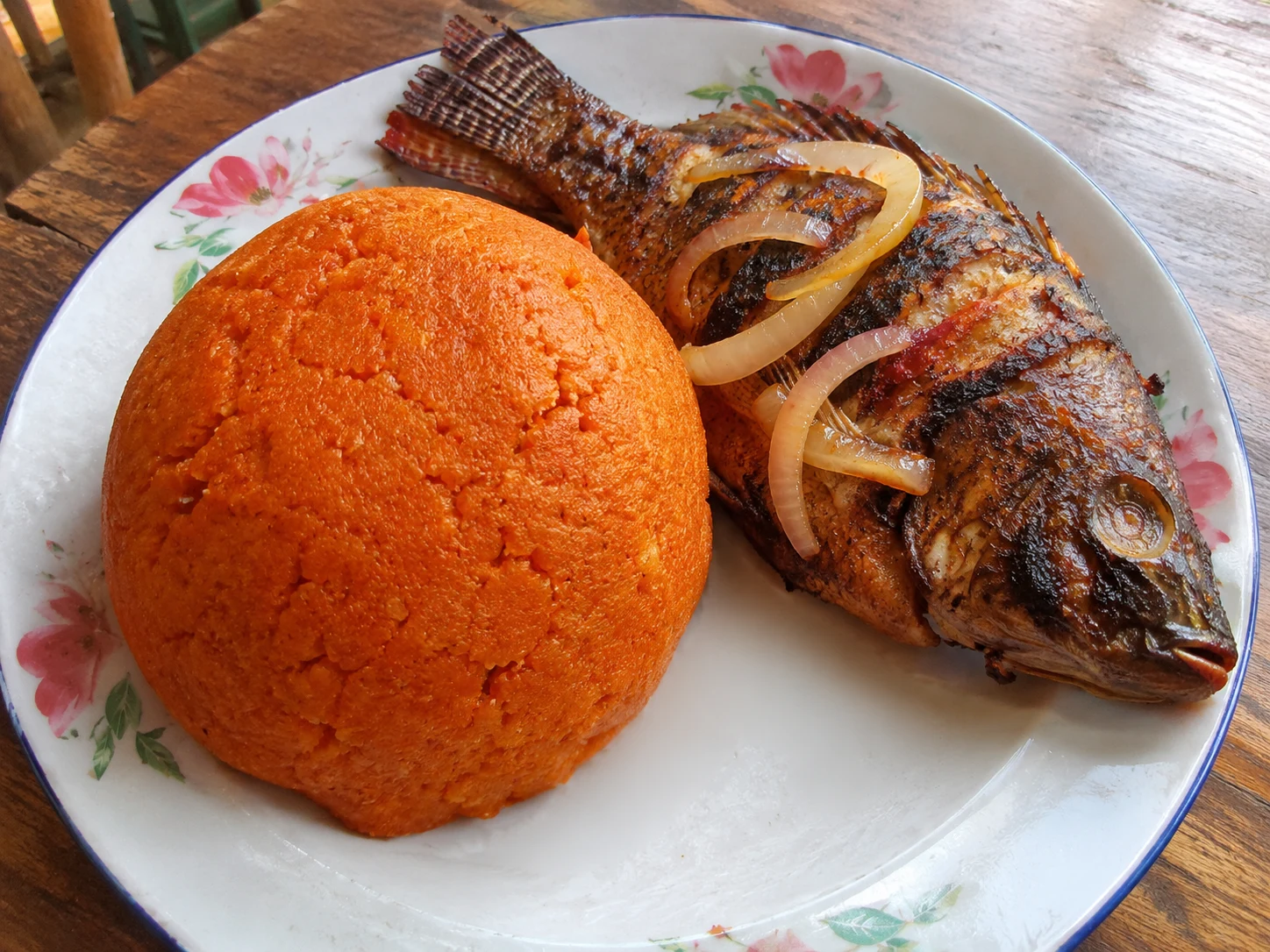
Djenkoumé is much more than a simple corn flour-based dish. It is a preparation that carries within it stories of transmission, terroir, community, and adaptation. In several regions of West Africa, particularly in Togo and in border areas of Benin and Ghana, it is known as a cooked corn paste, dense, creamy, usually enhanced by a red sauce made from tomato, oil, spices, sometimes fish, meat, or shellfish depending on means, seasons, and local customs. Djenkoumé belongs to this large family of African dishes where a cereal base is combined with an aromatic sauce: an essential culinary principle that combines satiety, nutrition, and conviviality.
Prepare this speciality
Choose a detailed recipe, adjust the portions and prepare your ingredients before starting. Our cooking tips and food safety advice complement the steps described in the recipes.
Explore further: Cooking tips · Food hygiene and safety advice.
History and uses
What makes djenkoumé unique is its dual identity. On one hand, it is deeply rooted in ancient traditions of cereal processing, with very precise cooking gestures, often learned from childhood. On the other hand, it is an extraordinarily flexible dish, capable of evolving with the contemporary context: it is found on family tables, during ceremonies, but also in restaurants that revisit urban African cuisine. This blend of continuity and renewal largely explains its unique place in African gastronomy.
🥣🔥 A DEMANDING AND REFINED CULINARY TECHNIQUE
Preparing djenkoumé is not an improvised act. The success of the dish relies on mastering texture, heat, and cooking rhythm. Generally, one starts with corn flour, sometimes slightly fermented according to regional customs, which is diluted in water to avoid lumps. This base is then cooked gradually, with energetic arm work using a wooden spatula or cooking stick. The movement is continuous: stirring, crushing, folding the dough back on itself, until a homogeneous, flexible but firm consistency is obtained, capable of holding its shape on the plate without becoming dry.
Where djenkoumé differs from other corn pastes is that cooking can incorporate a spicy sauce base or a seasoned oily base that colors and flavors the paste. Depending on the versions, concentrated tomato, onion, chili, garlic, ginger, and sometimes local spices are added. The result is a more flavorful paste in itself, and not just a neutral base for the sauce. This characteristic contributes to its strong identity.
In many households, cooking djenkoumé is considered proof of culinary skill. One must feel the exact moment when the paste “sets,” recognize the right shine by eye, adjust water or flour in real-time, and maintain a heat that does not burn the bottom of the pot. This technicality, transmitted orally, shows how rich African cuisines are in subtle know-how, far from clichés that reduce them to “simple” recipes.
🧭🍅 A CROSSROADS DISH BETWEEN TERROIR, TRADE, AND THE CIRCULATION OF TASTES
The history of djenkoumé is part of the great movements of foodstuffs in Africa. Corn, which has become essential in many regions, gradually established itself in local food systems, complementing other cereals and tubers. Its success is due to its productivity, its ability to be preserved as grain or flour, and its versatility in cooking. Djenkoumé illustrates this creative appropriation: populations have transformed an available ingredient into a codified dish, carrying identity.
The sauce that accompanies or permeates djenkoumé also tells the story of exchanges. Tomato, now central to many West African cuisines, has been integrated and then reinterpreted with local techniques of long cooking, spicy frying, and flavor concentration. Chili, vegetable oils, smoked or dried fish, shrimp, artisanal broths: all these elements reflect regional trade circuits, domestic economies, and preferences built over generations.
Thus, djenkoumé is not just “local.” It is the living result of a dialogue between territorial anchoring and cultural circulation. This is precisely what gives it its place in African cuisine: it embodies a connected, inventive culinary Africa, capable of integrating influences without losing its own logic.
In my books

Continue exploring the continent’s cuisines with Africa at the Table — 54 countries, 54 iconic dishes, by Alioune FALL. This book is in English.
Explore further
👩🏾🍳🤝 A SOCIAL LANGUAGE OF SHARING AND BELONGING
In many African contexts, eating is not just about nourishing oneself, it is also about affirming bonds. Djenkoumé fully participates in this relational dimension. Often served in a large communal dish or in generous portions, it promotes a meal punctuated by dialogue, proximity, and attention to others. The way of serving, distributing the sauce, offering an extra portion to a guest, all of this is part of a code of hospitality.
This dish also features in significant moments: family gatherings, religious celebrations, community festivals, returns to the village, shared Sundays. It then becomes a powerful emotional marker. Many people in the diaspora associate its taste with home, childhood, the voices of elders, the smells of weekend cooking. In these migratory trajectories, djenkoumé acts as a bridge between past and present, between country of origin and country of residence.
Its collective preparation is also a space for intergenerational transmission. The youngest observe, taste, repeat the gestures. The elders correct, explain, tell stories. Through this process, the dish becomes a tool for cultural pedagogy: one learns techniques, but also values, memories, a way of being together.
🌾🥬 A NUTRITIONAL AND ECOLOGICAL READING OF DJENKOUMÉ
From a nutritional perspective, djenkoumé is based on an energizing carbohydrate base, adapted to the needs of significant physical activities and lifestyles where meals must sustain over time. Depending on the accompaniments, it can be enriched with protein (fish, meat, legumes), lipids (oils), micronutrients (vegetables, leaves, condiments). Like many traditional African dishes, its final balance mainly depends on the composition of the sauce and the portions.
It can perfectly fit into a balanced modern diet if certain parameters are adjusted: amount of oil, diversity of vegetables, proportion of lean protein, salt control. It can also be adapted to contemporary preferences in a vegetarian or lighter version, without losing its distinctive taste.
From an ecological point of view, djenkoumé testifies to a cuisine of local resources. Locally ground corn, market products, dried or smoked condiments, the valorization of sometimes neglected cuts: all this refers to logics of sobriety and food resilience. In a context where global food systems are weakened by climate and economic crises, these African culinary know-how offer concrete avenues for thinking about sustainable, accessible, and culturally relevant food.
🎶🏠 A STRONG PRESENCE IN AFRICAN CULINARY MODERNITY
Today, djenkoumé continues to evolve. In West African capitals, restaurateurs offer it with revisited sauces, more contemporary presentations, or combinations with less traditional seasonal products. In the diaspora, it is sometimes adapted with ingredients available in Europe or North America, while retaining its basic structure. This movement is not a loss of authenticity: it is proof that tradition is alive.
Social networks, culinary channels, and blogs also play a role in its dissemination. They document family recipes, compare regional variations, and give visibility back to dishes sometimes marginalized by Western gastronomic standards. In this context, djenkoumé becomes a symbol of cultural affirmation: cooking this dish, sharing it, and explaining it, is to assert the richness of African culinary heritage.
Its place in African cuisine is therefore central on several levels: technical, historical, social, nutritional, and identity-based. Djenkoumé represents an African way of thinking about meals: a nourishing base, an expressive sauce, a taste for community, an intelligence of adaptation. It reminds us that the continent's cuisines are neither static nor uniform, but traversed by nuances, circulations, and permanent creations.
🌍 CONCLUSION
Ultimately, talking about djenkoumé is talking about a dish that connects the earth to the home, the gesture to memory, the individual to the community. It is a dish of continuity, capable of crossing generations while embracing change. Its strength lies there: in its apparent simplicity, it concentrates remarkable cultural depth. And in the great mosaic of African cuisines, it occupies a precious place, that of a landmark that is both daily and symbolic, humble and majestic, local and universal.
In the kitchen : Djenkoumé
Recipes from the site to put your knowledge into practice:
Discover these cuisines at a restaurant
Explore our restaurant and caterer directories. Choose your destination and check the establishment’s menu to confirm which dishes are offered and available.
Continue exploring
Enjoy discovering ingredients and African cuisines? Join our newsletter. The illustrated PDF 10 sauces africaines incontournables is in French and is offered after confirming a subscription to the French or bilingual edition.