Tunisian Fricassé
Tunisia
Understanding : Tunisian Fricassé
🥖🇹🇳 INTRODUCTION
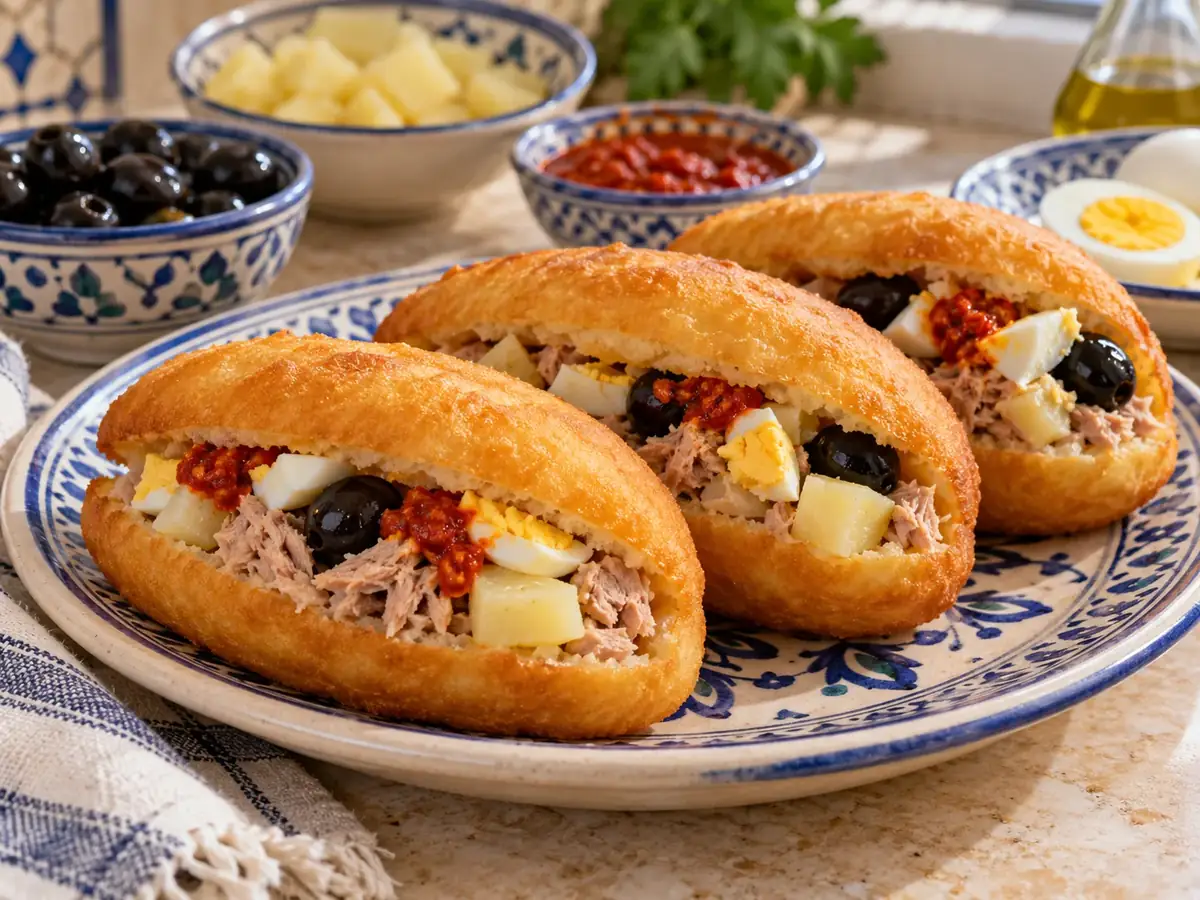
The Tunisian fricassé is one of those dishes that tells the story of an entire country in a single bite. At first glance, it's a small fried bun, filled with a savory preparation: tuna, potatoes, olives, hard-boiled egg, harissa, sometimes capers or méchouia salad (a grilled vegetable salad) depending on local customs. But behind this apparent simplicity lies a concentration of social history, culinary cross-pollination, and Maghrebi identity. In Tunisia, fricassé is at once street food, a childhood memory, an everyday snack, and a symbol of conviviality. Its place in African cuisine is important, as it perfectly illustrates a central dynamic of the continent: the art of transforming accessible ingredients into a deeply local, expressive, and shared creation.
Prepare this speciality
Choose a detailed recipe, adjust the portions and prepare your ingredients before starting. Our cooking tips and food safety advice complement the steps described in the recipes.
Explore further: Cooking tips · Food hygiene and safety advice.
History and uses
Fricassé holds a unique position because it connects several worlds. It lies at the border between bakery and family cooking, between frying and assembly, between Mediterranean, Arab, Amazigh, and Tunisian Jewish heritages. It's a food that crosses social classes, generations, and territories: it's found in large coastal cities, in popular neighborhoods, in homes, during outings, celebrations, or impromptu small meals. Its cultural strength lies in its ability to be both modest and emblematic.
🍞🔥 A precise culinary architecture: dough, frying, filling, and balance of textures
The heart of the fricassé is first and foremost its bread. It's not simply a neutral support. The dough, usually leavened, is shaped into small oval or round buns, then fried until it has a golden crust and a soft crumb. This frying gives an immediate sensory signature: a slightly crispy exterior, a soft interior, ready to absorb the powerful flavors of the filling. The bread is then opened on the side, like a generous pocket, and carefully filled.
The classic Tunisian filling relies on a play of contrasts. Tuna brings the salty, iodized flavor; mashed or diced potato softens the whole and adds body; hard-boiled egg enriches the texture; olives add bitterness and depth; harissa imposes the spiciness and aromatic warmth. In some variations, méchouia salad or marinated vegetables introduce a smoky and tangy note. Each component has a precise function: no presence is anecdotal. A well-made fricassé should be neither dry, nor overwhelming, nor unbalanced in spice. It seeks harmony between fat, salt, spice, softness, and texture.
This precision shows that fricassé is a skill, not just a snack. The yeast dosage, the oil temperature, the moment it's removed from frying, the distribution of harissa, the quality of the olives, the texture of the potato: all these details distinguish an ordinary fricassé from a memorable one. In many Tunisian homes, these gestures are passed down empirically, through observation and repetition, like many African culinary techniques based on experience rather than strict measurement.
🌍🧭 A HISTORY OF TUNISIAN AND MEDITERRANEAN CROSS-POLLINATION ROOTED IN NORTH AFRICA
Understanding fricassé also means understanding Tunisia as a historical crossroads. The country has long been traversed by movements of people, products, and culinary practices. Fricassé, in its current form, is often associated with urban traditions and Judeo-Tunisian heritages that have left a lasting mark on national gastronomy. The presence of tuna, olives, chili, and frying refers to Mediterranean worlds, but the Tunisian way of assembling these elements remains very specific.
Harissa, in particular, anchors fricassé in the Tunisian taste personality. It's not just a spicy condiment; it carries a national identity, with its nuances of garlic, chili, spices, and sometimes caraway or coriander depending on the recipes. In fricassé, it plays a structuring role: it connects the ingredients, it signs the Tunisian taste, it transforms a filled bun into a distinctive experience. This ability to “mark” a dish with an emblematic condiment is found in many African cuisines, where spice pastes, chili sauces, and aromatic blends play a central cultural role.
In the broader African culinary map, fricassé also represents the North African contribution to the grab-and-go food culture. Like other specialties of the continent, it shows that a popular dish can be technically elaborate, historically rich, and socially transversal. It thus helps to deconstruct the idea that street food is secondary to so-called “noble” cuisine. In reality, it is often in the street that the gustatory memory of a people is best preserved.
In my books

Continue exploring the continent’s cuisines with Africa at the Table — 54 countries, 54 iconic dishes, by Alioune FALL. This book is in English.
Explore further
🏙️🤝 A SOCIAL FOOD: ACCESSIBILITY, CONVIVIALITY, AND EMOTIONAL ATTACHMENT
The Tunisian fricassé is deeply linked to the rhythms of daily life. It's eaten at the market, after school, during a work break, while traveling, at an informal family gathering. Its format makes it practical, nourishing, economical, and satisfying. This accessibility is fundamental: it allows fricassé to exist in all layers of society. It belongs to no one in particular, so it belongs to everyone.
Its emotional dimension is very strong. Many Tunisians associate fricassé with specific memories: a neighborhood shop, a well-known vendor, a grandmother's recipe, the smell of frying on the weekend, a simple moment of celebration. In the diaspora, it often becomes a powerful identity marker. Preparing or sharing a fricassé in France, Canada, or elsewhere means rediscovering a language of taste that connects to the country of origin. This phenomenon is common to many diasporic African cuisines: popular dishes become “edible archives” of collective memory.
Fricassé is also a medium for sociability. People discuss the best places, compare recipes, debate the right level of harissa, and exchange dough tips. These seemingly light conversations are actually forms of cultural transmission. They maintain the continuity of a living heritage, without formal institutions, but with remarkable power.
🥔🐟 A NUTRITIONAL READING AND CONTEMPORARY ADAPTATIONS
From a nutritional perspective, fricassé combines carbohydrates (bread, potato), proteins (tuna, egg), fats (frying, oil), fiber, and variable micronutrients depending on vegetable additions. It's an energetic food, historically designed to be filling. Like many traditional specialties, its nutritional impact depends on the context of consumption: frequency, portion, quality of ingredients, accompaniments.
Today, many adaptations appear without betraying the spirit of the dish. Some reduce the size, add more vegetables, use better-controlled cooking oils, or offer oven-baked versions inspired by fricassé, even if frying remains the classic signature. Others vary the filling with chickpeas, vegetarian options, or different fish depending on availability. This plasticity is a strength: it allows fricassé to remain relevant in urban lifestyles, concerned with health and dietary diversity.
In the current African context, where there is a desire to value culinary heritage while addressing modern nutritional challenges, fricassé offers an excellent example of a possible balance between tradition and innovation. Major taste codes can be preserved while adjusting certain practices to better meet contemporary expectations.
🎉📚 A LASTING PLACE IN AFRICAN CUISINE: LIVING, POPULAR, AND EXPORTABLE HERITAGE
The place of Tunisian fricassé in African cuisine is both symbolic and concrete. Symbolic, because it embodies popular North African creativity and the ability to produce a strong culinary identity with simple ingredients. Concrete, because it circulates, is exported, adapts, and contributes to the international visibility of African cuisines in their real diversity.
It also reminds us of an essential truth: African cuisine is not a uniform block. It is plural, traversed by terroirs, histories, migrations, and distinct techniques. In this plurality, Tunisian fricassé holds a prominent place as an urban, warm, spicy, generous, immediately recognizable specialty. It dialogues with other African traditions of bread, frying, sandwiches, and composed fillings, while retaining its clear Tunisian personality.
Finally, fricassé contributes to a broader rehabilitation of popular African cuisines. Long underestimated in certain gastronomic discourses, they are now being rediscovered for their technical intelligence, historical depth, and emotional power. Fricassé, with its golden bread, vibrant harissa, and characterful filling, is a brilliant demonstration of this.
🇹🇳 CONCLUSION
Ultimately, talking about Tunisian fricassé means talking about a dish that creates connections: a connection between past and present, between street and home, between Tunisia and the diaspora, between North Africa and the rest of the continent. It's a dish that nourishes the body, but also belonging. And that is precisely why it deserves a major place in African culinary memory: because it is living, shared, transmissible, and profoundly human.
In the kitchen : Tunisian Fricassé
Recipes from the site to put your knowledge into practice:
Discover these cuisines at a restaurant
Explore our restaurant and caterer directories. Choose your destination and check the establishment’s menu to confirm which dishes are offered and available.
Continue exploring
Enjoy discovering ingredients and African cuisines? Join our newsletter. The illustrated PDF 10 sauces africaines incontournables is in French and is offered after confirming a subscription to the French or bilingual edition.