Ifisashi
Zambia, Southern Africa
Understanding : Ifisashi
🥜🌍 INTRODUCTION
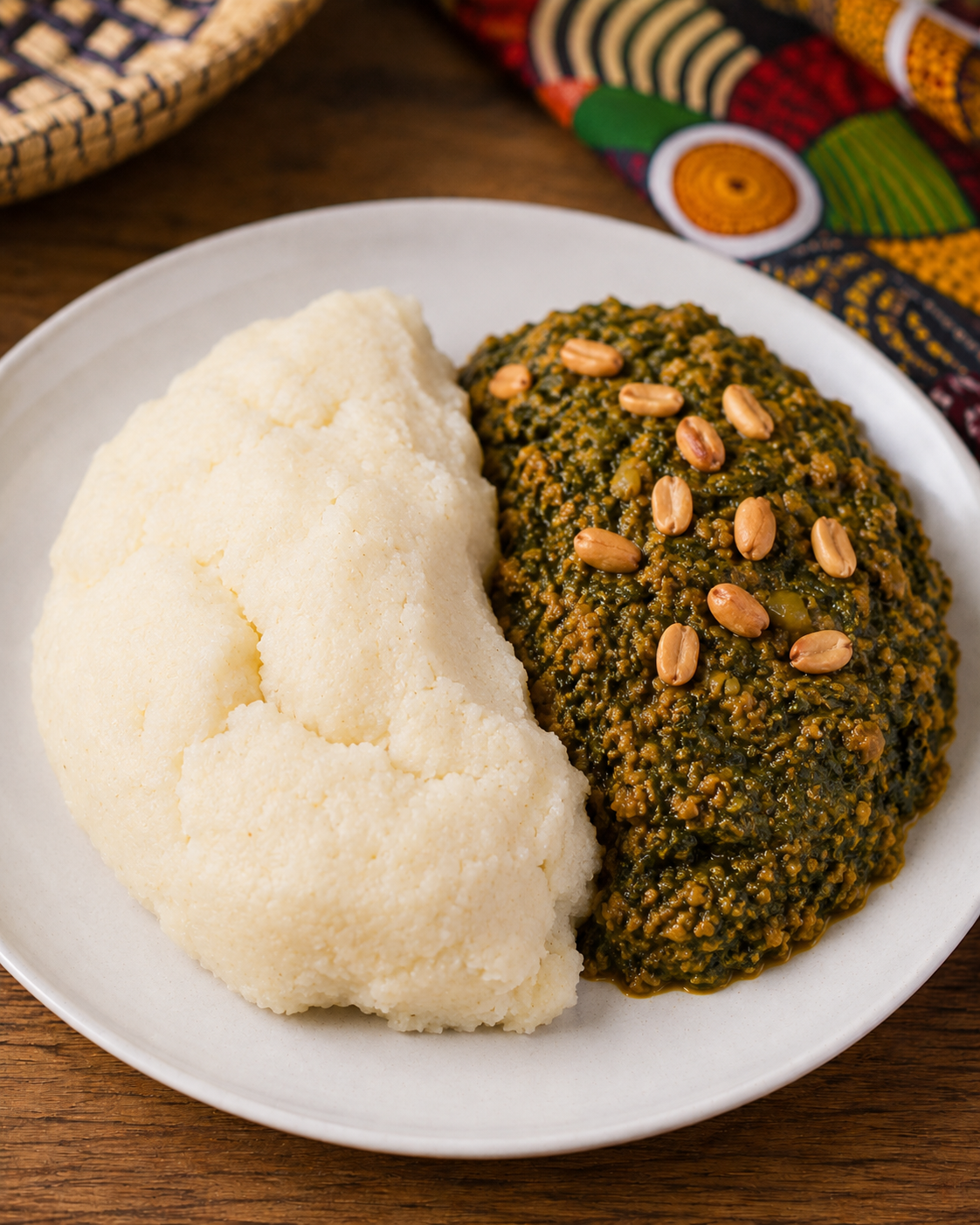
Ifisashi is one of the most iconic dishes of Zambia and, more broadly, of Southern Africa. Both nourishing, deeply rooted in domestic habits, and carrying a strong cultural significance, it perfectly illustrates the culinary logic of many African societies: combining a local plant-based staple, often leaves or vegetables, with a sauce rich in flavor and energy, then accompanying it with a reference starch like nshima (a thick porridge made from maize flour) in Zambia. In its most common form, ifisashi is a preparation of leafy greens cooked in a peanut-based sauce, sometimes supplemented with vegetables such as pumpkin, cabbage, sweet potato leaves, or other greens available depending on the region and season.
Prepare this speciality
Choose a detailed recipe, adjust the portions and prepare your ingredients before starting. Our cooking tips and food safety advice complement the steps described in the recipes.
Explore further: Cooking tips · Food hygiene and safety advice.
History and uses
However, reducing ifisashi to a simple “peanut and vegetable sauce” would be to miss its depth. This dish tells a story of an intimate relationship with the land, food crops, agricultural timings, and family sharing. It also reflects a great intelligence of culinary economics: transforming accessible ingredients into a complete, satisfying, and adaptable meal. In African cuisines, this intelligence is central. Ifisashi is an elegant demonstration of this, as it combines simplicity of components, complexity of taste, and high social value.
Its place in African cuisine is important for another reason: it embodies the continuity between daily food and heritage. It is not just a festive dish or a dish of necessity; it is a dish of life. It is found in homes, canteens, local restaurants, in urban and rural contexts, with variations that reflect Zambian cultural diversity. Thus, ifisashi functions as a culinary matrix: a common base that each community, each family, and each cook interprets in their own way.
🍃🔥 A DISCREET BUT DEMANDING TECHNIQUE, BASED ON BALANCE AND MASTERY OF FIRE
The success of ifisashi relies on subtle know-how. The general principle is to cook vegetables or leaves in a peanut sauce made from diluted peanut paste or flour. But this technical description doesn't tell the whole story. The difficulty lies in the final texture, in managing the potential bitterness of the leaves, in the creaminess of the sauce, and in the balance between sweetness, the natural fat of the peanut, and the vegetal character of the ingredients.
In many domestic practices, the leaves are first sorted, washed, then cut, sometimes blanched depending on their nature. Then, they are simmered with a minimum of water to preserve taste and nutritional density. Peanut paste is incorporated gradually to avoid lumps and obtain a smooth, coating sauce, neither too liquid nor too thick. The heat must remain moderate: too high, the sauce sticks or separates; too low, the flavors do not develop properly. Some versions include onion, tomato, or chili, while others remain very simple to let the peanut and leaves speak for themselves.
This work shows that everyday African cuisines are far from rudimentary. They involve a fine reading of raw materials, continuous adaptation to the quality of the day's produce, and a taste memory that guides adjustments. In ifisashi, every detail counts: the variety of leaves, the freshness of the peanut, the cooking time, the level of reduction. It is this precision that elevates the dish from a simple utilitarian preparation to a true culinary signature.
🌾🥣 AGRICULTURAL ANCHORING, NUTRITIONAL LOGIC, AND LOCAL FOOD INTELLIGENCE
Ifisashi is inseparable from local agricultural systems. Peanuts and leafy greens play an important role in many rural economies of Southern Africa. Their seasonal availability, relatively accessible cost, and nutritional value make them pillars of the diet. The dish therefore reflects a concrete link between food production and family cooking.
From a nutritional perspective, ifisashi is particularly interesting. Leafy greens provide fiber, micronutrients, and bioactive compounds beneficial for health. Peanuts provide lipids, plant proteins, and energy. The combination with nshima, a preparation based on corn flour, completes the meal by providing the carbohydrates necessary for satiety. This creates a coherent whole, capable of meeting daily energy needs while remaining based on local resources.
This nutritional coherence aligns with a logic found in many African cuisines: building complete meals from intelligent combinations rather than from an abundance of expensive ingredients. Ifisashi demonstrates that nutritional density can emerge from local cuisine, rooted in the terroir. In the contemporary context, where issues of food security and sustainability are becoming crucial, this type of dish gains new relevance. It offers a model where culture, nutrition, and ecology are not separate, but deeply intertwined.
In my books

Continue exploring the continent’s cuisines with Africa at the Table — 54 countries, 54 iconic dishes, by Alioune FALL. This book is in English.
Explore further
🏡🤲 A DISH OF TRANSMISSION, COMMUNITY, AND IDENTITY
Ifisashi is not just eaten; it is experienced. In many families, learning begins early, often through observation: watching a mother, an aunt, a grandmother adjust the sauce, taste, correct, start again. This oral and gestural transmission is a major characteristic of African culinary heritage. The recipe exists, but it is less fixed than in a written context; it is embodied by practice.
The dish also plays a relational role. Served with nshima, it is part of a shared meal where conviviality is central. Conversations around the table, the way portions are distributed, the attention paid to guests, all contribute to the experience. Like many African sauce-based dishes, ifisashi promotes a collective temporality of the meal: people eat together, at the same pace, in an atmosphere of closeness.
In urban and diasporic contexts, ifisashi often becomes a strong identity marker. Preparing it far from one's country of origin means maintaining a link with family and cultural memory. Ingredients may change slightly depending on what is found in foreign markets, but the structure of the dish remains, and with it the sense of belonging. This ability to travel without dissolving is one of the signs of great culinary traditions.
🌍🍲 THE PLACE OF IFISASHI IN THE MOSAIC OF AFRICAN CUISINES
On a continental scale, ifisashi occupies a place comparable to other African dishes based on the principle of vegetables + oilseeds + accompanying starch. Structural similarities can be found with various peanut sauces from West Africa, Central Africa, or other areas of Southern Africa, even if the precise ingredients, textures, and aromatic profiles vary. This kinship does not mean uniformity; rather, it reveals a shared culinary logic, adapted to distinct local ecologies and histories.
The specificity of ifisashi lies particularly in its Zambian roots, its strong link with nshima, and the important place of leafy greens in its identity. Where some African peanut sauces emphasize meat or fish more, ifisashi can fully embrace a plant-based centrality. This gives it a valuable uniqueness in contemporary discussions about African cuisines: it shows that the continent's traditions have long offered models of complete, flavorful, and culturally valued plant-based dishes.
In the international recognition of African gastronomies, ifisashi deserves increased visibility. It represents an everyday cuisine that does not seek ostentation, but expresses a fundamental sophistication: balance of flavors, mastery of textures, nutritional intelligence, symbolic strength. At a time when the global culinary scene is increasingly interested in terroir narratives and sustainable practices, ifisashi appears as an exemplary dish.
✨📚 LIVING TRADITION, CURRENT CREATIVITY, AND CULINARY FUTURE
Far from being static, ifisashi continues to evolve. In some urban kitchens, new vegetable combinations, more contemporary presentations, or enriched versions are experimented with according to current dietary preferences. African chefs value this type of dish in heritage and creative approaches, highlighting the nobility of local ingredients long considered “ordinary.”
This dynamic is essential because it helps to avoid two pitfalls: folklorizing traditional cuisine or abandoning it in the name of modernity. Ifisashi shows that another path is possible: preserving the fundamental logics of the dish while allowing room for innovation. This is precisely how great cuisines live: through simultaneous transmission and transformation.
Ultimately, ifisashi holds a major place in African cuisine because it concentrates several key dimensions of the continent's culinary heritage. It is rooted in the land and agricultural cycles, nutritionally rich, technically demanding in its apparent simplicity, deeply social in its consumption, and flexible enough to interact with contemporary tastes. It is a dish of continuity and future, a dish that connects generations, territories, and ways of inhabiting food.
🌍 CONCLUSION
Talking about ifisashi is therefore recognizing the power of everyday African cuisines, those that nourish daily while carrying worldviews. In a bowl of ifisashi, memory, care, economy of means, gustatory pleasure, and collective belonging meet. This is why its place is not only legitimate, but essential, in any serious reflection on African gastronomic richness.
In the kitchen : Ifisashi
Recipes from the site to put your knowledge into practice:
Discover these cuisines at a restaurant
Explore our restaurant and caterer directories. Choose your destination and check the establishment’s menu to confirm which dishes are offered and available.
Continue exploring
Enjoy discovering ingredients and African cuisines? Join our newsletter. The illustrated PDF 10 sauces africaines incontournables is in French and is offered after confirming a subscription to the French or bilingual edition.