Kelewele
Ghana, Africa
Understanding : Kelewele
🍌🔥 INTRODUCTION
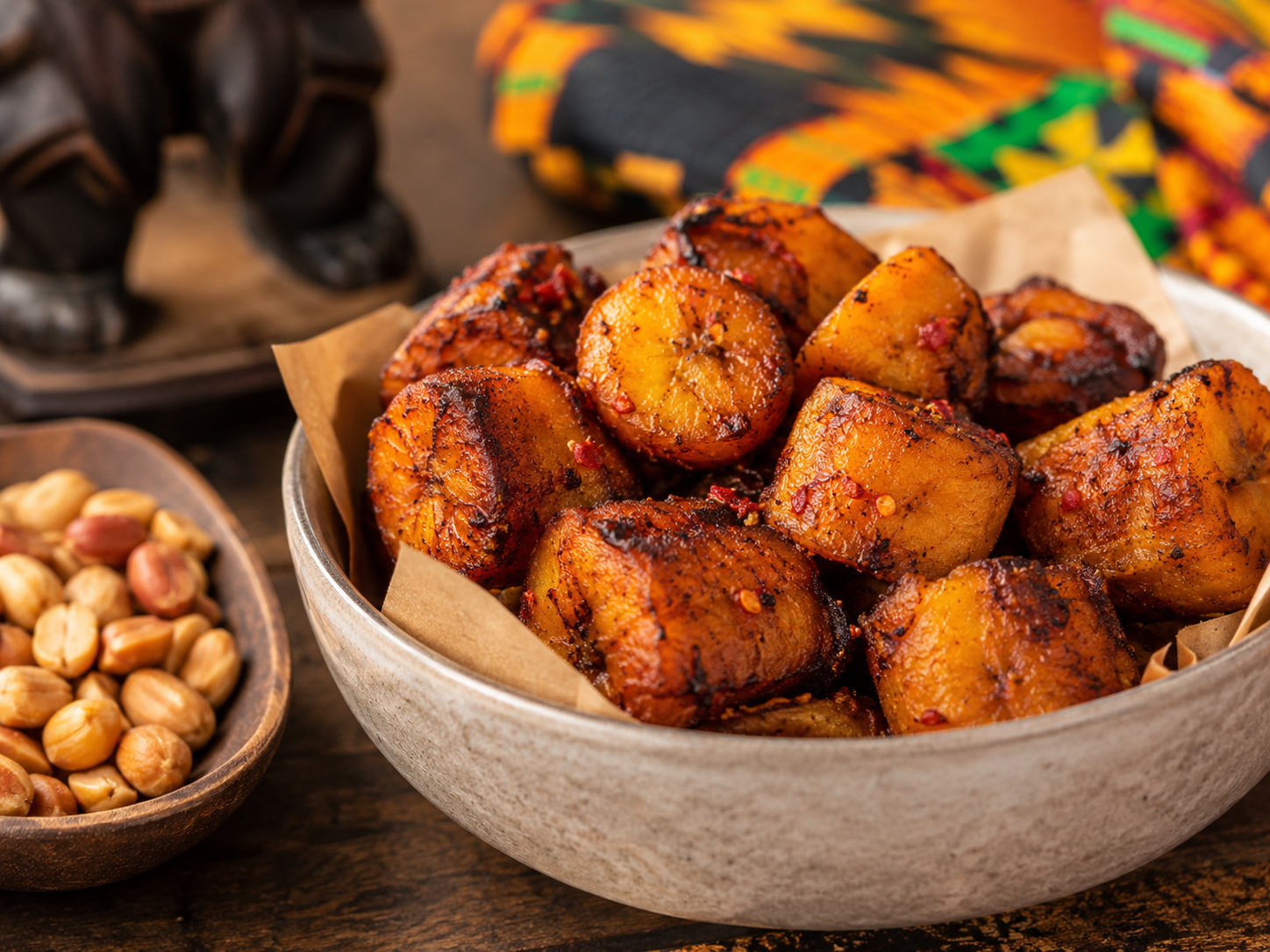
Kelewele is one of Ghana's most iconic street foods, and arguably one of West Africa's most well-known plantain-based preparations. At first glance, it may seem simple: diced ripe plantain, seasoned with a blend of spices, then fried until partially caramelized. Yet, behind this apparent simplicity lies a dish of great cultural richness. Kelewele says something fundamental about African cuisines: their ability to transform an everyday ingredient into a complete, identity-forming, and collective culinary experience.
In Ghanaian cities, kelewele is everywhere: on market edges, by roadsides, near entertainment venues, in residential and popular neighborhoods, often at nightfall. Its scent is immediately recognizable, a blend of the natural sugar of ripe plantain, ginger, chili, sometimes cloves, pepper, or garlic depending on the recipe. This scent attracts, gathers, creates a sensory geography of the city. One doesn't just buy a portion of food; one participates in an urban ritual, in an evening temporality, in a culture of informal sharing.
Prepare this speciality
Choose a detailed recipe, adjust the portions and prepare your ingredients before starting. Our cooking tips and food safety advice complement the steps described in the recipes.
Explore further: Cooking tips · Food hygiene and safety advice.
History and uses
The place of kelewele in African cuisine thus extends beyond the Ghanaian national framework. It represents a culinary model where local agriculture, frying techniques, mastery of spices, street economy, and sociability meet. It dialogues with other African fried plantain traditions, while asserting its own personality thanks to its intense aromatic profile and unique social function.
🧄🌶️ A PRECISE COMPOSITION: PLANTAIN, SPICES, AND THE SCIENCE OF FRYING
The heart of kelewele lies in the choice of plantain. It must be ripe, often yellow with black spots, to offer a good balance between holding its shape during cooking and sweet softness. Too green, it will be starchy and unexpressive. Too ripe, it risks falling apart in the oil. The cutting into cubes or diamonds is also not insignificant: the size influences the final texture, the caramelization surface, and the ability to absorb the seasoning.
The seasoning is the signature of the dish. Fresh ginger is almost always central; it brings warmth, pungent freshness, and aromatic depth. Chili adds direct intensity, while garlic, onion, or certain dry spices complete the flavor structure. Some preparations include a touch of salt before frying, others adjust the seasoning after cooking. In several versions, the plantain pieces are marinated with spices so that the flavors penetrate the flesh better. This step may seem simple, but it is decisive for obtaining kelewele that is not just “spicy on the surface,” but truly flavored to the core.
Frying, finally, is a step of precision. The oil must be hot enough to quickly sear the outside, form a thin crust, and limit excessive fat absorption. But it must not be too hot, otherwise the plantain sugars and spices will blacken before the inside is tender. Good kelewele presents a sought-after contrast: slightly crispy edges, a tender heart, sweet, salty, and spicy notes that respond to each other without neutralizing. This complexity of texture and taste demonstrates that African street food is not improvised; it requires very advanced empirical mastery.
🌍🥜 A STRATEGIC PLACE IN WEST AFRICAN FOOD CULTURES
Kelewele is part of a larger universe where plantain plays a major role in West and Central Africa. A versatile food, plantain can be boiled, pounded, fried, roasted, or processed into flour. Its presence in regional cuisines is linked to its agronomic adaptation, its availability, and its energy value. Kelewele represents one of the most gourmet expressions of this ingredient, particularly in an urban context where speed, accessibility, and intense flavor are sought after.
This dish also dialogues with local economies. It mobilizes relatively accessible products, creates added value through processing, and supports small catering activities, often run by women entrepreneurs. Kelewele vendors occupy an important place in the informal economic fabric: they feed entire neighborhoods, generate family income, and transmit specific culinary know-how. Their role recalls an essential reality of African cuisines: gastronomic innovation and continuity largely depend on the daily work of street and household actors.
In the mapping of African cuisines, kelewele thus embodies a meeting point between terroir and urbanity. It is rooted in a local agricultural product, but its current form is deeply linked to city life, mobility, nocturnal rhythms, and contemporary sociabilities. This articulation between rural and urban is one of the central dynamics of current African gastronomy.
In my books

Continue exploring the continent’s cuisines with Africa at the Table — 54 countries, 54 iconic dishes, by Alioune FALL. This book is in English.
Explore further
🏙️🤝 STREET FOOD, COLLECTIVE MEMORY, AND DIASPORIC IDENTITY
Kelewele is not just consumed to satisfy hunger. It is also linked to emotions, memories, and habits of life. For many Ghanaians, it evokes specific scenes: waiting around a stall, the sound of oil, end-of-day discussions, outings with friends, night journeys punctuated by a gourmet stop. This emotional dimension gives the dish a cultural depth that goes beyond its recipe.
In the African diaspora, kelewele has become a strong identity marker. Preparing it in London, Paris, New York, Toronto, or elsewhere means recreating an atmosphere, rediscovering a taste of home, transmitting a memory to generations born far from Ghana. Ingredients sometimes adapt to local markets, chili levels vary according to the audience, but the spirit remains the same: spicy warmth, plantain sweetness, immediate conviviality.
This ability to travel while retaining its identity places kelewele among African dishes with strong global heritage potential. It is easily shareable, understandable by diverse audiences, but it retains a clear cultural signature. As such, it contributes to the international visibility of African cuisines, often still underrepresented in dominant gastronomic narratives.
🍽️⚖️ NUTRITIONAL VALUE, CONTEMPORARY USES, AND CULINARY REINTERPRETATIONS
Nutritionally, kelewele primarily provides carbohydrates, varying fibers depending on maturity and cooking, as well as energy related to frying. Its interest depends on the overall dietary context: in moderate portions, accompanied by roasted peanuts or a protein source, it can be part of a coherent meal or snack. Consumed frequently in large quantities, like any fried food, it requires a certain balance with other lighter preparations.
Traditionally, it is often served with roasted peanuts, a remarkable combination from a taste and nutritional perspective: the crunch and lipid richness of the peanuts respond to the spicy tenderness of the plantain. This duo enhances satiety and illustrates a frequent African logic of intelligent pairing between starchy food and oilseeds.
Today, reinterpretations are emerging. Some chefs offer kelewele baked or air-fried to reduce the amount of oil, others play with new spices, different cuts, or more contemporary presentations as an accompaniment to main dishes. Despite these innovations, the fried street version remains the emotional and cultural reference. It reminds us that a popular dish can evolve without losing its historical legitimacy.
🎉📚 A MAJOR CONTRIBUTION TO THE RECOGNITION OF AFRICAN CUISINES
The place of kelewele in African cuisine is major because it concentrates several fundamental dimensions: valorization of a local product, technical mastery, aromatic intensity, social anchoring, economic accessibility, and cultural export capacity. It shows that the continent's cuisines are not only defined by grand ceremonial dishes, but also by everyday preparations that structure collective life.
Kelewele also helps change perceptions of African gastronomy. It proves that a street dish can be sophisticated in its balance, rich in history, and worthy of heritage analysis. It reminds us that African culinary modernity does not only come through haute cuisine, but also through the recognition of popular know-how, long made invisible.
Ultimately, kelewele is much more than just spicy fried plantain. It is a form of culinary language: a language of warmth, movement, city, and sharing. It tells the story of Ghana, but also broader African dynamics: inventiveness from local resources, the importance of women in food economies, the power of taste memory, and the circulation of dishes across borders and diasporas.
🌍 CONCLUSION
In the great mosaic of African cuisines, kelewele occupies a luminous place. It is immediate yet profound, simple yet technically demanding, popular yet patrimonial. And it is precisely this fertile tension that makes its greatness. Eating kelewele is tasting a moving history, a living culture, a culinary Africa that asserts itself with confidence, generosity, and character.
In the kitchen : Kelewele
Recipes from the site to put your knowledge into practice:
Discover these cuisines at a restaurant
Explore our restaurant and caterer directories. Choose your destination and check the establishment’s menu to confirm which dishes are offered and available.
Continue exploring
Enjoy discovering ingredients and African cuisines? Join our newsletter. The illustrated PDF 10 sauces africaines incontournables is in French and is offered after confirming a subscription to the French or bilingual edition.