Lablabi
Tunisia
Understanding : Lablabi
🥣🇹🇳 INTRODUCTION
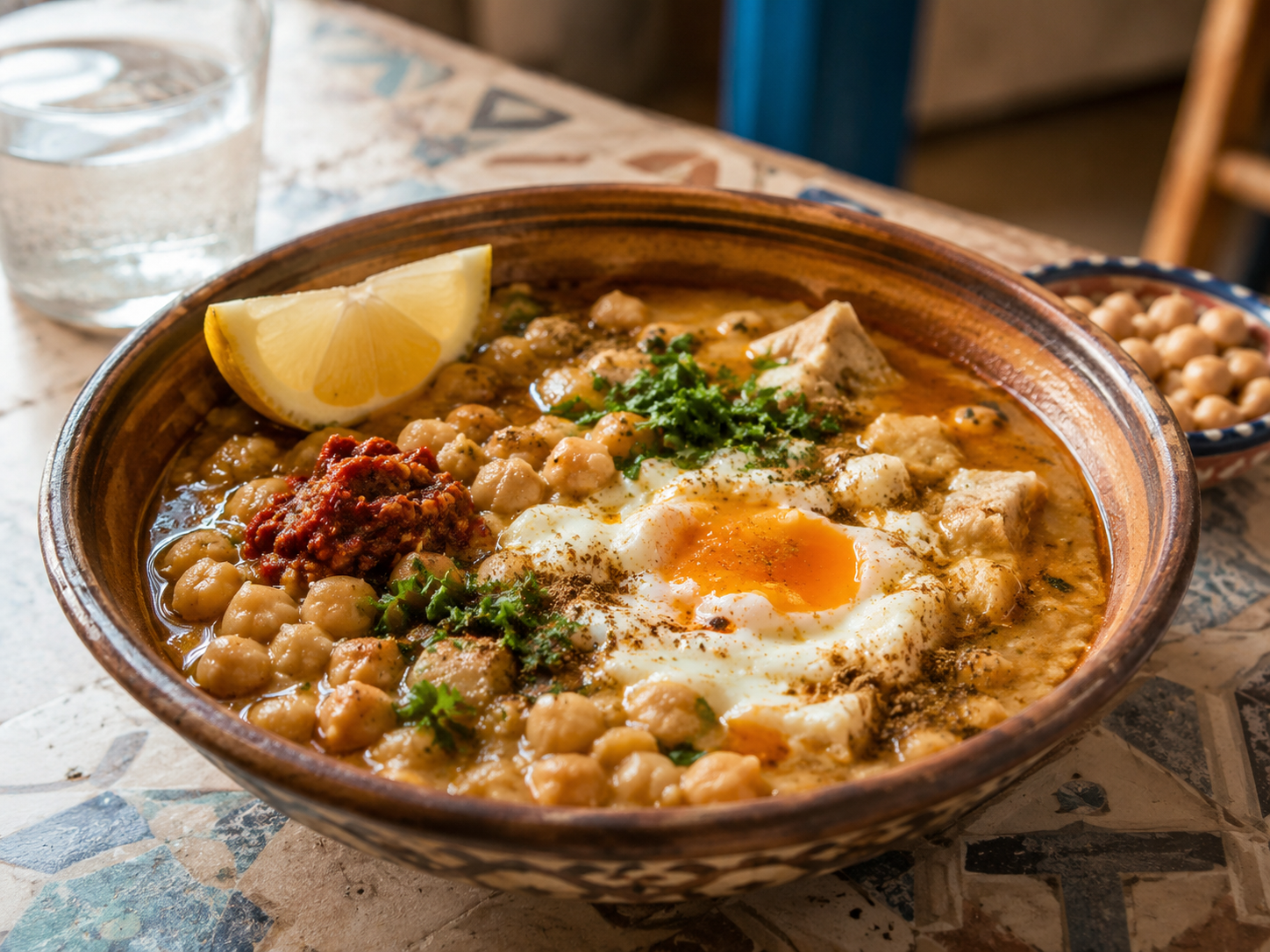
Lablabi is one of Tunisia's most iconic dishes, and undoubtedly one of the best examples of the cultural power of popular African cuisines. At first glance, it's a chickpea soup served very hot over pieces of bread, enriched with garlic, cumin, harissa, olive oil, lemon, sometimes an egg, tuna, capers, or olives depending on the region, family habits, and available resources. But this definition remains incomplete. Lablabi is not just a recipe: it's a social practice, an urban memory, an identity marker, and a form of culinary resilience.
In Tunisian cities, it is often associated with cool mornings, quick but hearty meals, street food stalls, and small eateries known to regulars. It feeds the worker, the student, the traveler, the night owl, the busy family, and the tradition enthusiast alike. Its generally affordable cost, nutritional density, and comforting ability explain its longevity. It is both everyday food and emotional heritage.
Prepare this speciality
Choose a detailed recipe, adjust the portions and prepare your ingredients before starting. Our cooking tips and food safety advice complement the steps described in the recipes.
Explore further: Cooking tips · Food hygiene and safety advice.
History and uses
Its place in African cuisine is essential, as it crystallizes several fundamental logics of the continent: valuing legumes, intelligent assembly, respect for bread as a structuring element of the meal, the importance of condiments, and the art of transforming modest ingredients into a complex experience. Lablabi shows that culinary greatness does not depend on the luxury of products, but on the mastery of balances and the depth of social customs.
🍞🔥 A SUBTLE CULINARY ARCHITECTURE: BROTH, CHICKPEAS, BREAD, AND LIVELY CONDIMENTS
Lablabi is based on a precise construction. The base is a long-cooked chickpea broth, often flavored with garlic and cumin, sometimes enriched with a little concentrated cooking broth to enhance its depth. At the time of serving, pieces of stale or slightly dry bread are placed at the bottom of the bowl, then the boiling soup is poured over them. The heat instantly transforms the texture: part of the bread melts and thickens the whole, while another part retains some chewiness. This interplay between liquid and solid is central to the dish's identity.
Then come the seasonings, which make lablabi a highly customizable dish. Harissa brings the fire and spicy structure. Cumin amplifies the earthy notes of the chickpeas. Olive oil adds roundness and fruitiness. Lemon balances with its acidity. Garlic, raw or infused depending on practices, provides additional aromatic tension. A poached egg or one cracked into the hot broth adds binding and sweetness. Tuna, capers, or olives introduce saline notes that connect the dish to the Tunisian Mediterranean world.
This architecture proves the sophistication of a so-called “simple” cuisine. Lablabi requires a fine understanding of temperatures, textures, and proportions. Too much bread, and the dish becomes pasty. Too little broth, and it loses its purpose as a nourishing soup. Too much harissa, and the flavors are crushed. Not enough lemon, and the whole can seem heavy. Good lablabi is a matter of dynamic balance, sometimes adjusted bowl by bowl.
🌍📜 CROSSED HERITAGES AND TUNISIAN ANCHORAGE WITHIN MEDITERRANEAN AFRICA
Lablabi is part of a long history of culinary circulations in the Mediterranean and North Africa. Chickpeas, present for centuries in the region's food systems, play a major role in many popular preparations. Bread, a pillar of North African tables, is also central as a vector of texture, satiety, and anti-waste. The alliance of the two, reinforced by garlic, spices, and oil, testifies to an ancient food logic: cooking with what you have, without sacrificing flavor.
In Tunisia, this logic has produced its own identity. The role of harissa, the national condiment par excellence, gives lablabi a distinctly Tunisian signature. The possibility of adding tuna or capers reflects the country's maritime openness and Mediterranean affinities. Cumin and garlic recall broader continuities with the cuisines of the Maghreb and the Arab world, while the practice of bread soaked in a spicy broth refers to universal gestures of popular cooking.
Within the African context, lablabi illustrates the richness of North Africa as a fully African culinary space, with its historical, linguistic, and taste specificities. It reminds us that African cuisine is plural: from the thick sauces of West Africa to the stews of Southern Africa, from the steamed dishes of the Horn of Africa to Maghrebi soups, the continent offers a mosaic of forms. Lablabi occupies a special place as a nourishing, urban, spicy, and deeply social soup-dish.
In my books

Continue exploring the continent’s cuisines with Africa at the Table — 54 countries, 54 iconic dishes, by Alioune FALL. This book is in English.
Explore further
🤝🏙️ A TOTAL SOCIAL DISH: ACCESSIBILITY, CONVIVIALITY, AND URBAN MEMORY
Lablabi is a local dish. It is often eaten standing at the counter, sitting in small stalls, or at home in moments of seeking comfort. It accompanies workdays, post-celebration mornings, cool seasons, tight budgets, but also sincere desires for authentic taste. Its democratic dimension is fundamental: it crosses social classes and brings very different audiences together around the same bowl.
This social role makes lablabi a living heritage element. Each address has its reputation, each family its way of dosing garlic or lemon, each regular their garnish preferences. These micro-variations create a shared culinary culture, made of discussions, comparisons, and local loyalties. Like many popular African dishes, lablabi is a place for conversation as much as it is food.
In Tunisian and Maghrebi diasporas, it also plays a powerful memorial role. Reproducing it abroad allows for the recreation of an emotional environment: the smell of hot cumin, the steam of the broth, the spiciness of the harissa, the sensation of soaked bread. These are sensory markers of belonging. Lablabi then becomes a living archive of origin, transmitted to children and shared with guests from other cultures.
🥗⚖️ NUTRITION, SUSTAINABILITY, AND MODERNITY OF A POPULAR CLASSIC
Nutritionally, lablabi has remarkable qualities. Chickpeas provide vegetable protein, fiber, minerals, and excellent satiety. Olive oil, used in moderation, provides quality lipids. Lemon and garlic enrich the aromatic profile without relying on additives. Bread, especially if whole grain or well-fermented, complements the energy intake. The dish can therefore be balanced, especially when accompanied by a diversified diet throughout the day.
Lablabi is also exemplary from the perspective of food sustainability. It values inexpensive, available, and storable ingredients, limits waste by reusing bread, and relies heavily on legumes, whose ecological interest is increasingly recognized. In a global context marked by rising food prices and environmental challenges, this type of traditional dish appears as an intelligent response: nourishing, affordable, culturally rooted.
Its modernity lies precisely in this. Lablabi does not need to be “reinvented” to remain relevant; it is already aligned with many contemporary concerns: plant-based cuisine, sobriety, relative seasonality, economic accessibility. Of course, current versions exist, with more refined presentations or gastronomic variations. But the essence remains in the popular version, the one that preserves the spirit of sharing and immediate warmth.
✨🍲 A MAJOR PLACE IN AFRICAN CUISINE, BETWEEN HUMILITY AND GRANDEUR
The place of lablabi in African cuisine is major because it embodies a truth often forgotten: the humblest dishes are sometimes the most culturally complete. It connects history, nutrition, household economics, cooking techniques, urban rituals, and collective memory. It tells the story of Tunisia, but also broader African dynamics: the importance of legumes, the creativity of necessity cuisines, the power of condiments, and the centrality of the meal as a social fact.
Lablabi also contributes to the international revaluation of African cuisines. In a gastronomic world long centered on European canons, it reminds us that sophistication can be popular, that complexity can arise from three well-mastered ingredients, and that culinary identity is built as much in the street as in restaurants.
Ultimately, lablabi is a connecting dish. A link between bread and soup, between past and present, between home and city, between Tunisia and its diasporas, between Mediterranean Africa and the entire continent. It is both daily and symbolic, modest and profound, immediate and lasting. This is precisely what constitutes its greatness.
🇹🇳 CONCLUSION
To speak of lablabi is to recognize that African cuisine is not just about recipes, but about edible social worlds. In a bowl of lablabi, one finds taste, of course, but also a way of living together, of caring with little, of transmitting without discourse, and of asserting an identity with simplicity. That is why its place in African cuisine is not only legitimate but indispensable.
In the kitchen : Lablabi
Recipes from the site to put your knowledge into practice:
Discover these cuisines at a restaurant
Explore our restaurant and caterer directories. Choose your destination and check the establishment’s menu to confirm which dishes are offered and available.
Continue exploring
Enjoy discovering ingredients and African cuisines? Join our newsletter. The illustrated PDF 10 sauces africaines incontournables is in French and is offered after confirming a subscription to the French or bilingual edition.