Mahewu (mageu)
Southern Africa
Understanding : Mahewu (mageu)
🥛🌾 INTRODUCTION
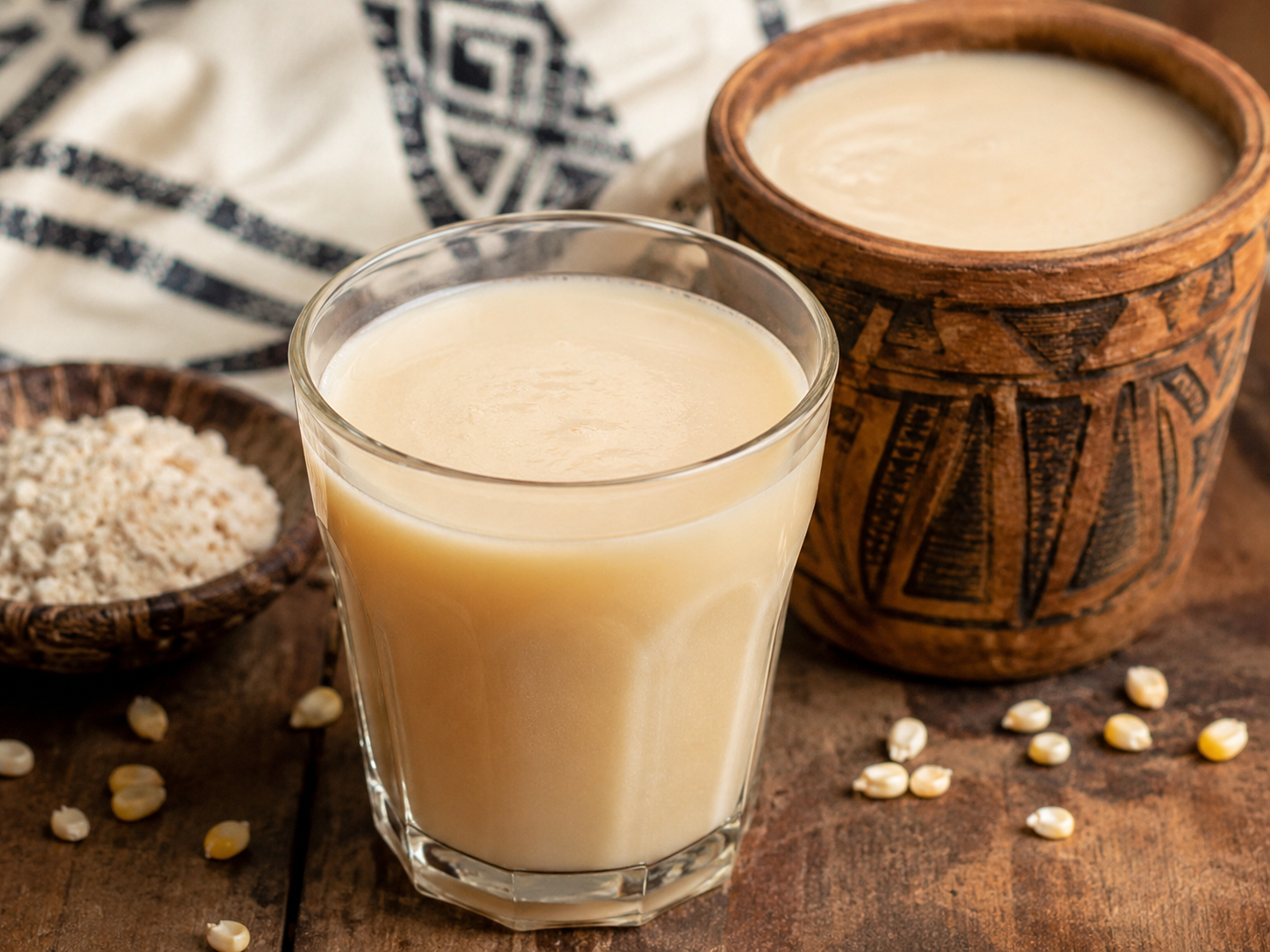
Mahewu, sometimes spelled mageu or maheu depending on the region and language, is one of the most important traditional drinks in Southern Africa. Made from fermented cereals, usually corn but sometimes sorghum or other flours depending on local practices, it is a thick, slightly tart, nourishing drink consumed daily in many households. It is found notably in South Africa, Zimbabwe, Zambia, Botswana, and neighboring cultural areas, with variations in texture, taste, and process. Its longevity and popularity make it more than just a traditional drink: mahewu is a dietary staple, a vehicle for cultural transmission, and a remarkable illustration of African food intelligence.
Prepare this speciality
Choose a detailed recipe, adjust the portions and prepare your ingredients before starting. Our cooking tips and food safety advice complement the steps described in the recipes.
Explore further: Cooking tips · Food hygiene and safety advice.
History and uses
Mahewu holds a unique place because it straddles the line between drink and food. It hydrates, but it also satisfies hunger. It can accompany a workday, serve as a snack, support a school morning, or be offered to a guest as a sign of welcome. This functional versatility explains its deep roots in daily life. In contexts where economic accessibility, nutritional value, and preservation must be reconciled, fermented cereal-based drinks offer a particularly relevant solution. Mahewu is one of the most successful examples.
Its place in African cuisine is fundamental for another reason: it embodies the importance of traditional fermentations in the continent's food systems. These fermentations, often transmitted orally, are not marginal folklore; they are at the heart of sophisticated techniques for processing, securing, and enriching food. Mahewu thus reminds us that African cuisines have long possessed empirical microbiological knowledge of great finesse.
🔥🥣 MASTERED PRODUCTION: COOKING, INOCULATION, FERMENTATION, AND SENSORY BALANCE
The preparation of mahewu relies on a clear but demanding technical sequence. It generally begins by cooking a porridge of corn flour (or another cereal) in water until a smooth, lump-free base is obtained, cooked sufficiently to develop a stable texture. This cooking step is crucial: it gelatinizes the starch, prepares the medium for fermentation, and gives the final product its characteristic consistency.
After cooking, the porridge is left to cool. A fermenting agent is then added, which can come from a previous batch of mahewu, already fermented flour, malt, or other domestic leavens according to local traditions. The mixture then rests for several hours, sometimes a day or more, depending on the ambient temperature and the desired taste profile. During this fermentation, microorganisms transform available sugars, produce organic acids, and profoundly modify the aroma, digestibility, and stability of the product.
The point of balance is essential. A successful mahewu should not be aggressively acidic, nor too bland. Its texture should remain fluid but consistent, with a velvety mouthfeel. The expected taste combines residual cereal sweetness, slight acidity, sometimes a hint of malt. Some versions are filtered, others retain more solids. Some are slightly sweetened according to modern uses, others remain strictly traditional. This diversity shows that mahewu is a family of practices rather than a single formula.
The mastery of these steps demonstrates precise know-how. Temperature, resting time, water quality, container hygiene, nature of the ferment: each variable influences the result. People who regularly prepare mahewu develop true sensory expertise, capable of anticipating the evolution of fermentation by smell, texture, and taste.
🧬🌍 FERMENTATION, HEALTH, AND AFRICAN FOOD INTELLIGENCE
Mahewu illustrates a central principle of African cuisines: transform to nourish better. Cereal fermentation can improve digestibility, modify the bioavailability of certain nutrients, and contribute to the microbiological safety of the final product through acidification. Without making simplistic promises, it is recognized that many traditional fermentations offer functional benefits, especially in contexts where the preservation of fresh food is difficult.
Mahewu also fits into an efficient energy and economic logic. Basic ingredients are often accessible, storable, and locally available. The transformation process does not require heavy technology but values robust domestic knowledge. This combination of low cost, nutritional value, and adaptability is a major strength in African food systems.
In my books

Continue exploring the continent’s cuisines with Africa at the Table — 54 countries, 54 iconic dishes, by Alioune FALL. This book is in English.
Explore further
In contemporary debates on sustainable nutrition, traditional fermented foods are gaining visibility, and mahewu appears as an exemplary candidate. It addresses modern challenges with ancient solutions: waste reduction, extended shelf life, microbial diversity, territorial anchoring, low dependence on complex industrial chains. This does not mean that tradition and innovation should be opposed, but rather that African culinary heritage already contains relevant answers to current challenges.
🏡🤲 A DRINK OF SOCIAL CONNECTION, TRANSMISSION, AND BELONGING
Like many everyday African foods, mahewu has a strong relational dimension. It is often prepared in family quantities, shared throughout the day, offered to relatives, neighbors, and visitors. In some contexts, it accompanies community moments, collective work, or gatherings. Its consumption therefore goes beyond the individual act of hydration: it participates in an economy of connection.
Intergenerational transmission is central. Recipes are not always written; they are transmitted through demonstration, correction, and habit. One learns to recognize the right acidity, to feel when fermentation is complete, to adjust according to the season. This mode of transmission is typical of many African cuisines, where culinary skill is primarily a living practice.
In the Southern African diaspora, mahewu often becomes an identity marker. Reproducing it abroad, even with different flours or time constraints, helps maintain a taste link with the country of origin. This continuity shows the symbolic power of fermented foods: they carry a memory of home, family routines, and ancestral gestures. Mahewu is not just “what we drink,” it is also “where we come from.”
🏭🥤 BETWEEN CRAFT AND INDUSTRIALIZATION: CONTINUITIES, TENSIONS, AND NEW FORMS
Mahewu exists today in both artisanal and industrial forms. In several countries, bottled or cartoned versions are widely distributed, sometimes flavored, sweetened, or standardized to meet the expectations of urban markets. This industrialization has ambivalent effects. It increases accessibility, enhances product visibility, and facilitates its integration into modern consumption channels. But it can also smooth out the diversity of local taste profiles, reduce fermentation variability, and distance the product from the domestic practices that constituted its cultural richness.
However, these two worlds are not necessarily mutually exclusive. In many contexts, consumers alternate between commercial mahewu and homemade mahewu depending on the occasion, available time, and preferences. This coexistence reflects a broader reality of contemporary African cuisines: tradition does not disappear in the face of modernity; it reconfigures itself.
The place of mahewu in African cuisine is strengthened precisely by this adaptability. It remains identifiable despite transformations. It remains a sensory and cultural landmark, even when it changes container, texture, or sugar level. This resilience is the hallmark of great food traditions.
✨📚 A MAJOR PLACE IN AFRICAN CUISINE: LIVING HERITAGE AND SUSTAINABLE FUTURE
Mahewu deserves central recognition in African gastronomy for several converging reasons. Firstly, it represents the historical mastery of cereal fermentations, a field in which African societies have developed remarkable knowledge. Secondly, it embodies a complete food solution: hydrating, energetic, accessible, and adaptable. It is also a powerful vehicle for cultural transmission, sociability, and belonging. Finally, it strongly engages with contemporary issues of sustainability, nutrition, and food sovereignty.
From a pan-African perspective, mahewu resonates with other fermented drinks and porridges on the continent, whether based on millet, sorghum, corn, or other local cereals. This resonance reveals a common logic: fermentation as a shared cultural technology, modulated according to regional ecologies and histories. Mahewu occupies, in this ensemble, a reference place in Southern Africa.
Ultimately, talking about mahewu means recognizing the depth of everyday African cuisines. It means understanding that an apparently simple drink can concentrate considerable technical, nutritional, social, and symbolic dimensions. It means seeing in a glass of mahewu not only a food preparation but a living archive of the continent's knowledge.
🌍 CONCLUSION
Mahewu is therefore both heritage and future. Heritage, because it carries ancient gestures, transmitted tastes, and family memories. Future, because it offers a sober, local, fermented, and relevant food model for the challenges of the 21st century. Its place in African cuisine is, as such, non-negotiable: it is structural, fertile, and exemplary.
In the kitchen : Mahewu (mageu)
Recipes from the site to put your knowledge into practice:
Discover these cuisines at a restaurant
Explore our restaurant and caterer directories. Choose your destination and check the establishment’s menu to confirm which dishes are offered and available.
Continue exploring
Enjoy discovering ingredients and African cuisines? Join our newsletter. The illustrated PDF 10 sauces africaines incontournables is in French and is offered after confirming a subscription to the French or bilingual edition.