Mishkaki
Tanzania, East Africa
Understanding : Mishkaki
🍢🌍 INTRODUCTION
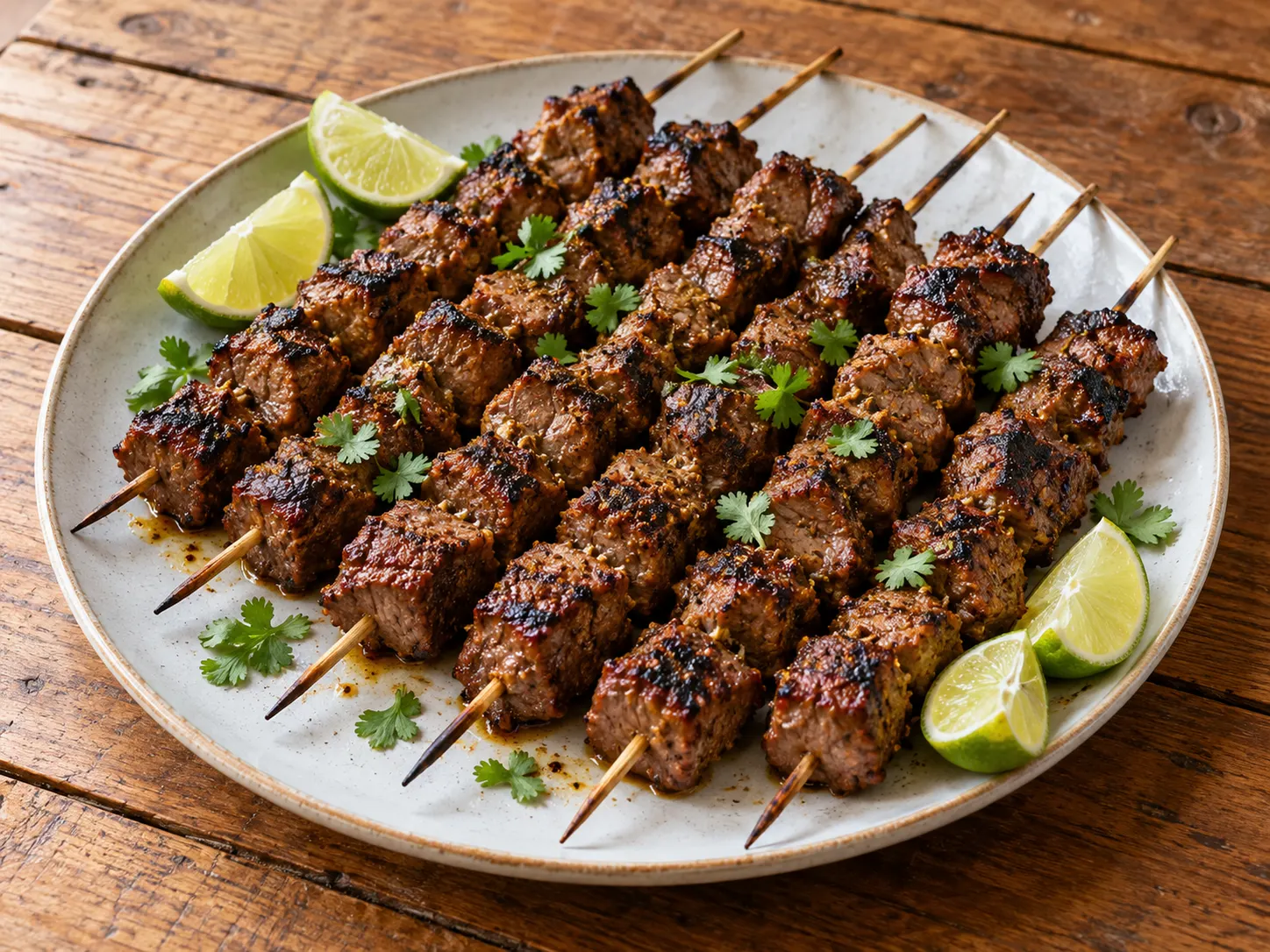
Mishkaki is one of the great emblems of Swahili coast cuisine, particularly in Tanzania and in nearby East African culinary spaces. At first glance, it consists of marinated meat skewers, threaded onto sticks and then grilled over charcoal. But like many popular African dishes, its scope extends far beyond its apparent form. Mishkaki is at once a technique, an urban culture, a social ritual, and a taste memory. Its scent of embers, spices, and seared meat is part of the sensory landscape of many East African cities, especially in the evening, when the stalls come alive and the street becomes a vibrant culinary scene.
Prepare this speciality
Choose a detailed recipe, adjust the portions and prepare your ingredients before starting. Our cooking tips and food safety advice complement the steps described in the recipes.
Explore further: Cooking tips · Food hygiene and safety advice.
History and uses
Mishkaki holds an important place in African cuisine because it embodies several fundamental dimensions: the masterful use of fire, the value of marinating, the conviviality of eating standing up, the circulation of influences between Africa, the Arab world, India, and the Indian Ocean, and the ability of popular cuisines to produce highly complex flavors with relatively simple means. In East Africa, it is often associated with gatherings, outings, modest or spontaneous celebrations. It brings together diverse audiences, crosses social classes, and connects daily life with festivities.
Its uniqueness also lies in its Swahili identity. Mishkaki is not a simple “universal skewer” transplanted to Africa. It is a situated creation, shaped by maritime trade histories, the cultural exchanges of the coast, and local seasoning preferences. It speaks as much of geography as of cuisine: in every bite, one finds traces of ports, markets, spices, migrations, and transmitted know-how.
🔥🥩 DEMANDING TECHNICAL MASTERY: CUTTING, MARINATING, EMBERS, AND TIMING
The success of mishkaki first relies on the meat. The pieces must be carefully chosen: tender enough to cook quickly without drying out, but firm enough to stay on the skewer. Beef, goat, sometimes chicken depending on the context, are used with appropriate cuts. The size of the cubes is essential: too large, they cook poorly in the center; too small, they dry out quickly. Good mishkaki therefore begins with precise butchery.
Next comes the marinade, the true aromatic heart of the dish. It varies by family and vendor, but frequently includes garlic, ginger, lemon or lime, chili, salt, sometimes green papaya (to tenderize), yogurt in some influences, ground spices (coriander, cumin, pepper), and sometimes a light sweet touch to aid caramelization. The resting time allows the flavors to penetrate the meat and soften its texture. This step distinguishes a bland mishkaki from a memorable one: embers alone are not enough; preparation beforehand is crucial.
Charcoal grilling requires fine control of heat. Too much flame burns the outside before internal cooking; too low heat results in gray, unexpressive meat. The grill master must regularly turn the skewers, manage the distance from the embers, sometimes lightly baste to maintain juiciness and shine. The desired result is clear: marked surface, smoky notes, tender interior, retained juices. The perfect mishkaki offers slight resistance to the tooth, then a supple chew, never rubbery.
This technicality proves that African street food is a space of high empirical competence. Mishkaki masters read the meat, smoke, wind, heat, and time with remarkable precision, without sophisticated instrumentation. It is a fully legitimate form of culinary expertise.
🧭🌊 SWAHILI HERITAGE AND CULTURAL CIRCULATIONS IN EAST AFRICA
Mishkaki is part of the long history of the Swahili coast, a meeting point for African, Arab, Persian, Indian, and later European worlds. This coast developed an original material and culinary culture, where local products interact with techniques and spices from elsewhere. Marinated grilled skewers exist in many regions of the world, but mishkaki has its own personality shaped by this Swahili context: a balance between acidity, spices, and smoke, street service, convivial consumption, and typical East African accompaniments.
Its presence in Tanzanian urban centers, as well as its spread into the hinterland, testifies to the vitality of internal exchanges between the coast and continental areas. Mishkaki acts as a culinary link: it carries a coastal style to broader spaces, while adapting to local availability of meat and condiments. This adaptability is one of the hallmarks of vibrant African cuisines.
In my books

Continue exploring the continent’s cuisines with Africa at the Table — 54 countries, 54 iconic dishes, by Alioune FALL. This book is in English.
Explore further
In the continent's culinary map, mishkaki represents the great African tradition of direct fire cooking. From north to south, east to west, grilled dishes hold a major place in food sociability. What mishkaki specifically brings is the Swahili syntax of spices and marinating, which enriches the African heritage of grilled meats.
🏙️🤝 STREET, SOCIABILITY, AND POPULAR ECONOMY
Mishkaki is profoundly urban in its contemporary uses. At the end of the day, stalls are set up, embers glow red, customers arrive in small groups. People order a few skewers, chat, share, and extend the evening. This mode of consumption creates a particular sociability: quick but warm, informal but codified. The vendor knows their regulars, adjusts the chili, offers accompaniments, and maintains a relationship of trust.
Economically, mishkaki supports thousands of small businesses: meat supply, skewer making, charcoal sales, marinade preparation, and accompaniment trade. Like many street food sectors in Africa, it contributes to the livelihood of entire families and the dynamism of neighborhoods. It also offers a form of accessibility: one can consume in small quantities according to one's budget, without sacrificing gustatory pleasure.
This popular dimension is essential to understanding its place in African cuisine. Mishkaki is not just a dish “to taste”; it is a miniature social system where work, hospitality, reputation, and local memory intersect. The best spots become neighborhood landmarks, almost informal institutions.
🍋🥗 ACCOMPANIMENTS, NUTRITIONAL BALANCE, AND CURRENT TRANSFORMATIONS
Traditionally, mishkaki can be served with fresh condiments (onion, chili, lemon), spicy sauces, sometimes flatbread, or simple garnishes depending on the context. This association is important: the acidity of lemon and the freshness of onions balance the fat of the grilled meat, while chili enhances the aromatic identity. In some environments, it is accompanied by fries, salads, or other modern urban elements, proof of its integration into changing eating habits.
Nutritionally, mishkaki primarily provides protein and, depending on the cuts chosen, a variable amount of lipids. The marinade can improve perceived tenderness and limit excessive fat addition during cooking. Like any grilled meat, the balance depends on frequency, portions, and vegetable accompaniment. Integrated into a diversified diet, it can hold a satisfying place, especially when combined with vegetables and acidic elements that lighten the meal.
Today, variations are appearing: lighter chicken mishkaki, fish versions on certain coasts, inspired plant-based options (mushrooms, marinated tofu in diasporic contexts), and revisited marinades with contemporary influences. These evolutions show that tradition is not static. Mishkaki retains its identity as long as its structuring principles remain: expressive marinade, charcoal grilling, and convivial service.
✨📚 A MAJOR PLACE IN AFRICAN CUISINE: LIVING, POPULAR, AND EXPORTABLE HERITAGE
Mishkaki deserves a central place in any serious reading of African cuisines. It embodies the sophistication of popular practices, the richness of Swahili heritage, the importance of fire as a culinary technology, and the social power of street food. It shows that the most everyday African dishes are often the most revealing of a culture's deep structures: relationship to ingredients, time, work, and community.
Internationally, mishkaki has strong potential for recognition. Its format is universally accessible, its taste is immediately appealing, but its identity remains distinctly African. This combination is valuable for the global visibility of the continent's gastronomies. The risk would be to reduce it to an “exotic skewer” without context; the challenge, on the contrary, is to preserve its narrative, its gestures, and its historical roots.
🧭 CONCLUSION
Ultimately, mishkaki is more than meat on a stick. It is a cultural ember. It connects coast and interior, past and present, craftsmanship and modernity, economic necessity and collective pleasure. In the African culinary mosaic, it occupies a luminous place: that of an intensely popular, technically rigorous, emotionally powerful, and historically profound dish.
To speak of mishkaki is to recognize that African cuisine is also built in the street, to the rhythm of flames, expert hands, and evening conversations. It is there, in this proximity, that an essential part of the continent's gastronomic heritage is forged.
In the kitchen : Mishkaki
Recipes from the site to put your knowledge into practice:
Discover these cuisines at a restaurant
Explore our restaurant and caterer directories. Choose your destination and check the establishment’s menu to confirm which dishes are offered and available.
Continue exploring
Enjoy discovering ingredients and African cuisines? Join our newsletter. The illustrated PDF 10 sauces africaines incontournables is in French and is offered after confirming a subscription to the French or bilingual edition.