Mloukhia
Tunisia
Understanding : Mloukhia
🍲🌍 INTRODUCTION
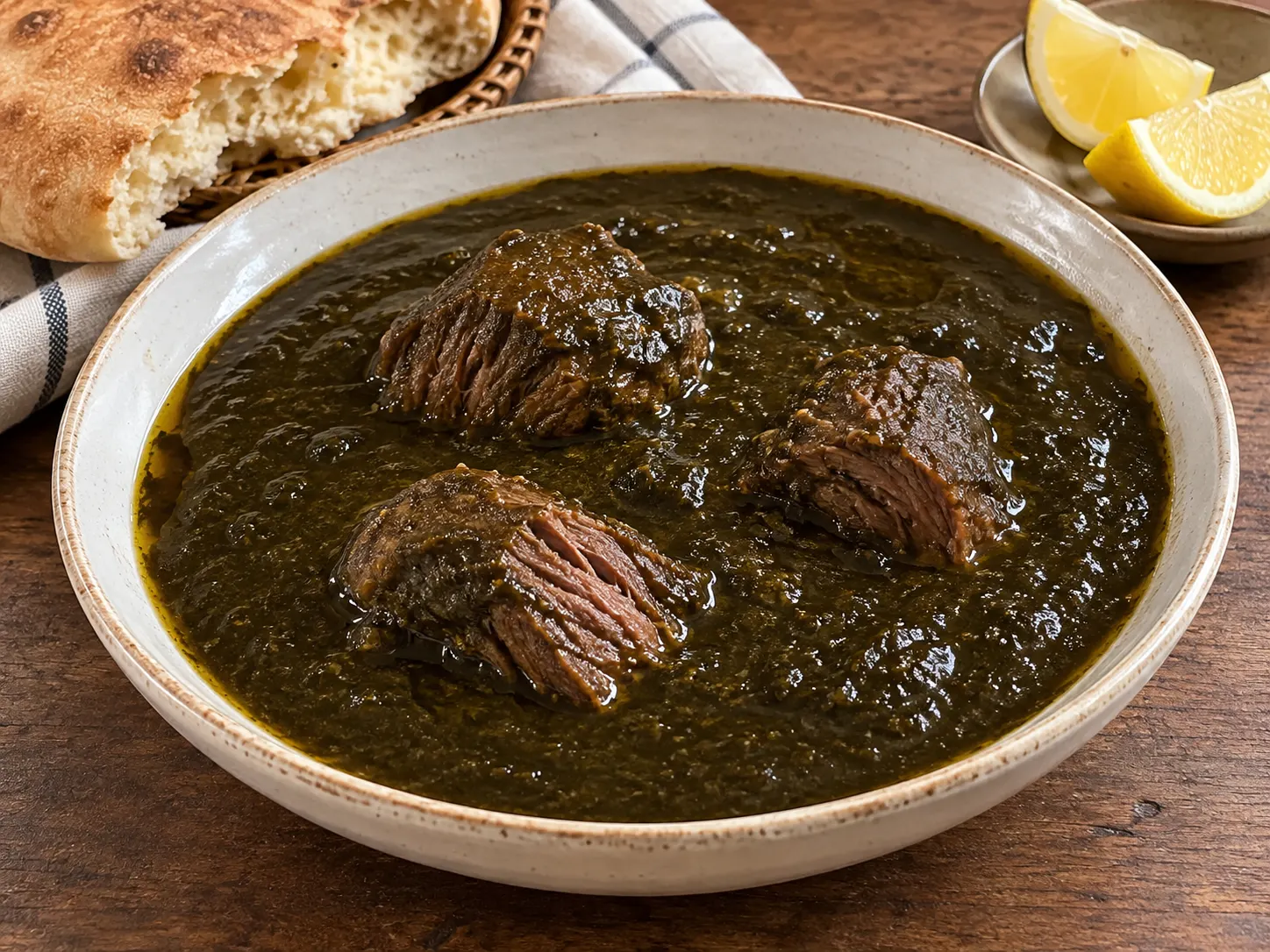
Mloukhia is one of Tunisia's most emblematic and unique dishes. It often intrigues at first glance with its dark, almost black color, its coating texture, and its deep aroma of spices, olive oil, and slow-cooked meat. Yet, for those who know it intimately, mloukhia is not just a dish: it's a culinary event, a marker of family memory, a symbol of patience, and a powerful expression of North African cuisine. Its place in African cuisine is major, as it embodies a form of slow and popular sophistication at once, where technique, time, and transmission count as much as the ingredients.
Prepare this speciality
Choose a detailed recipe, adjust the portions and prepare your ingredients before starting. Our cooking tips and food safety advice complement the steps described in the recipes.
Explore further: Cooking tips · Food hygiene and safety advice.
History and uses
First, it's important to understand that Tunisian mloukhia (a dish made from jute mallow leaves) is distinctly different from other preparations based on jute mallow leaves known in the Arab and African world. In Tunisia, the leaf is dried and then reduced to a very fine powder. This powder is cooked for a long time in oil and water, with a blend of spices, garlic, and pieces of meat (often beef, sometimes lamb), until a dense, shiny, deeply aromatic sauce is obtained. The final result is neither a light soup nor an ordinary stew: it's a slow-cooked sauce, served with bread, where each bite is marked by a rare concentration of flavor.
In Tunisian culture, mloukhia is associated with important moments, Friday meals in some families, gatherings, wishes for prosperity and continuity. It can be served on significant occasions because it represents patient abundance: one starts early, watches over the cooking, adjusts without haste, and shares when the dish is finally ready. This relationship with time is essential to understanding its heritage value.
🕰️🔥 A LONG-TERM CUISINE: TECHNIQUE, VIGILANCE, AND PRECISION OF GESTURES
Preparing traditional mloukhia requires true culinary discipline. It often begins with mixing the mloukhia powder with olive oil, sometimes cold, to form a smooth, lump-free base. This step, which may seem simple, is decisive: if the powder is poorly incorporated, the final texture will be uneven. Then, water is gradually added, and a slow cooking process begins, which can last several hours.
During this cooking, vigilance is constant. It's necessary to stir at key moments, control the heat to prevent the preparation from sticking, monitor the reduction, incorporate garlic and spices at the right time, and then the meat, which must cook until tender without falling apart completely. Some families add specific spices, others prefer a more sober expression to let the mloukhia itself dominate. The dosage remains a domestic art passed down orally.
The final texture is one of the most demanding criteria. Good mloukhia must be homogeneous, creamy, neither too liquid nor too compact. Its color must be deep, shiny, without a dull appearance. Its taste must combine vegetable intensity, the richness of the oil, the warmth of the spices, and meaty depth. It's a dish that doesn't forgive approximation: overcooked, it loses its finesse; undercooked, it remains raw and unbalanced.
This technical requirement shows an often-forgotten reality: traditional African cuisines are highly skilled cuisines, even when they are practiced in domestic settings. Mloukhia, in particular, is a school of patience and precision.
🌿📜 HISTORICAL ROOTS, AFRICAN CIRCULATIONS, AND TUNISIAN IDENTITY
Mloukhia is part of a long history of leafy plants and sauces in Africa and around the Mediterranean. Jute mallow is known in different regions, with varied uses: fresh leaves in some Levantine cuisines, viscous preparations in Egypt, leafy sauces in West or Central Africa with other comparable plant species in their culinary function. However, the Tunisian long-cooked powdered version constitutes its own trajectory, shaped by local practices and a specific taste sensibility.
What is remarkable is how Tunisia has transformed this ingredient into a ceremonial dish for enhanced daily life. The powder allows for preservation and deferred use, which connects mloukhia to ancient food storage logics. The long cooking, the use of olive oil and spices, the addition of meat pieces, compose a distinct Maghrebi style. The dish is both African by its continental roots and Tunisian by its particular expression.
In my books

Continue exploring the continent’s cuisines with Africa at the Table — 54 countries, 54 iconic dishes, by Alioune FALL. This book is in English.
Explore further
In broader African cuisine, mloukhia holds a precious position: it reminds us that North Africa fully participates in the continent's major culinary dynamics, with its own techniques and symbols. It helps broaden the perception of African gastronomy, often reduced to a few simplified categories. Here, we see a cuisine dark in color but luminous in complexity, locally rooted and historically open to circulations.
🏡🤲 AN EDIBLE FAMILY MEMORY: TRANSMISSION, RITUAL, AND BELONGING
Mloukhia is a dish of transmission. In many Tunisian families, learning to prepare it marks an important passage in the culinary journey. Gestures are transmitted in an embodied way: how to mix the powder, when to add a certain ingredient, how to read the surface of the sauce, how to recognize the right stage of reduction. This pedagogy of doing is a major heritage asset.
The dish is also strongly relational. It is shared, it brings people together, it imposes a rhythm. Because it requires time, it creates social time: someone watches the pot, someone prepares the bread, someone tells an anecdote related to an old cooking session. Mloukhia then becomes a domestic center of gravity. It organizes the home around it.
In the Tunisian diaspora, this role is even more pronounced. Recreating mloukhia far from home is to recreate an emotional continuity. The smell that diffuses for hours, the color in the pot, the first tasting with bread: all of this acts as a reminder of origin. The dish becomes a language of cultural fidelity, transmitted to children born elsewhere.
🥗⚖️ NUTRITIONAL PROFILE, CONTEMPORARY USES, AND ADAPTATIONS
Mloukhia, depending on its recipe, can be an energetic and nutritious dish. The leaf powder provides interesting plant compounds, fiber, and micronutrients. Olive oil contributes lipids and caloric density, while meat provides protein, iron, and B vitamins. The final balance obviously depends on the amounts of oil, the type of meat, and the portion consumed.
In a contemporary approach, some families adapt the recipe by slightly reducing fat, choosing leaner cuts, or adjusting the accompaniment to balance the overall meal. Others explore vegetarian versions, although the traditional meat version remains the most culturally representative. These adaptations show that mloukhia can evolve without losing its fundamental identity, as long as the logic of slow cooking and the aromatic base are respected.
From a modern culinary perspective, mloukhia also offers an important lesson: the value of a dish is not measured by its visual complexity, but by the depth of its process. It anticipates, in a way, current trends in slow cooking, flavor extraction, and respect for culinary time.
✨🍞 AN ESSENTIAL PLACE IN AFRICAN CUISINE: POWER, PATIENCE, AND HERITAGE
Mloukhia's place in African cuisine is essential because it brings together dimensions rarely combined with such force: demanding technique, symbolic charge, historical continuity, social role, and exceptional taste quality. It is a dish that commands respect for time, ingredients, and transmission. It testifies to a knowledgeable culinary Africa, where domestic practices reach a level of refinement often underestimated.
Mloukhia also contributes to the recognition of North African cuisines as a major component of the continental gastronomic heritage. It reminds us that culinary Africa is plural in its colors, textures, and temporalities. Alongside quick grills, street fries, instantly vibrant sauces, it offers another grammar: that of constructed slowness.
🌍 CONCLUSION
Ultimately, mloukhia is a dish of depth. Depth of color, taste, history, and social connection. It nourishes the body, of course, but it also nourishes collective memory. It teaches that a cuisine can be popular without being simple, traditional without being rigid, local without being closed. In the great mosaic of African cuisines, it occupies a majestic place: that of a discreet pillar, a work of patience, a living heritage that continues to speak to present and future generations.
In the kitchen : Mloukhia
Recipes from the site to put your knowledge into practice:
Discover these cuisines at a restaurant
Explore our restaurant and caterer directories. Choose your destination and check the establishment’s menu to confirm which dishes are offered and available.
Continue exploring
Enjoy discovering ingredients and African cuisines? Join our newsletter. The illustrated PDF 10 sauces africaines incontournables is in French and is offered after confirming a subscription to the French or bilingual edition.