Muriwo
Zimbabwe
Understanding : Muriwo
🥬🌍 INTRODUCTION
Muriwo is one of the foundations of daily diet in Zimbabwe, and more broadly a symbol of the central place of leafy greens in many African cuisines. The word often refers to a set of preparations based on edible leaves, cooked in a simple but precise manner, then served as an accompaniment to sadza (a maize meal porridge) which structures many Zimbabwean meals. Behind this apparent simplicity lies a rich culinary universe: botanical diversity, cooking techniques adapted to each leaf, a balance between bitterness, sweetness, creaminess, and a deep anchoring in rural and urban household economies.
Prepare this speciality
Choose a detailed recipe, adjust the portions and prepare your ingredients before starting. Our cooking tips and food safety advice complement the steps described in the recipes.
Explore further: Cooking tips · Food hygiene and safety advice.
History and uses
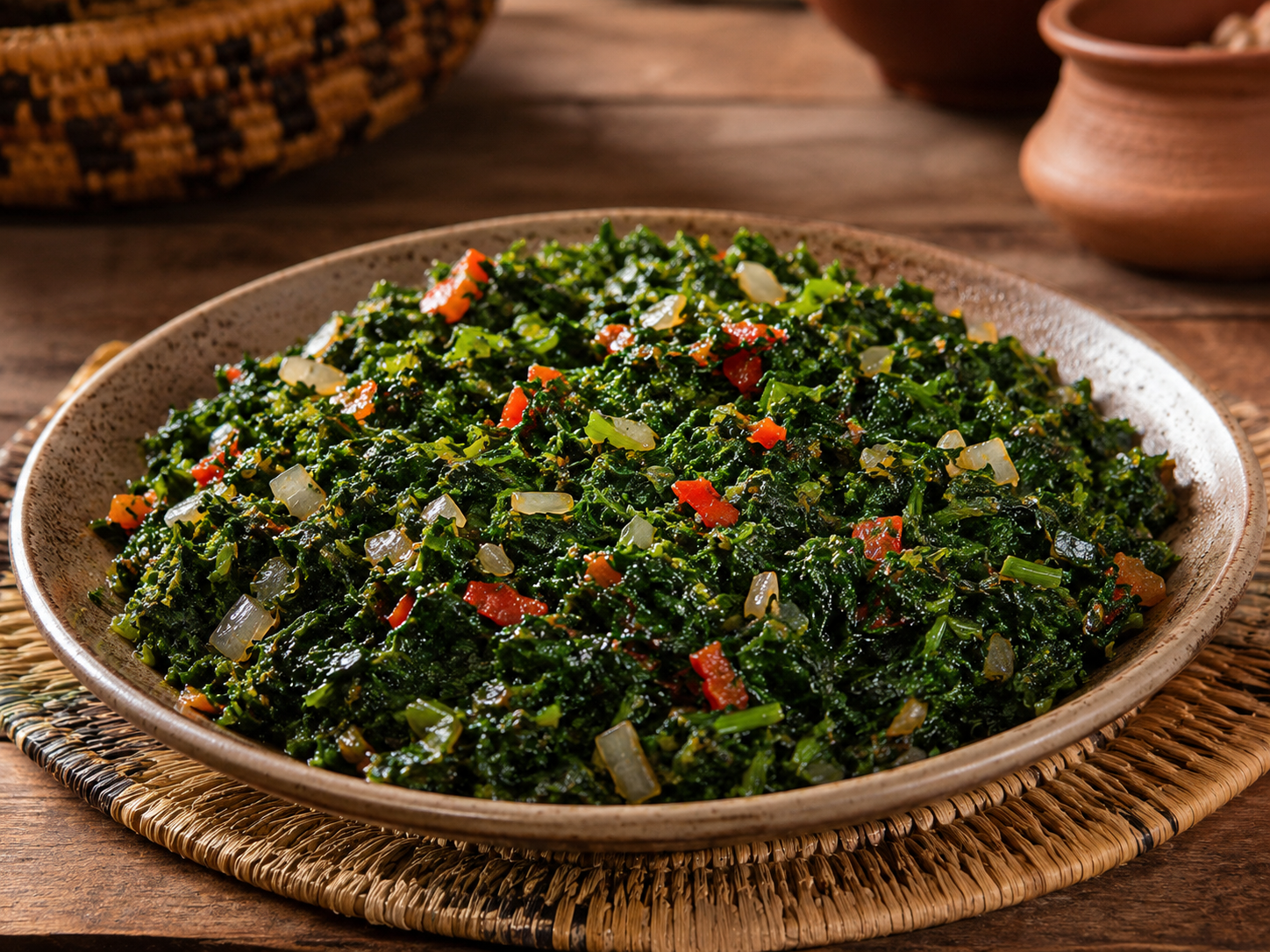
To speak of muriwo is not to speak of a single, fixed dish, but of a family of practices. Depending on the seasons, regions, and available resources, cabbage, covo (a type of collard green), rape (a leafy green vegetable), pumpkin, sweet potato, amaranth, or other local greens are used. Some recipes remain very simple, with onion, tomato, and salt. Others include a touch of pounded peanuts, a little oil, sometimes modest protein additions. This plasticity is the strength of muriwo: it can be daily, economical, nourishing, and yet still carry very subtle taste nuances.
Its place in African cuisine is major because it embodies an essential food logic on the continent: intelligently valuing local plant resources, without depending on expensive ingredients. Muriwo shows how African cuisines transform constraint into creativity, and the everyday into heritage. It is a dish of continuity, care, and transmission, often less visible internationally than major festive specialties, but absolutely central to the real lives of families.
🍃🔥 A CUISINE OF PRECISION: TAMING LEAVES, PRESERVING TEXTURES AND BALANCING FLAVORS
Cooking muriwo requires a fine knowledge of the leaves used. Not all react in the same way to heat, water, salt, or oil. Some cook quickly and become tender in minutes. Others require prior blanching to soften a natural bitterness or reduce a fibrous texture. Experienced cooks know how to adapt cooking time, cutting size, and order of incorporation according to the plant variety.
The most common aromatic base relies on onion and tomato, lightly sautéed to create a sweet-and-sour base. The leaves are then added, often in several handfuls, as their volume reduces upon cooking. The challenge is to maintain a certain consistency: good muriwo should not be watery or overcooked. It must remain discernible in the mouth, with a supple but lively texture. Too long a cooking time erases vegetable aromas and impoverishes the dish.
In some versions, the addition of peanut paste profoundly transforms the sensory profile. Peanuts bring roundness, natural fat, depth, and satiety. They soften the bitterness of certain leaves and create a light sauce that coats the whole. This leaf + peanut combination is common in several African regions, proof of a shared culinary logic: balancing sometimes intense vegetable flavors with rich and accessible local fats.
This level of adjustment shows that muriwo is far from being a secondary, “automatic” accompaniment. It requires attention, experience, and an eye for detail. It is a cuisine of precision, where a few minutes and a few gestures make all the difference.
🌾🏡 AGRICULTURAL ANCHORING, FOOD SECURITY AND EVERYDAY INTELLIGENCE
Muriwo is intimately linked to local agricultural systems. In many families, especially in rural areas, the leaves come from home gardens, small plots, local markets, or seasonal foraging. This proximity between production and cooking makes the dish particularly resilient. When resources are limited, leafy greens often remain accessible and allow for a regular and nutritious diet.
This dimension is crucial in analyzing its African place. Muriwo is not just “traditional”; it is strategically important for food security. It values plants adapted to local environments, sometimes more resistant than other crops, and allows for balanced meals at a moderate cost. Associated with sadza, it forms a stable food base: energy from cereals on one side, micronutrients and fiber from leaves on the other.
In my books

Continue exploring the continent’s cuisines with Africa at the Table — 54 countries, 54 iconic dishes, by Alioune FALL. This book is in English.
Explore further
In a context of economic and climatic pressures, this logic gains even more value. Muriwo represents a form of culinary sustainability already in practice for a long time: real seasonality, short supply chains, low industrial processing, domestic know-how. It reminds us that African cuisines possess robust food models, often underestimated in global discussions on sustainable nutrition.
🤝🍽️ A STRONG SOCIAL FUNCTION: SHARING, TRANSMISSION AND IDENTITY
Muriwo holds an important emotional place in the memory of family meals in Zimbabwe. It accompanies the ordinary moments of the day, but it is precisely this regularity that gives it its cultural depth. Dishes that are eaten often become powerful identity markers: they fix memories, gestures, smells, and ways of being together.
Its preparation is also a space for transmission. Younger generations learn to recognize leaves, to sort them, wash them, cut them, to understand which ones to blanch, which ones to cook directly. They learn the right taste, neither too salty nor too bland, neither too fatty nor too dry. This informal pedagogy, repeated in home kitchens, is one of the great drivers of continuity for African culinary heritages.
In the Zimbabwean diaspora, muriwo retains this role as a link. Even when certain local leaves are difficult to find, substitutions are made with vegetables available locally. The goal is not to reproduce identically, but to preserve the logic of the dish: carefully cooked greens, served with a starchy base, in a spirit of sharing. This adaptability reinforces its cultural vitality.
🥗📊 NUTRITIONAL VALUE AND CONTEMPORARY RELEVANCE
From a nutritional perspective, muriwo is particularly interesting. Leafy greens are generally rich in fiber, vitamins (especially A, C, K depending on the varieties), folates, and minerals such as calcium, iron, magnesium, and potassium, with variations depending on the species and cooking methods. The possible presence of tomato and onion complements the intake of protective compounds. The addition of peanuts increases energy density and provides lipids and plant proteins.
Integrated with sadza, muriwo contributes to a coherent meal: complex carbohydrates for energy, vegetables for micronutrients, and possibly peanuts or another protein source for balance. Of course, the final quality depends on the proportions, overall dietary diversity, and frequency of different accompaniments. But the basic structure is solid and relevant, including for modern reflections on public nutritional health.
Muriwo also responds to contemporary trends that increasingly value plant-based foods. What some consider innovative today has long existed in African practices: dishes centered on leaves, flavorful, satisfying, economical, and adaptable. Muriwo can therefore be read as a tradition of the future as much as a heritage of the past.
✨🌍 A MAJOR PLACE IN AFRICAN CUISINE: HUMILITY, EXCELLENCE AND FUTURE
Muriwo holds a major place in African cuisine because it expresses a discreet excellence. It is not a spectacular dish intended to impress visually; it is a dish that sustains societies, day after day. It connects agriculture, nutrition, household economy, taste culture, and family cohesion. It demonstrates that gastronomic value is not measured solely by the rarity of ingredients, but by the quality of gestures and the social depth of the meal.
Across the continent, it resonates with countless leaf preparations: sukuma wiki (collard greens) in East Africa, leaf sauces in West and Central Africa, green vegetable preparations throughout Southern Africa. These kinship ties confirm a great African constant: the centrality of leafy greens in subsistence and pleasure cuisines.
🌍 CONCLUSION
Ultimately, to speak of muriwo is to make visible a backbone of African cuisine. It is to recognize the culinary dignity of everyday life, the intelligence of local practices, and the power of ordinary transmission. In a plate of sadza and muriwo, there is more than a meal: there is a story of territory, family, resilience, and taste.
Muriwo therefore deserves full recognition, not as a simple accompaniment, but as a living culinary heritage. It is proof that a dish can be modest in form and immense in its scope. And in the mosaic of African cuisines, this powerful modesty is a greatness in itself.
In the kitchen : Muriwo
Recipes from the site to put your knowledge into practice:
Discover these cuisines at a restaurant
Explore our restaurant and caterer directories. Choose your destination and check the establishment’s menu to confirm which dishes are offered and available.
Continue exploring
Enjoy discovering ingredients and African cuisines? Join our newsletter. The illustrated PDF 10 sauces africaines incontournables is in French and is offered after confirming a subscription to the French or bilingual edition.