Ojja
Tunisia
Understanding : Ojja
🍅🔥 INTRODUCTION
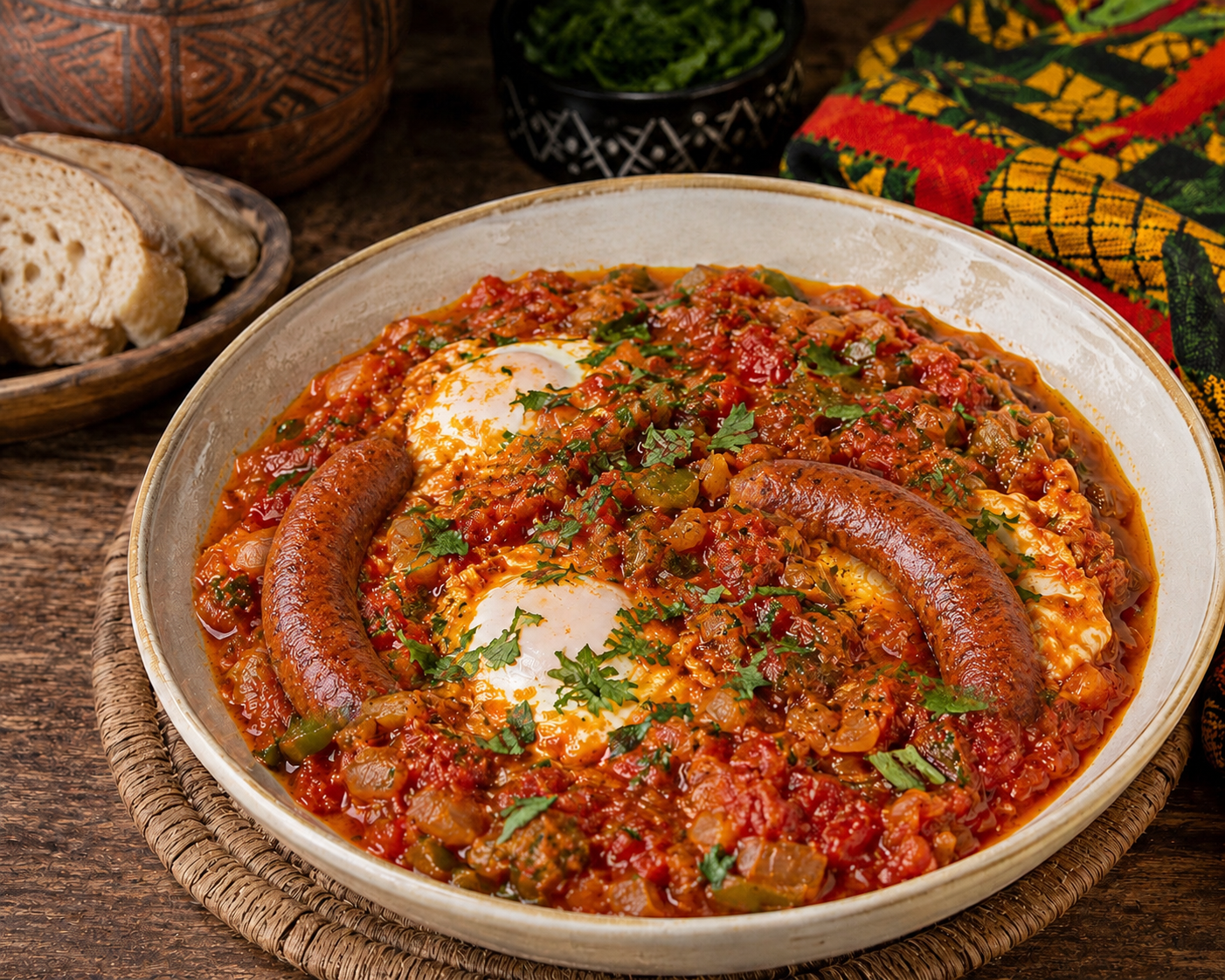
Ojja is one of the most vibrant, accessible, and expressive dishes in Tunisian cuisine. Generally prepared in a pan with a base of tomato, chili, garlic, olive oil, and spices, then enriched with eggs poached directly in the sauce, it can accommodate various garnishes such as merguez (a spicy lamb or beef sausage), seafood, kefta (ground meat mixture), vegetables, or sometimes local cold cuts depending on the context. Both simple in principle and infinitely adaptable in its variations, ojja is a concentrate of culinary culture: warmth, sharing, controlled improvisation, and aromatic intensity.
Prepare this speciality
Choose a detailed recipe, adjust the portions and prepare your ingredients before starting. Our cooking tips and food safety advice complement the steps described in the recipes.
Explore further: Cooking tips · Food hygiene and safety advice.
History and uses
In the Tunisian domestic sphere, ojja is an everyday dish as much as it is a convivial one. It can be cooked quickly for a family meal, served piping hot in the center of the table, then enjoyed with bread that often replaces cutlery. This act of dipping, breaking bread, and sharing the pan anchors ojja in a culture of collective meals very present in North Africa. The dish is also common in eateries, cafe-restaurants, and small popular tables, where it exists in more robust and heavily spiced versions.
Its place in African cuisine is important because ojja embodies several major dynamics of the continent: the valorization of tomato-spice sauces, the central role of chili as a flavor architecture, the art of minute cooking, and the ability to produce a complete dish with accessible ingredients. It reminds us that African cuisines are not just long-cooking cuisines; they also master fast, urban, intense formats, adapted to modern rhythms without losing their identity.
🧄🌶️ A PRECISE CULINARY GRAMMAR: tomato base, controlled heat, and egg as a living binder Ojja first relies on a solid aromatic base. Onion (depending on the version), garlic, fresh or concentrated tomato, harissa, sometimes caraway or ground coriander, form a powerful foundation. The initial cooking aims to concentrate the flavors: it is necessary to reduce the acidity of the tomato, cook the garlic without burning it, integrate the harissa homogeneously, and obtain a dense, shiny sauce, ready to receive the eggs.
The eggs are not just a final addition. They are the textural hinge of the dish. Cracked into the simmering sauce, they cook in contact with the residual heat and the tomato-oil-spice mixture. The white should set without becoming rubbery, the yolk can remain runny or firmer according to preference. This cooking requires a real sense of timing. A few seconds too long completely change the experience.
In versions with merguez or seafood, an additional step is added: the garnish must be cooked separately or partially to control water, fat, and salinity, then integrated without diluting the sauce. A successful ojja remains concentrated. It should never become a liquid soup. It must coat the bread, carry the chili, and maintain a tension between fat, acidity, heat, and umami.
This precision demonstrates that ojja, despite its image as an “easy” dish, mobilizes real skills: reduction management, chili mastery, reading egg texture, final balance. It is fast cooking, but not rushed.
🌍🧭 OJJA IN TUNISIAN AND NORTH AFRICAN CULINARY HISTORY
Ojja belongs to a larger family of tomato and egg-based dishes found in several Mediterranean regions. But the Tunisian version has a clear identity thanks to harissa, its spicy intensity, and local variations. It dialogues with neighboring preparations, while asserting a more ardent and often more concentrated taste personality.
Its development is linked to the historical integration of tomato and chili into North African cuisines, then to their local appropriation. In Tunisia, these ingredients are not mere imports: they have been transformed into a national language. Ojja is one of its most eloquent dialects. It also reflects the Tunisian relationship to pan cooking, direct, frank, convivial, where the dish is often served in the cooking vessel itself.
In my books

Continue exploring the continent’s cuisines with Africa at the Table — 54 countries, 54 iconic dishes, by Alioune FALL. This book is in English.
Explore further
In the African culinary map, ojja occupies a place representative of urban North Africa: a cuisine of simple products, powerful condiments, short techniques, and strong sensory identity. It complements other slower African models (stews, long sauces, broths) and shows the temporal diversity of the continent's culinary practices.
🏙️🤝 A SOCIAL DISH: IMMEDIATE SHARING, HOSPITALITY AND POPULAR MEMORY
Ojja is deeply relational. It is placed in the center, bread is brought closer, and people eat together. This mode of consumption creates direct proximity. The hot dish calls for immediate tasting, often punctuated by comments on the level of spice, the quality of the sauce, the cooking of the eggs. There is a performative dimension to ojja: you see it bubbling, you smell it before tasting it, you share it in the moment.
It also plays a role in hospitality. Preparing an ojja for someone is offering a generous, expressive dish, without heavy protocol. In popular contexts, it is appreciated because it allows for quick and tasty nourishment. In family contexts, it serves as an agile solution when you need to cook well and quickly.
For Tunisian and Maghrebi diasporas, ojja is a strong emotional anchor. Easy to reproduce with ingredients available abroad, it becomes a bridge between here and there. A spoonful of harissa, the smell of spicy tomato, bread dipping into the pan: these gestures are enough to reactivate a powerful collective memory.
🥗⚖️ NUTRITIONAL READING AND CONTEMPORARY ADAPTATIONS
Nutritionally, ojja offers an interesting base: eggs (proteins, micronutrients), tomato (antioxidant compounds), garlic and spices, olive oil in varying amounts. Everything then depends on the additions. With merguez, the dish becomes richer in lipids and salt. With vegetables or lean seafood, it can remain relatively balanced. The accompanying bread, almost essential, completes the energy intake.
From a modern perspective, ojja is easily adaptable without losing its identity. One can reduce the amount of oil, increase the proportion of vegetables, choose lighter proteins, modulate the spice according to the guests. One can also propose robust vegetarian versions (chickpeas, peppers, mushrooms) that respect the tomato-harissa-egg logic.
This adaptability explains its longevity. Ojja remains relevant in current urban rhythms: quick to prepare, strong in taste, adaptable, economical. It meets time constraints without compromising culinary pleasure.
✨🍳 A MAJOR PLACE IN AFRICAN CUISINE: intensity, accessibility, and living heritage The place of ojja in African cuisine is major because it concentrates cardinal qualities: strong taste identity, accessibility of ingredients, real technicality, social power, and capacity for evolution. It shows that a popular dish can be both everyday and heritage, simple in appearance and sophisticated in balance.
It also contributes to the visibility of North African cuisines within the African whole, reminding us that the culinary continent is thought of in the plural. Ojja is not an isolated “small local dish”; it is a fully African expression of an art of cooking with fire, sauce, and sharing.
🌍 CONCLUSION
Ultimately, ojja is a pan of character. It speaks of Tunisia in its most direct form: warmth, spice, generosity, sense of community. It also speaks of culinary Africa in its ability to do much with little, to create emotion with ordinary ingredients, to transmit an entire culture through a dish eaten with hands, bread, and conversation.
To speak of ojja is to recognize the greatness of popular African cuisines: living, intelligent, hospitable cuisines, where every meal can become an act of memory and connection. And in this constellation, ojja shines with a particular intensity, that of dishes that do not cheat: frank, warm, shared, unforgettable.
In the kitchen : Ojja
Recipes from the site to put your knowledge into practice:
Discover these cuisines at a restaurant
Explore our restaurant and caterer directories. Choose your destination and check the establishment’s menu to confirm which dishes are offered and available.
Continue exploring
Enjoy discovering ingredients and African cuisines? Join our newsletter. The illustrated PDF 10 sauces africaines incontournables is in French and is offered after confirming a subscription to the French or bilingual edition.