Salatat dakwa
Sudan
Understanding : Salatat dakwa
🥜🌍 INTRODUCTION
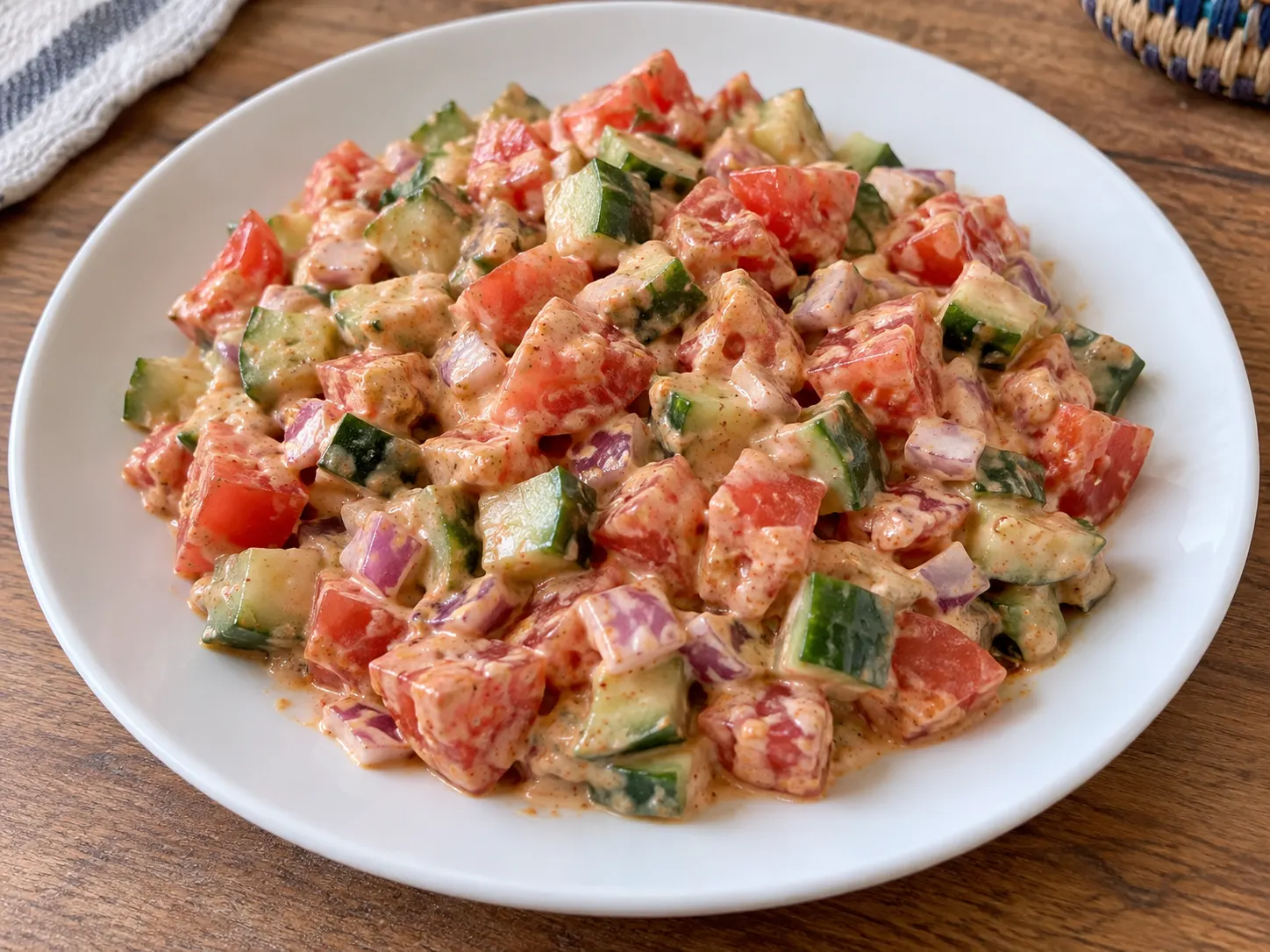
Salatat dakwa, often understood as a salad or preparation based on dakwa (pounded peanuts or peanut butter depending on usage), is a remarkable expression of Sudanese and Sahelo-Nilotic cuisines, where peanuts play a structuring role in daily diet. The dish showcases a very African culinary idea: taking a dense, nutritious, and widely available ingredient, then transforming it into a sauce, seasoning, or salad base capable of uniting fresh textures and deep flavors. Behind its apparent simplicity, salatat dakwa tells a story of agricultural circulations, domestic ingenuity, pragmatic nutrition, and popular refinement.
Prepare this speciality
Choose a detailed recipe, adjust the portions and prepare your ingredients before starting. Our cooking tips and food safety advice complement the steps described in the recipes.
Explore further: Cooking tips · Food hygiene and safety advice.
History and uses
In many African culinary traditions, peanuts are not just an addition. They are a pillar. They thicken, soften, bind, enrich. They give body to sauces, length on the palate, and an immediately recognizable taste signature. Salatat dakwa is fully part of this universe. Depending on the context, it can take the form of a salad seasoned with a lemony and spicy peanut sauce, a thicker mixture served as an accompaniment, or an intermediate preparation between condiment and appetizer. Variations are numerous, but the guiding idea remains stable: vegetable freshness + peanut roundness + acidic/spicy tension.
Its place in African cuisine is important because it illustrates a major continental logic: the balance between nutritional density and gustatory pleasure. In environments where efficient nourishment is necessary, peanuts become an intelligent answer. But salatat dakwa shows that this answer is not only functional. It can be subtle, nuanced, convivial, and culturally marked. The dish thus connects necessity, creativity, and identity.
🧄🍋 A FINE GUSTATORY CONSTRUCTION: FRESHNESS, CREAMINESS AND AROMATIC TENSION
The success of salatat dakwa relies on balance. A vegetable base, often composed of raw vegetables or simply cooked elements, welcomes a seasoned peanut sauce or paste. This sauce may include lemon, light vinegar, garlic, chili, sometimes tomato, finely chopped onion, herbs, or local spices. The goal is to avoid heaviness: the peanut should coat without smothering, enrich without dominating.
Texture is central. If the preparation is too thick, it loses its salad character and becomes a compact paste. Too liquid, it does not adhere to the vegetable elements and appears diluted. The right technique is to emulsify gradually: dilute the peanut base with water, lemon juice, or another acidic element, then adjust the salt, chili, and aromatics. The aim is a coating, supple consistency, capable of binding the components.
The sensory contrast makes the dish beautiful: crispness of vegetables, fatty sweetness of peanuts, liveliness of acid, a hint of chili heat, depth of garlic. This architecture reminds us that African cuisines can produce complex compositions without an excessive multiplication of ingredients. It is a cuisine of intuitive precision, where each component has a clear gustatory function.
Depending on the household, the amount of chili varies greatly. Some versions favor sweetness and roundness, others embrace a marked intensity. Some add protein elements or legumes, others remain on a vegetable register. This flexibility is constitutive of salatat dakwa: it is not a fixed formula, but a family of practices.
🌾📜 PEANUTS, HISTORICAL EXCHANGES AND AFRICAN ANCHORAGE
Understanding salatat dakwa requires placing peanuts in African food history. Introduced and widely disseminated over centuries, they have been fully integrated into the agricultural and culinary systems of many regions of the continent. From the Sahel to coastal West Africa, from certain Nilotic areas to Central Africa, they have become a key ingredient for sauces, stews, condiments, and snacks.
In Sudan and its neighboring cultural spaces, this integration has produced original culinary forms, of which salatat dakwa is a part. The dish testifies to a cross between local practices, regional influences, and adaptations to available resources. Its logic joins other African peanut-based preparations, while retaining its own identity through its seasonings, table uses, and its inscription in specific Sudanese contexts.
In my books

Continue exploring the continent’s cuisines with Africa at the Table — 54 countries, 54 iconic dishes, by Alioune FALL. This book is in English.
Explore further
In African cuisine at large, salatat dakwa holds a relevant place because it shows a facet sometimes less publicized: that of "intermediate" preparations, neither entirely a long-cooking sauce nor a simple raw salad, but a living assembly where seasoning provides structure. It broadens the understanding of African gastronomies beyond usual categories.
🏡🤝 DOMESTIC PRACTICE, CONVIVIALITY AND CULINARY TRANSMISSION
Salatat dakwa is deeply linked to home cooking. It can appear in ordinary meals, as a nourishing and tasty accompaniment, but also in informal reception contexts. Its domestic appeal is obvious: often accessible ingredients, relatively quick preparation, high satiety power, great adaptability.
The dish promotes conviviality because it is easily shared. It can accompany breads, flatbreads, starches, or grilled meats, and integrate into tables composed of several small dishes. This versatility makes it an excellent social mediator: it connects different elements of the meal, brings guests together around a consensual but expressive taste.
Transmission is primarily through gesture: how to lightly roast peanuts if necessary, how to pound or loosen, how to balance acidity, when to add garlic, how to avoid bitterness. This knowledge circulates between generations, often without strict written recipes. One learns through progressive correction, comparative tasting, and memory of the "right taste." This mode of transmission is at the heart of African culinary heritage.
In diasporas, salatat dakwa maintains a function of identity continuity. Even when certain specific ingredients are missing, the fundamental idea of the dish remains reproducible: a peanut base seasoned with acidic-spicy tension, applied to fresh elements. This maintenance of logic, despite substitutions, is a sign of cultural vitality.
🥗⚖️ NUTRITIONAL DENSITY, DIETARY BALANCE AND MODERNITY
Nutritionally, salatat dakwa presents an interesting profile. Peanuts provide lipids, vegetable proteins, satiety, and micronutrients. The vegetable components add fiber, water, vitamins, and freshness. The whole can form a balanced accompaniment, especially when integrated into a diversified meal including starches and other nutritional sources.
The key remains the dosage. An excessive amount of peanut paste can make the dish heavy; a well-constructed acidic seasoning, on the contrary, helps maintain a feeling of relative lightness. Salt and chili must also be adjusted precisely. Well-made, salatat dakwa offers a good compromise between richness and vivacity.
In the contemporary context, where satisfying and flavorful vegetable preparations are sought, this dish appears very current. It meets modern expectations without denying its roots: simple ingredients, minimal transformation, strong gustatory personality, compatibility with varied diets. It can be served as a starter, accompaniment, or even a light meal depending on the composition.
✨🍽️ AN ASSERTED PLACE IN AFRICAN CUISINE: LIVING HERITAGE AND TASTE INTELLIGENCE
Salatat dakwa deserves a recognized place in African cuisine because it condenses essential principles of the culinary continent: valorization of a key agricultural product, mastery of sensory balances, articulation between nutrition and pleasure, domestic anchoring, and adaptability. It reminds us that African cuisines excel in the art of "binding" ingredients, in both the technical and social sense.
This dish also contributes to the contemporary reinterpretation of African heritage. For a long time, dominant gastronomic narratives underestimated popular peanut-based preparations, reducing them to rustic recipes. However, salatat dakwa demonstrates exactly the opposite: it is a cuisine that is fine in its balance, cultural in its transmission, and modern in its relevance.
🌍 CONCLUSION
Ultimately, salatat dakwa is much more than a peanut salad. It is a complete culinary grammar, where roundness meets freshness, where economy of means produces richness of taste, where the table becomes a space for connection. In the African mosaic, it occupies a precious place: that of dishes seemingly modest, but vast in their historical, social, and nutritional scope.
To speak of salatat dakwa is to recognize the depth of everyday African cuisines, those that truly nourish populations while carrying complex identities. It is also to affirm that a living culinary heritage is not measured by its visual sophistication, but by its ability to endure, evolve, and bring people together. As such, salatat dakwa is fully, intensely, a great expression of African cuisine.
In the kitchen : Salatat dakwa
Recipes from the site to put your knowledge into practice:
Discover these cuisines at a restaurant
Explore our restaurant and caterer directories. Choose your destination and check the establishment’s menu to confirm which dishes are offered and available.
Continue exploring
Enjoy discovering ingredients and African cuisines? Join our newsletter. The illustrated PDF 10 sauces africaines incontournables is in French and is offered after confirming a subscription to the French or bilingual edition.