Seswaa (or chotlho)
Botswana
Understanding : Seswaa (or chotlho)
🥩🌍 INTRODUCTION
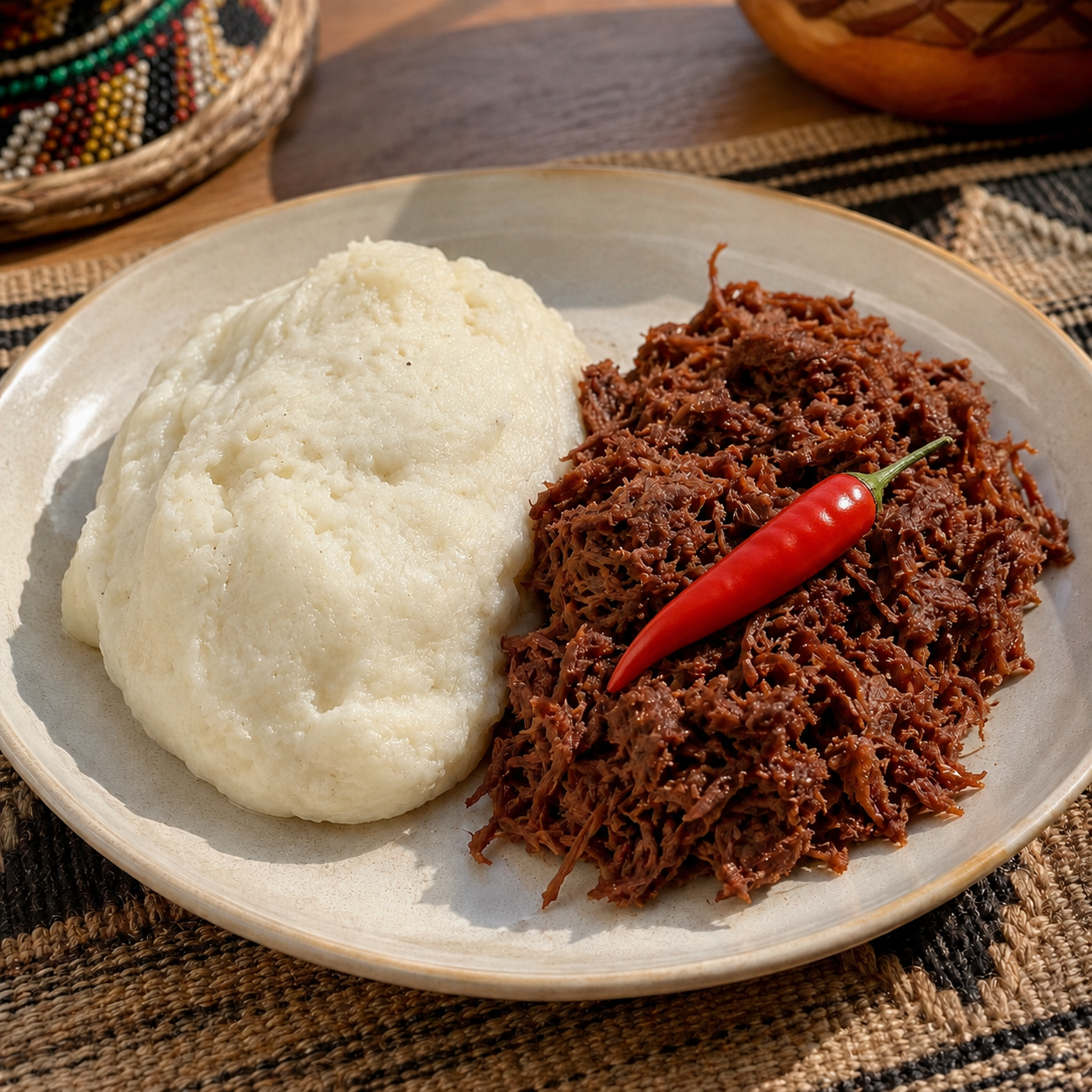
Seswaa is one of Botswana's most iconic dishes and a fundamental culinary landmark in Southern Africa. At first glance, it may seem very simple: meat, traditionally beef, sometimes goat depending on the context, slow-boiled, then pounded or shredded until it achieves a fibrous and tender texture, simply seasoned with salt. But this simplicity is precisely what gives it strength. Seswaa proves that a dish can achieve remarkable depth with few ingredients, provided that time, cooking, and technique are mastered.
In Batswana households, seswaa is a dish of great symbolic value. It appears in daily life, but it takes on a special dimension during ceremonies, community celebrations, weddings, family gatherings, and important events. It is associated with hospitality, generosity, and the continuity of traditions. It is often served with bogobe (a thick porridge made from cereals, especially sorghum or maize) or pap, as well as vegetable accompaniments. This association places seswaa within a complete dietary logic, where processed meat becomes a focal point around which the collective meal is organized.
Prepare this speciality
Choose a detailed recipe, adjust the portions and prepare your ingredients before starting. Our cooking tips and food safety advice complement the steps described in the recipes.
Explore further: Cooking tips · Food hygiene and safety advice.
History and uses
Its place in African cuisine is significant for several reasons. Firstly, it illustrates the historical importance of livestock in many Southern African societies, not only as an economic resource but also as a social and cultural marker. Secondly, it highlights a meat processing technique based on slow cooking and pounding, a technique that combines dietary efficiency, pleasant texture, and a strong capacity for sharing. Finally, it reminds us that African meat cuisines are not limited to spectacular grilling; they also include slow, deep, socially structuring preparations.
🔥🪵 A TECHNIQUE OF PATIENCE: slow cooking, pounding, and texture balance The success of seswaa relies on a precise operational chain. It begins by selecting cuts of meat suitable for long cooking, often with bones in some practices, to enrich the broth and enhance the flavor. The meat is cooked in water, with minimal seasoning, usually salt, until it becomes very tender. Time is an ingredient in itself: the fibers must be allowed to relax without rushing the cooking.
Once tender, the meat is removed and traditionally pounded in a wooden mortar with a pestle. This pounding is not a simple destruction of the fiber. It is a technical gesture aimed at a specific texture: neither a puree nor intact pieces, but a coherent, juicy, filamentous mass, easy to share and eat with a cereal paste. In contemporary kitchens, one can shred manually or use modern tools, but the logic remains the same.
The cooking broth can be reincorporated in small quantities to adjust moisture and intensify the taste. The final result must be tender, flavorful, never dry. The deliberately simple seasoning highlights the quality of the meat and the depth achieved by slow cooking. This simplicity is not an absence of cooking; it is a culinary aesthetic. It values the product, the technique, and the texture rather than the accumulation of spices.
This type of preparation demonstrates an often underestimated culinary skill. Achieving a balanced seswaa requires knowing how to read the cooking, feel the fiber, and dose the final moisture. It is a discreet precision cuisine, where the hand and experience count as much as the recipe.
🐄🏡 LIVESTOCK, SOCIETY, AND LIVING HERITAGE IN BOTSWANA
To understand seswaa, it must be placed in the historical relationship between Botswana's communities and livestock farming. Livestock has long represented wealth, security, prestige, mutual aid, and integration into the social fabric. In this context, meat dishes hold a special place, especially during collective events. Seswaa is one of the most direct culinary expressions of this link between livestock farming and community.
Its presence in ceremonies gives it a ritual dimension. Preparing seswaa for a group is an act of recognition and sharing. The dish becomes a way to materialize the importance of the occasion. It is not just consumed; it is offered to the collective. This logic of food giving is a major characteristic of many African cultures, where cuisine actively participates in social cohesion.
Seswaa is also a living heritage because it continues to evolve without losing its identity core. Urban contexts, time constraints, and modern equipment modify certain steps, but the fundamental structure remains: meat cooked slowly, transformed into a filamentous texture, shared with cereal accompaniments.
In my books

Continue exploring the continent’s cuisines with Africa at the Table — 54 countries, 54 iconic dishes, by Alioune FALL. This book is in English.
Explore further
🌍🍽️ SESWAA'S PLACE IN THE MOSAIC OF AFRICAN CUISINES
On a continental scale, seswaa holds a unique place among African meat cuisines. It shares with other traditions the use of slow cooking and communal sharing, but it distinguishes itself by its aromatic minimalism and its characteristic pounded texture. Where some cuisines favor complex marinades, spicy sauces, or intense smoking, seswaa chooses the path of purity.
This purity is valuable in understanding African gastronomy. It reminds us that the continent's diversity is not only about the variety of ingredients but also about culinary philosophies. Seswaa represents a philosophy of restraint: few elements, much mastery. It thus dialogues with other African dishes that are seemingly simple but technically demanding.
It also helps to broaden the visibility of Southern African cuisines, which are sometimes less publicized than those of other regions of the continent. By highlighting seswaa, we recognize Botswana's specific contribution to African culinary heritage: an art of long time, texture, and conviviality.
🤲🥣 CONVIVIALITY, TRANSMISSION, AND CONTEMPORARY USES
Seswaa is a deeply social dish. It is designed to be shared, often in large quantities, in contexts where the meal is as much a relational act as a nutritional intake. The way it is served, the order of portions, the chosen accompaniments, all contribute to a collective language. Eating seswaa together is an affirmation of a bond.
Transmission occurs mainly through practice. Younger generations observe the selection of cuts, the cooking time, the pounding technique, the final adjustment with the broth. This embodied knowledge is at the heart of culinary continuity. It is not reduced to quantities; it relies on sensations: touch, smell, fiber resistance, moisture level.
In cities and diasporas, seswaa continues to exist in adapted forms. Some use pressure cookers to reduce time, others shred with a food processor, and still others introduce additional seasonings. These adaptations demonstrate the dish's vitality. As long as the logic of tenderness, filaments, and sharing is preserved, the identity of seswaa remains recognizable.
🥗📊 NUTRITION, BALANCE, AND CURRENT RELEVANCE
Nutritionally, seswaa primarily provides high-quality protein, heme iron, zinc, and B vitamins, with a variable lipid profile depending on the cuts used. Served with local cereals like sorghum or maize, it contributes to an energetically coherent meal. The addition of vegetables as an accompaniment helps improve the overall balance of fiber and micronutrients.
Its contemporary relevance is real. In a world dominated by fast food, seswaa reminds us of the value of slow preparations, homemade food, and collective cooking. It also offers a model of a main dish that is easily expandable to feed several people, which remains relevant in family and community contexts.
Of course, as with any meat dish, the frequency of consumption and the choice of cuts matter. But integrated into a diversified diet, seswaa retains a perfectly legitimate place, especially thanks to its nutritional density and its ability to provide satiety.
✨📚 A DISCREET BUT ESSENTIAL GRANDEUR IN AFRICAN CUISINE
Seswaa holds an essential place in African cuisine because it unites dimensions rarely brought together with such clarity: historical depth, dietary efficiency, symbolic value, precise technique, and social power. It shows that a dish can be minimalist without being poor, popular without being mundane, traditional without being rigid.
It is also an important reminder for contemporary gastronomic narratives: culinary sophistication does not reside solely in the complexity of ingredient lists. It can reside in the mastery of time, fire, fiber, and sharing. Seswaa is one of the best African demonstrations of this truth.
🌍 CONCLUSION
Ultimately, talking about seswaa means recognizing the strength of African cuisines of transmission, those that hold communities together around a dish that nourishes both the body and social connection. In the great culinary mosaic of the continent, seswaa is a masterpiece: simple, dense, hospitable, memorable. It fully deserves its place among the great African gastronomic heritages.
In the kitchen : Seswaa (or chotlho)
Recipes from the site to put your knowledge into practice:
Discover these cuisines at a restaurant
Explore our restaurant and caterer directories. Choose your destination and check the establishment’s menu to confirm which dishes are offered and available.
Continue exploring
Enjoy discovering ingredients and African cuisines? Join our newsletter. The illustrated PDF 10 sauces africaines incontournables is in French and is offered after confirming a subscription to the French or bilingual edition.